


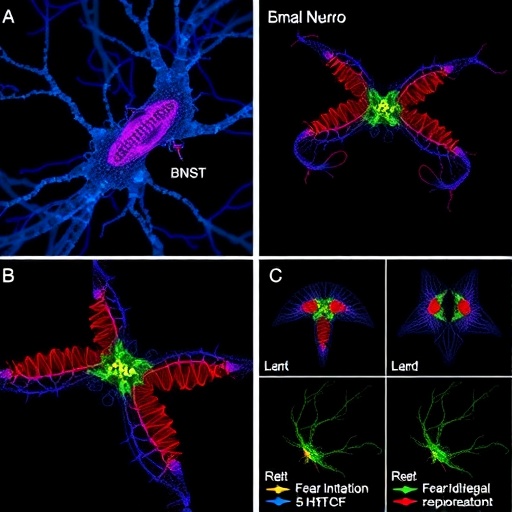
In a groundbreaking study poised to redefine our understanding of fear extinction and its underlying molecular pathways, researchers have unveiled how chemogenetic modulation of corticotropin-releasing factor (CRF) neurons within the bed nucleus of the stria terminalis (BNST) can effectively alleviate behavioral disparities observed in fear extinction learning among 5-HT2C receptor mutant mice. This investigation, recently published in Translational Psychiatry, illuminates the intricate neurobiological mechanisms bridging serotonin receptor signaling and stress-related behavioral adaptation, offering promising avenues for therapeutic development in anxiety and trauma-related disorders.
Fear extinction, the process by which an organism learns to suppress a previously acquired fear response, is fundamentally important for adaptive behavior and psychological resilience. However, significant individual differences exist in the efficiency of extinction learning, often linked to genetic variance and receptor functionality. The 5-HT2C receptor, a subtype of serotonin receptor integral to the modulation of mood and anxiety circuits, has been implicated in the pathophysiology of several psychiatric conditions characterized by impaired fear extinction, such as post-traumatic stress disorder (PTSD). By meticulously dissecting the behavioral phenotype of 5-HT2C receptor mutant mice, the research team shed light on receptor-dependent modulation of extinction learning and the potential compensatory roles of CRF neurons in the BNST.
The bed nucleus of the stria terminalis, a limbic forebrain structure, is critically involved in sustained anxiety states and stress responses. CRF neurons within the BNST serve as central effectors of neuroendocrine and autonomic reactions to stress. The study’s deployment of chemogenetics—a technique that employs engineered receptors activated by designer drugs—allowed precise, temporally controlled modulation of these neurons, providing an unprecedented level of functional insight. Through this approach, the researchers were able to selectively activate or inhibit BNST CRF neurons in mutant mice and observe consequent effects on fear extinction learning.
Behavioral assays revealed that 5-HT2C receptor mutant mice exhibited significant impairments in the extinction of conditioned fear responses compared to wild-type controls, consistent with the receptor’s theorized influence on fear circuitry. Intriguingly, chemogenetic activation of BNST CRF neurons in these mutants reversed the impaired extinction phenotype, restoring behavioral performance to levels analogous to wild-type animals. This finding underscores a crucial, previously underappreciated compensatory mechanism through CRF signaling within the BNST that can override genetic deficits in serotonin receptor function to recalibrate fear learning.
Further electrophysiological recordings indicated that modulation of CRF neurons altered synaptic plasticity dynamics within the BNST and its downstream targets, such as the amygdala and hypothalamus. These changes in neuronal excitability and network connectivity likely underpin the observed behavioral effects. The nuanced interplay between serotonergic and CRF systems revealed here integrates multiple neurochemical pathways, illustrating the brain’s capacity for adaptive plasticity in response to genetic perturbations.
The implications for clinical science are profound. Given that diminished extinction learning is a hallmark feature of numerous anxiety disorders, the capacity to selectively target and tune CRF neuron activity in humans might represent a novel therapeutic strategy. Current pharmacotherapies frequently yield insufficient remission rates and are burdened with side effects; hence, circuit-specific interventions hold considerable promise. Moreover, this research highlights the importance of personalized medicine approaches, emphasizing that understanding an individual’s genetic makeup can inform tailored interventions at the circuit level.
Notably, the study’s chemogenetic methodology offers advantages in translational relevance. Designer receptors exclusively activated by designer drugs (DREADDs) can be engineered for precision targeting in neural populations implicated in symptomatology, providing a platform for potential gene therapy or neuromodulation-based treatments. While the leap from murine models to human applications is non-trivial, these findings set a compelling precedent for future research in neuromodulatory treatments for psychiatric illness.
In addition to advancing neuropsychiatric research paradigms, these findings add to the growing body of evidence delineating how the serotonin system intricately interacts with stress-related neuropeptides like CRF to shape emotional learning. Decoding this crosstalk is essential for unraveling the complex etiology of stress-induced psychopathology. The authors propose that therapeutic manipulation of BNST CRF neurons could selectively enhance extinction learning in patients with genetically or environmentally induced deficits in serotonergic pathways.
While the research provides robust evidence for the compensatory role of BNST CRF neurons, the authors acknowledge that fear extinction involves multiple distributed brain regions, including the prefrontal cortex and hippocampus. Future studies integrating multimodal neuroimaging and optogenetics could further elucidate network-wide changes underlying extinction modulations. Additionally, exploring sex differences and developmental trajectories may reveal how these mechanisms operate across different populations, enhancing the generalizability of findings.
Beyond its immediate clinical applications, the study offers invaluable insights into the fundamental neurobiology of threat processing and adaptive learning. Understanding how genetic mutations in serotonin receptors can be counterbalanced by specific neuronal circuits not only informs psychiatric illness treatment but also expands our comprehension of brain plasticity and resilience. This research exemplifies the power of combining cutting-edge genetics, chemogenetics, and behavioral neuroscience to decode complex phenotypes.
In summary, Schulte, Böke, Lössl, and colleagues deliver a compelling demonstration of how chemogenetic interventions targeting CRF neurons in the BNST can remedy impaired fear extinction learning caused by 5-HT2C receptor mutations. This discovery opens promising horizons for targeted neuromodulatory therapies in anxiety and trauma-related conditions while laying foundational knowledge of the intricate neurochemical orchestration of fear extinction. As psychiatric research increasingly integrates molecular genetics with circuit-level understanding, studies like this herald a transformative era in personalized mental health treatments.
The synergy between serotonergic signaling and CRF neuron activity revealed here may also extend to other aspects of emotional regulation and cognitive flexibility, suggesting broad applicability of these findings. Harnessing such circuit-level compensation mechanisms could revolutionize interventions for a spectrum of neuropsychiatric disorders characterized by dysfunctional adaptive learning. The convergence of genetics, neurobiology, and innovative neuromodulation exemplified in this work embodies the future of neuroscience research and clinical innovation.
Continuing to elucidate the molecular substrates and circuit dynamics involved in fear extinction remains an urgent scientific and medical priority. With this landmark study providing a detailed roadmap, subsequent investigations are poised to translate these insights into clinically effective strategies that enhance resilience and recovery in patients struggling with debilitating anxiety disorders.
Cite Scienmag News
Glenn Wilkins. (January 10, 2026). Chemogenetic Targeting of BNST CRF Neurons Boosts Fear Extinction in 5-HT2C Mutants. Scienmag. https://scienmag.com/chemogenetic-targeting-of-bnst-crf-neurons-boosts-fear-extinction-in-5-ht2c-mutants/
Glenn Wilkins. "Chemogenetic Targeting of BNST CRF Neurons Boosts Fear Extinction in 5-HT2C Mutants." Scienmag, 10 January 2026, https://scienmag.com/chemogenetic-targeting-of-bnst-crf-neurons-boosts-fear-extinction-in-5-ht2c-mutants/. Accessed 3 September 2026.
Glenn Wilkins. "Chemogenetic Targeting of BNST CRF Neurons Boosts Fear Extinction in 5-HT2C Mutants." Scienmag. January 10, 2026. https://scienmag.com/chemogenetic-targeting-of-bnst-crf-neurons-boosts-fear-extinction-in-5-ht2c-mutants/


