

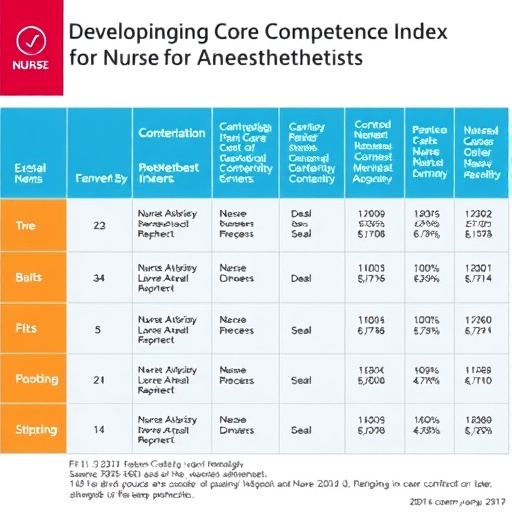
In an era where the demand for highly skilled healthcare professionals is escalating, the nuances of educating nursing graduates, particularly in specialized fields such as anesthesia, have come under scrutiny. A team of researchers, spearheaded by Yin et al., has embarked on a groundbreaking study aimed at establishing a core competence index system tailored for undergraduate anesthesia nursing graduates. Their research stands as a testament to the importance of advancing nursing education through evidence-based frameworks. Utilizing methodologies such as the Delphi technique and Analytic Hierarchy Process (AHP), this research publication offers vital insights into the competencies essential for future nurses specializing in anesthesia.
The study set out against a backdrop of a healthcare landscape shaped by rapid technological advancements and evolving patient care standards. As roles within healthcare continue to expand, the need for nurses trained in anesthesia becomes critical. Thus, the researchers identified the necessity of developing a robust core competence index that would outline the essential skills, knowledge, and attitudes required for excellence in anesthesia nursing education. This development is poised to enhance curriculum design and foster a more competent workforce in the field of anesthesia.
To understand the complexities of this research, one must first appreciate the methodologies employed. The Delphi technique involves a structured communication process that seeks to gather insights from a panel of experts through iterative rounds of questioning. This approach facilitates consensus building regarding the core competencies required for anesthetic nursing practices. The researchers engaged various stakeholders, including educators, practitioners, and healthcare administrators, to provide a multidimensional perspective on the subject.
Alongside the Delphi technique, the Analytic Hierarchy Process (AHP) was utilized to prioritize the identified competencies based on their significance and applicability in real-world settings. AHP allows researchers to systematically evaluate factors by breaking them down into a hierarchy of criteria and making pairwise comparisons. This dual methodological approach underpins the study’s credibility, ensuring that the resultant core competence index is not only comprehensive but also relevant to contemporary nursing practices.
As the research progressed, participants highlighted critical competencies spanning clinical skills, critical thinking, communication, and professionalism. These competencies are increasingly recognized as foundational for nursing practice, particularly in high-stakes environments such as anesthesia. Effective communication, for instance, is essential for ensuring patient safety and fostering collaboration among multidisciplinary teams. As such, the integration of these competencies into educational frameworks is vital for preparing nursing graduates to meet contemporary challenges in anesthesia care.
The data gathered through the Delphi methodology was meticulously analyzed, allowing the researchers to construct a comprehensive framework that delineates the core competencies. This framework serves as a guiding document for educational institutions vested in producing competent nursing graduates. It emphasizes not only what is taught but also how skills are practiced and assessed throughout the educational journey. Institutions can use this index to evaluate their existing curricula, identifying gaps and areas for enhancement in their nursing programs.
Moreover, this research underscores the importance of aligning educational outcomes with the expectations of the healthcare industry. By involving practitioners in the research process, the authors ensured that the devised core competence index is grounded in practical realities. This will, in turn, facilitate smoother transitions for graduates entering the workforce, as they will be better equipped with the requisite skills and knowledge to excel in anesthesia nursing.
The implications of this study extend beyond academia; they resonate powerfully within healthcare systems that rely on the effectiveness of their nursing staff. By establishing a consensus on core competencies, healthcare organizations can streamline their recruitment processes, ensuring that the candidates they consider are well-prepared for the roles they will undertake. This alignment between education and practice is pivotal for not only improving patient outcomes but also for fostering a culture of safety and excellence in clinical environments.
In conclusion, the research conducted by Yin et al. marks a significant advancement in the landscape of anesthesia nursing education. Through a rigorous methodological approach, it has succeeded in identifying and prioritizing the core competencies essential for undergraduate nursing graduates specializing in anesthesia. As healthcare continues to evolve, such evidence-based frameworks will be critical in shaping future educational policies and practices, thus ensuring that the next generation of nurses is equipped to face the challenges in this demanding specialty.
As we navigate the complexities of global health challenges, fostering competent nursing graduates will remain a priority. The establishment of this core competence index paves the way for ongoing improvements in nursing education, ultimately benefiting healthcare systems and, most importantly, the patients they serve.
Yin, X., Wang, L., Han, J. et al. Construction of a core competence index system for undergraduate anesthesia nursing graduates: a Delphi and Analytic Hierarchy Process.
BMC Nurs (2026). https://doi.org/10.1186/s12912-025-04284-2
Cite Scienmag News
SCIENMAG. (January 10, 2026). Developing Core Competence Index for Nurse Anesthetists. https://scienmag.com/developing-core-competence-index-for-nurse-anesthetists/
SCIENMAG. "Developing Core Competence Index for Nurse Anesthetists." Scienmag, 10 January 2026, https://scienmag.com/developing-core-competence-index-for-nurse-anesthetists/. Accessed 28 August 2026.
SCIENMAG. "Developing Core Competence Index for Nurse Anesthetists." Scienmag. January 10, 2026. https://scienmag.com/developing-core-competence-index-for-nurse-anesthetists/


