


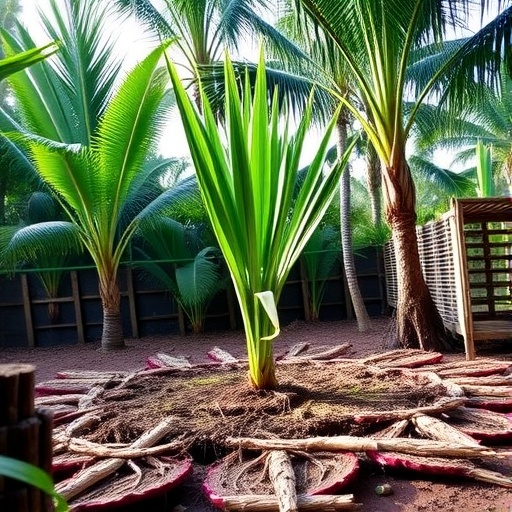
In the contemporary push towards sustainability, innovative solutions to manage agricultural waste have emerged as critical avenues for research and development. One particularly noteworthy study conducted by Agustin, Ma, and He explores the transformation of oil palm fronds into a valuable carbon source for the production of microbial bioflocculants. This ground-breaking approach not only addresses waste management challenges but also harnesses the potential of microbial processes to enhance agricultural practices.
Oil palm fronds, typically regarded as agricultural by-products, present a significant environmental challenge when not utilized effectively. Traditionally, these fronds are disposed of through burning or landfilling, leading to wasted potential and environmental degradation. However, the study highlights how these fronds can be valorized, serving as a renewable resource for bioflocculant production that could revolutionize various industries, including wastewater treatment and bioengineering.
The researchers emphasize that microbial bioflocculants have distinct advantages over their chemical counterparts, including lower toxicity, biodegradable properties, and effectiveness across a range of environmental conditions. Given the global push towards green technologies, the finding that oil palm fronds can serve as a sustainable carbon source to support microbial growth is particularly exciting. This suggests that agricultural waste can transcend its status as mere refuse and be reimagined as an essential component of sustainable production systems.
Bioflocculants are polysaccharide-based substances produced by microorganisms that enhance the aggregation of suspended particles in liquids. Their application in wastewater treatment can significantly improve the sedimentation process, thus increasing the efficiency of waste processing systems. The study indicates that bioflocculants derived from oil palm fronds may possess unique properties enabling them to outperform traditional flocculants in specific scenarios.
The research investigates the optimal conditions under which microbial bioflocculants can be produced from oil palm frond biomass. By evaluating various factors, such as temperature, nutrient availability, and microbial strains, the authors were able to determine the most effective parameters for bioflocculant synthesis. This precision is crucial, as variations in environmental conditions significantly affect microbial metabolism and the subsequent yield of bioflocculants.
Another fascinating aspect of the research is the potential for using bioflocculants in agri-food systems. The application of these natural flocculants could enhance the clarification processes in juice production or other liquid food processing, providing a more environmentally friendly alternative to artificial additives. The prospect of integrating such bio-based solutions into everyday agricultural practices is a powerful testament to the circular economy model.
Moreover, the team’s findings extend beyond mere environmental benefits. The economic implications of adopting microbial bioflocculant technology could be profound, particularly in rural areas where palm oil cultivation is prevalent. By converting agricultural waste into valuable products, local farmers could bolster their income while simultaneously contributing to a more sustainable ecosystem. This dual benefit positions bioflocculant production as a key opportunity within a global market that increasingly values sustainability and waste reduction.
The research also underlines the essential role of interdisciplinary collaboration in driving such innovations. The integration of microbiology, environmental science, and agricultural engineering creates a robust framework for tackling complex challenges. As researchers, industry partners, and policymakers work together, scalability becomes a central focus; expressing how bioflocculants can be integrated into existing processes represents a significant step in transitioning to renewable practices.
As the study moves forward, researchers will likely further explore the performance of these bioflocculants in diverse settings, including their efficacy in different types of wastewater and their interactions with various pollutants. Understanding how these bioproducts behave in real-world scenarios is crucial for widespread adoption.
In conclusion, the valorization of oil palm fronds as a renewable carbon source for microbial bioflocculant production presents a promising frontier in agricultural waste management. The process not only mitigates the challenges associated with palm oil waste but also highlights the potential of sustainable practices to contribute meaningfully to environmental and economic stability. As the world grapples with pressing ecological issues, such innovative research could pave the way for transformative changes in how we think about waste, resources, and sustainability.
The exploration of agricultural waste as a resource, particularly through the lens of microbial bioflocculant production, sheds light on the myriad possibilities that lie ahead in the quest for greener practices. This study serves as a clarion call for more extensive research and collaboration, signaling a shift towards a future where waste is not merely discarded but transformed into valuable assets.
Through the commitment of the scientific community to explore such promising areas, the potential for constructing a more sustainable future remains bright. This research not only exemplifies a pioneering approach in waste valorization but also reinforces the broader narrative of ecological responsibility and innovation that is essential in the modern world.
In summary, the valorization of oil palm fronds into microbial bioflocculants manifests a significant stride towards addressing both agricultural waste issues and the need for sustainable bioengineering solutions. The implications of this research may resonate across various sectors, heralding a future where environmental stewardship and innovation are intricately linked.
Agustin, Y.E., Ma, M., He, N. et al. Valorization of Oil Palm Frond as a Renewable Carbon Source for Microbial Bioflocculant Production: A Green Approach to Agricultural Waste Management.
Waste Biomass Valor (2026). https://doi.org/10.1007/s12649-025-03458-y
Cite Scienmag News
Denise Maddox. (January 9, 2026). Transforming Oil Palm Fronds into Green Bioflocculants. Scienmag. https://scienmag.com/transforming-oil-palm-fronds-into-green-bioflocculants/
Denise Maddox. "Transforming Oil Palm Fronds into Green Bioflocculants." Scienmag, 9 January 2026, https://scienmag.com/transforming-oil-palm-fronds-into-green-bioflocculants/. Accessed 4 September 2026.
Denise Maddox. "Transforming Oil Palm Fronds into Green Bioflocculants." Scienmag. January 9, 2026. https://scienmag.com/transforming-oil-palm-fronds-into-green-bioflocculants/


