


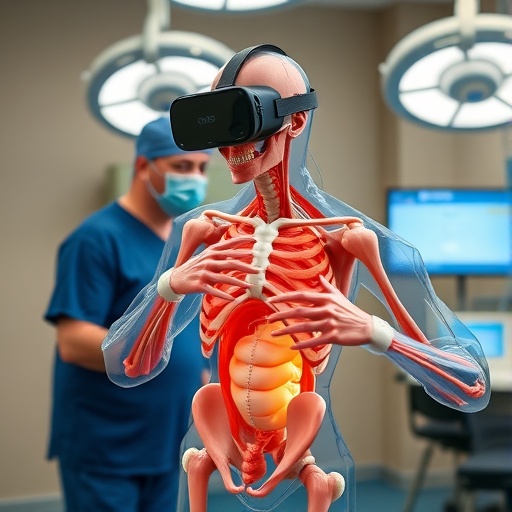
In a groundbreaking initiative that promises to reshape medical education, a team of researchers led by J.P. Ramspott has embarked on an innovative pilot study examining the application of virtual reality (VR) technology in teaching surgical topographic anatomy to medical students. This immersive approach seeks to address the traditional limitations of anatomical education, which often relies heavily on textbooks and physical cadaver dissections. With advanced VR simulations, students can engage with three-dimensional anatomical structures in a dynamic environment, allowing for a more profound understanding and retention of critical surgical concepts.
The traditional methods of teaching anatomy can sometimes struggle to fully prepare medical students for real-world surgical procedures. Textbooks provide two-dimensional representations, while dissections, although invaluable, are often limited by time, availability of specimens, and the preparing thereof. The advent of VR technology in medical education aims to bridge this gap, offering a more interactive and flexible alternative. By creating virtual environments that students can explore at their own pace, the VR approach not only enhances learning experiences but also aligns more closely with the needs of a generation that has grown up immersed in technology.
In this pilot study, the researchers meticulously designed a VR application that simulates surgical scenarios, which students could navigate through head-mounted displays. Participants in the study engaged with detailed anatomical models and gained firsthand experience in positioning, manipulating, and understanding the spatial relationships among organs and structures. Preliminary results indicated an increase in student engagement and comprehension, suggesting that VR could play a vital role in enhancing the educational framework within medical schools.
The technology behind VR, specifically in the medical field, leverages sophisticated graphics, haptic feedback, and interactive elements to create a compelling experience. This immersion allows students to visualize and practically engage with the body in a manner that conventional methods cannot replicate. For instance, understanding the spatial orientation of the heart relative to the lungs or the intricate pathways of nerves can be challenging; VR aids in breaking down these complex relationships, enabling a more comprehensive learning experience. By virtually dissecting and manipulating these structures, students can gain insights that would be difficult to achieve through dissection alone.
A key advantage of VR in medical education is its adaptability. Scenarios can be tailored to specific learning objectives, and educators can introduce varied cases of surgical conditions that students may encounter in their careers. This flexibility not only caters to diverse learning styles but also allows for repetition and practice without the constraints of physical resources. Students can revisit complex scenarios as needed, reinforcing their knowledge and improving their capabilities prior to actual patient interactions.
Moreover, the collaborative potential of VR technology cannot be understated. Virtual learning environments can facilitate group activities, where students from various locations can gather in a shared virtual space. This collaborative aspect not only enhances peer-to-peer learning but also fosters teamwork, a vital component of surgical practice. As medical professionals often work as part of multidisciplinary teams, training in settings that simulate this environment prepares students for the realities they will face in their careers.
The pilot study emphasizes not only the efficacy of VR as a pedagogical tool, but also highlights the need for evolving educational methodologies in light of technological advancement. The research team believes that the integration of VR in curricula could elevate the standard of medical education significantly. They are keen to evaluate the long-term retention of information learned through VR compared to traditional methods and are designing follow-up studies to assess this critical aspect.
While the results from this pilot study are promising, the authors acknowledge several challenges and considerations in the implementation of VR technology in medical curricula. Developing high-quality VR content requires investment in time and resources. Additionally, there is a learning curve associated with using VR equipment, and institutions must ensure access and provide adequate training to both educators and students alike.
Beyond the immediate implications for current medical students, the potential of VR extends into ongoing professional education and training. Medical technology and surgical practices are continually evolving, requiring physicians to update their skills throughout their careers. VR technologies can facilitate ongoing education by offering practitioners an accessible platform for refresher courses or new techniques, ensuring they remain at the pinnacle of their practice.
As the healthcare landscape becomes increasingly complex, the need for innovative educational approaches becomes more pressing. With the rise of VR in surgical education, there is an opportunity not only to improve anatomical understanding but also to inspire a new generation of medical professionals who are adept in technological fluency. This shift toward immersive learning experiences underscores the potential benefits of integrating modern technologies into classical fields of study.
Ultimately, the pilot study conducted by Ramspott and his team serves as a significant step towards revolutionizing medical education. Its findings indicate that virtual reality could indeed play an essential role in shaping the future of how students learn surgical anatomy, bridging gaps in knowledge and preparing them more effectively for their future roles in healthcare. As this field of research evolves, stakeholders must remain vigilant about embracing innovative solutions that can redefine educational methodologies in medicine, promoting a more profound understanding of anatomy and improved patient outcomes.
In conclusion, the implementation of virtual reality technology in medical education offers a promising avenue for enhancing student learning and engagement. As educators and institutions progressively adopt these technologies, there is hope that the next generation of medical professionals will be better prepared to meet the challenges of an ever-evolving healthcare environment.
Ramspott, J.P., Bungert, A.D., Szardenings, C. et al. Implementing virtual reality based surgical topographic anatomy for the education of medical students: a pilot study.
BMC Med Educ (2026). https://doi.org/10.1186/s12909-025-08563-z
Cite Scienmag News
Courtney Benton. (January 9, 2026). VR Enhances Surgical Anatomy Education for Students. Scienmag. https://scienmag.com/vr-enhances-surgical-anatomy-education-for-students/
Courtney Benton. "VR Enhances Surgical Anatomy Education for Students." Scienmag, 9 January 2026, https://scienmag.com/vr-enhances-surgical-anatomy-education-for-students/. Accessed 3 September 2026.
Courtney Benton. "VR Enhances Surgical Anatomy Education for Students." Scienmag. January 9, 2026. https://scienmag.com/vr-enhances-surgical-anatomy-education-for-students/


