


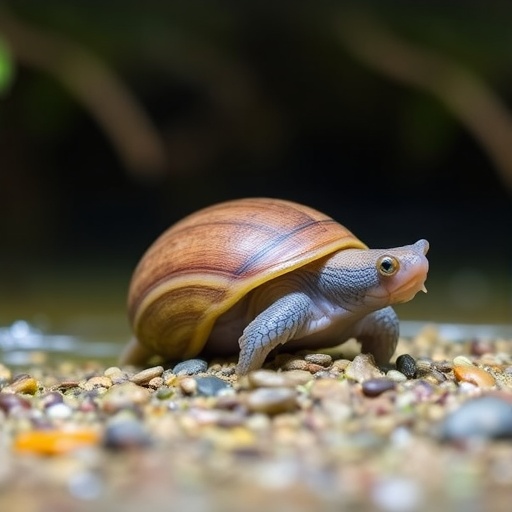
In a fascinating study published in 2026, researchers A.W.L. Fok, J.H. Liew, and Y.H. Sung shed light on the antipredator behavior of the freshwater snail, Sulcospira hainanensis, in response to one of its primary predators, the critically endangered big-headed turtle, Platysternon megacephalum. This investigation holds significant implications for understanding the complex interactions within freshwater ecosystems, especially as they pertain to predator-prey dynamics.
The freshwater snail, Sulcospira hainanensis, is a unique species native to specific regions and faces a myriad of ecological challenges. These snails are not only integral to their habitats but also provide numerous ecosystem services, like substrate stabilization and nutrient cycling. However, their survival is under threat, particularly from predators such as the big-headed turtle. In this context, the researchers observed and recorded the nuances of the snail’s behavior when faced with the imminent danger posed by these turtles.
To study the antivectionary responses of Sulcospira hainanensis, scientists set up controlled environments that mimicked their natural habitats. By carefully monitoring interactions, they were able to analyze how these snails naturally behave when encountering the big-headed turtle. Through intricate observational techniques and behavioral assays, the team gathered data that reveal critical insights into the survival strategies employed by these snails.
Among the array of behaviors documented, the most prominent was the snail’s ability to rapidly retract into its shell, a primary defense mechanism. This retraction not only offers physical protection but may also serve as a deterrent, reducing invisibility to the turtle. Nevertheless, the study found that environmental factors greatly influenced this behavior; in environments with abundant cover, snails showcased increased retraction and diving behaviors, suggesting they are adept at assessing their surroundings for safety.
Remarkably, the research highlighted the role of synaptic plasticity in the snails’ nervous systems, pointing to a possibility that their responses may not just be instinctual but also learned. By continually interacting with predators, the snails might refine their behaviors to enhance survival rates. This illustrates the deep complexity of evolutionary relationships, evidencing that even simple creatures like snails possess adaptive traits in the face of declining populations of their predators.
Furthermore, the findings raise a particularly compelling question regarding conservation. Given the declining numbers of the big-headed turtle, understanding its predatory influence on its prey becomes crucial. The data suggest that the extinction of this predator could lead to unregulated populations of Sulcospira hainanensis, which may in turn disrupt the ecological balance, emphasizing the interconnectedness of species within their habitats.
The significance of this research is amplified when considering broader ecological trends, such as habitat loss and climate change. As freshwater ecosystems face increasing pressures, the interactions between predator and prey species will become more complex and potentially lead to drastic shifts in community structure. This study serves as a poignant reminder of the importance of both preserving endangered species and understanding their ecological roles.
In addition to ecological insight, the study has implications for future research directions. The evolutionary adaptations of Sulcospira hainanensis and its antipredator strategies could provide a framework for investigating other freshwater species facing similar threats. The interplay between species, driven by predation pressures, can offer new perspectives on biodiversity and resilience in changing environments.
Research of this nature underscores the need for continued vigilance in conservation efforts. By studying species interactions at such a granular level, conservationists can devise strategies to protect not just individual species, but entire ecosystems. The findings encourage a holistic approach to ecological preservation, taking into account the myriad relationships existing in natural habitats.
In conclusion, the examination carried out by Fok, Liew, and Sung serves as an essential exploration of predator-prey dynamics that not only enhances our understanding of Sulcospira hainanensis but also illuminates the broader implications of species decline. As we navigate an era marked by ecological uncertainty, such studies are critical for informing effective conservation strategies that consider the intricate web of life sustaining our planet’s biodiversity.
This research may very well become a cornerstone in future explorations of antifensive animal behavior, contributing significantly to the scientific understanding of how organisms adapt to precarious ecological niches. By emphasizing these dynamic interactions, we further the conversation on biodiversity conservation and the sustainability of ecosystems under threat.
Ultimately, the implications of this research extend beyond the laboratory to touch upon global conservation policies and the strategies employed to combat species extinction. As such, the study of Sulcospira hainanensis and its responses to the big-headed turtle invariably reflects on our collective responsibility to protect vulnerable species and the intricate relationships they share in their habitats.
With every new piece of research, the scientific community inches closer to deciphering nature’s rhythms and routines. The work of Fok, Liew, and Sung exemplifies how detailed studies can unravel complex biological puzzles that underscore the delicate balance of our ecosystems, paving the way for informed conservation actions in the face of impending environmental challenges.
Fok, A.W.L., Liew, J.H. & Sung, Y.H. Antipredator behaviour of the freshwater snail (Sulcospira hainanensis) in response to the critically endangered big-headed turtle (Platysternon megacephalum).
Discov Anim 3, 5 (2026). https://doi.org/10.1007/s44338-025-00157-9
Cite Scienmag News
Gavin Prescott. (January 8, 2026). Freshwater Snail Adapts to Threat from Big-Headed Turtle. Scienmag. https://scienmag.com/freshwater-snail-adapts-to-threat-from-big-headed-turtle/
Gavin Prescott. "Freshwater Snail Adapts to Threat from Big-Headed Turtle." Scienmag, 8 January 2026, https://scienmag.com/freshwater-snail-adapts-to-threat-from-big-headed-turtle/. Accessed 3 September 2026.
Gavin Prescott. "Freshwater Snail Adapts to Threat from Big-Headed Turtle." Scienmag. January 8, 2026. https://scienmag.com/freshwater-snail-adapts-to-threat-from-big-headed-turtle/


