


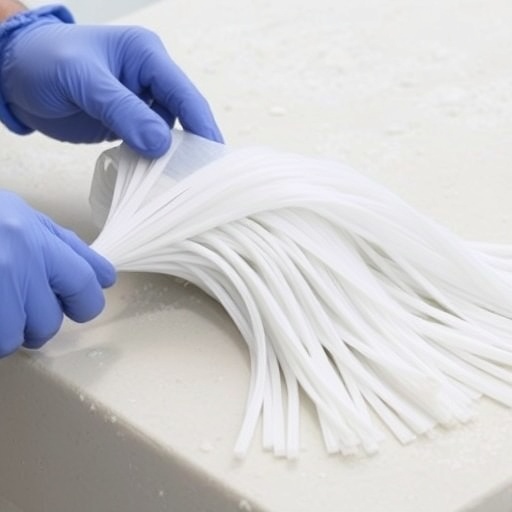
In a novel exploration of sustainable construction materials, Khezrloo, Nezarat, and Kheradmand have embarked on a groundbreaking study that seeks to enhance the tensile strength of geopolymers through the incorporation of recycled PVC fibers derived from cable waste. In an era marked by significant environmental concerns, this research not only addresses the challenges posed by plastic waste but also contributes to the development of greener alternatives for engineering applications. The geopolymers, known for their impressive mechanical properties and durability, stand to achieve even greater performance with this innovative reinforcement strategy.
PVC, or polyvinyl chloride, is a plastic commonly used in various applications, including electrical cables. However, the disposal of PVC waste presents a considerable environmental challenge. Traditional recycling methods can often be inefficient and insufficient in addressing the vast amounts of PVC that are discarded annually. By turning this waste into a valuable resource, the authors propose a cutting-edge solution that aligns with global sustainability goals while promoting a circular economy. Their work serves as a crucial reminder that waste materials can be effectively harnessed to create high-performance products, showcasing the potential of upcycling.
Previous literature has established geopolymers as viable alternatives to conventional cement-based materials due to their lower carbon footprint and superior resistance to chemical attacks. Researchers have delved into the enhancement of geopolymers through various methods, including the incorporation of fibers. However, the specific use of recycled PVC fiber as a reinforcement material has remained largely unexplored until now. This research fills a critical gap in the current knowledge base and provides a pathway for future investigations into hybrid materials that could further revolutionize the field of sustainable construction.
The team has meticulously outlined their experimental methodology, which involved the systematic incorporation of varying percentages of recycled PVC fibers into the geopolymer matrix. By conducting a series of mechanical tests, they aimed to determine how the tensile strength of the resulting composites was impacted by the addition of these fibers. This rigorous approach not only ensures the reliability of their findings but also sets a standard for future research endeavors in the domain of material science.
Initial findings from the study suggest that the introduction of recycled PVC fibers significantly enhances the tensile strength of the geopolymers, thereby warranting deeper investigations into the underlying mechanisms at play. Fiber-reinforced materials are known to exhibit improved structural integrity and durability when subjected to stress. The researchers hypothesize that the unique interaction between the PVC fibers and the geopolymeric matrix is responsible for the observed enhancements in mechanical properties.
Through an in-depth analysis of the fracture behavior of the composites, the authors have begun to elucidate the ways in which the PVC fibers contribute to improved energy absorption and crack propagation resistance. Such characteristics are vital for construction materials, as they directly correlate to the lifespan and safety of buildings and infrastructure. Understanding these parameters is essential for the development of materials that can withstand dynamic loading conditions, such as earthquakes or other natural disasters.
Moreover, the environmental implications of this study are profound. By utilizing recycled PVC from cable waste, the research not only mitigates plastic waste but also reduces the demand for virgin raw materials typically required for traditional geopolymer synthesis. This approach underscores the importance of integrating sustainability principles in material development, promoting practices that minimize environmental impact while maximizing resource efficiency. As the construction industry increasingly seeks sustainable solutions, this research serves as a beacon of hope for a future where waste is no longer seen as a burden but as an opportunity.
The implications of integrating recycled materials into geopolymers extend beyond sustainability; they open doors to a new era of innovation in construction methods. As the world grapples with pressing environmental issues, the construction sector stands at a critical crossroads. This research supports the notion that innovative materials such as PVC-reinforced geopolymers can play a pivotal role in achieving more sustainable building practices, ultimately leading to reduced greenhouse gas emissions and a smaller environmental footprint.
In addition to the immediate benefits of enhanced tensile strength, the findings from this study pave the way for future research avenues, including the exploration of other waste materials that can similarly be integrated into geopolymeric composites. As industries continue to face increasing pressure to adopt sustainable practices, the potential for leveraging waste materials in construction becomes an area ripe for exploration. By diversifying the types of fibers and materials explored, researchers can broaden the toolkit available to engineers seeking environmentally friendly solutions.
As interest in sustainable materials continues to grow, collaborative efforts across disciplines will be crucial. Researchers, engineers, and industry stakeholders must work together to address the multifaceted challenges associated with plastic waste and material performance. By fostering cross-disciplinary dialogue, the potential for innovative solutions increases, ultimately benefiting both the environment and society as a whole.
In conclusion, the study conducted by Khezrloo, Nezarat, and Kheradmand represents a significant stride toward the development of sustainable geopolymers, demonstrating that recycled materials can indeed enhance the performance of construction materials. The findings highlight the vital role of innovation in tackling contemporary environmental challenges and emphasize the necessity for continued research in this area. As we move toward a more sustainable future, the integration of recycled materials in construction will not only support environmental goals but also lead to stronger, more resilient infrastructure that can withstand the test of time.
The pioneering work on PVC-reinforced geopolymers places emphasis on utilizing waste while also focusing on enhancing the building materials essential for our modern cities. As this research paves the way for future explorations and applications, it stands to inspire a new generation of materials scientists and engineers committed to reshaping the future of construction. The journey to sustainable building practices is just getting started, but studies like this illuminate the path forward.
Ultimately, it is clear that innovation and sustainability must go hand in hand. The integration of recycled fibers into geopolymeric matrices not only offers an elegant solution to plastic waste but also strengthens the foundation upon which the next generation of construction materials can be built. The commitment to sustainable practices is reflected in the diligence of researchers pursuing such transformative work, and it is a testament to our collective responsibility in safeguarding the planet for generations to come.
Through this exciting avenue of research, the authors are not just pushing the boundaries of material science; they are also fostering hope that sustainable practices can become the norm rather than the exception. As industries evolve and adapt, the lessons learned from this study will be invaluable in guiding the way toward a future wherein building materials are both innovative and sustainable.
Khezrloo, A., Nezarat, M., Kheradmand, A.B. et al. Studying the tensile strength of geopolymers reinforced with recycled PVC fibers obtained from cable waste. Environ Sci Pollut Res (2026). https://doi.org/10.1007/s11356-025-37293-4
Cite Scienmag News
Violet Maxwell. (January 8, 2026). Reinforcing Geopolymers: Testing Strength with Recycled PVC Fibers. Scienmag. https://scienmag.com/reinforcing-geopolymers-testing-strength-with-recycled-pvc-fibers/
Violet Maxwell. "Reinforcing Geopolymers: Testing Strength with Recycled PVC Fibers." Scienmag, 8 January 2026, https://scienmag.com/reinforcing-geopolymers-testing-strength-with-recycled-pvc-fibers/. Accessed 3 September 2026.
Violet Maxwell. "Reinforcing Geopolymers: Testing Strength with Recycled PVC Fibers." Scienmag. January 8, 2026. https://scienmag.com/reinforcing-geopolymers-testing-strength-with-recycled-pvc-fibers/


