


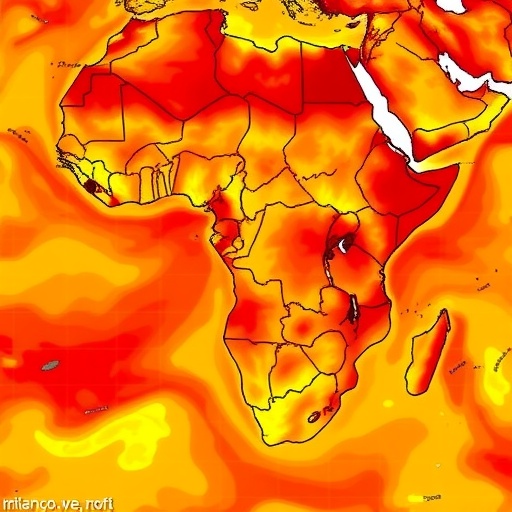
As climate change continues to escalate, the world is facing unprecedented shifts in both environmental and social dynamics. Among these changes, heatwaves represent a significant challenge, particularly in regions already vulnerable to climatic perturbations. A groundbreaking new study has shed light on the complex relationships between climate variables and land-use practices, unveiling critical insights into how these interactions may influence the intensity of heatwaves in Africa. Researchers, led by O.E. Adeyeri, have developed a sophisticated model to better understand these forces at play.
The study reveals that the interplay between climate change and land-use patterns is not merely additive but rather a coupled system that can either exacerbate or mitigate the impacts of rising temperatures. This reveals a pressing need for a deeper understanding of how agricultural practices, urban development, and deforestation contribute to the local microclimates that exacerbate heat-related risks. The findings serve to underline the importance of integrated land-use planning in mitigating future climate impacts.
One of the key takeaways from this research is the stark projection of heatwave intensification across various African regions. With parts of the continent already facing significant temperature increases, the model suggests that without proactive land-use management, the intensity and frequency of heatwaves are expected to rise dramatically. This increase poses severe consequences for both human health and agricultural productivity, potentially leading to adverse socio-economic outcomes.
The researchers employed a robust modeling framework, utilizing advanced statistical techniques and climate projections to simulate future scenarios under different land-use frameworks. This innovative approach allows them to capture the nuances and complexities of climate-land-use interactions better than previous studies. By examining various factors such as vegetation cover, urban heat islands, and soil moisture levels, Adeyeri and colleagues provide a more comprehensive picture of how land-use decisions can either mitigate or exacerbate climate change effects.
Importantly, the study highlights regions such as the Sahel and Southern Africa as particularly vulnerable. These areas are already grappling with challenges such as food insecurity and water stress, and increasing heatwave intensity could spell disaster. The interconnections between land use—such as agricultural expansion and urbanization—and rising temperatures create a precarious situation requiring immediate attention from policymakers and stakeholders.
The implications of the study extend beyond climate science; they are deeply intertwined with social equity and justice. Vulnerable communities that rely heavily on agriculture face the harshest consequences of heat stress while having the least capacity to adapt. The research emphasizes the need for inclusive climate adaptation strategies that recognize the unique challenges faced by marginalized populations.
As the study illustrates, effective land-use strategies can lead to the improvement of local climates, potentially reducing the magnitude of heatwaves. Adoption of practices such as reforestation, sustainable agricultural methods, and urban green spaces could help cool down the local environment. This not only benefits humans but also supports biodiversity, contributing to healthier ecosystems.
The findings also bear significant relevance for future urban planning endeavors. As African cities continue to grow, integrating climate-aware design into urban development will be crucial. Green roofs, parks, and permeable surfaces can help combat urban heat islands, mitigating some of the projected increases in temperature. This holistic vision of urban development aligns with increasingly popular concepts of ‘climate-smart cities.’
Additionally, the study paves the way for further research into the socio-economic impacts of climate adaptation strategies. Understanding the cost-benefit analysis of sustainable land-use practices could motivate local governments and businesses to prioritize climate-friendly initiatives. This is especially vital in a continent where economic growth and environmental stewardship must go hand in hand.
On a broader scale, the findings serve as a wake-up call for international communities. Climate change knows no borders; the effects of heatwaves in Africa ultimately intersect with global climatic patterns. The research offers critical insights into the need for collaborative global efforts in combating climate change and ensuring more resilient land-use systems worldwide.
It is essential to engage various stakeholders, including local communities, agricultural workers, urban planners, and government agencies, in addressing these challenges effectively. A concerted effort will be necessary to implement sustainable practices that not only mitigate heatwave intensity but also promote broader eco-social well-being.
As governments and organizations work together to forge pathways toward sustainability, continuous monitoring and research will remain crucial. The dynamic nature of climate-land-use interactions necessitates an adaptive management approach, allowing for ongoing adjustments based on emerging data and changing conditions.
In conclusion, the study conducted by Adeyeri et al. underscores the complex interplay between land use and climate change, especially in the context of Africa’s evolving environment. It acts as both a warning and a guide, emphasizing the need for proactive and integrated approaches to land management. As the world grapples with climate change effects, such research can illuminate the path toward sustainable solutions that safeguard both people and the planet.
Adeyeri, O.E., Ishola, K.A., Ajadi, S.A. et al. Coupled climate–land-use interactions modulate projected heatwave intensification across Africa.
Commun Earth Environ (2026). https://doi.org/10.1038/s43247-025-03110-6
Cite Scienmag News
Sloane Callahan. (January 8, 2026). Climate and Land Use Influence Africa’s Heatwaves. Scienmag. https://scienmag.com/climate-and-land-use-influence-africas-heatwaves/
Sloane Callahan. "Climate and Land Use Influence Africa’s Heatwaves." Scienmag, 8 January 2026, https://scienmag.com/climate-and-land-use-influence-africas-heatwaves/. Accessed 3 September 2026.
Sloane Callahan. "Climate and Land Use Influence Africa’s Heatwaves." Scienmag. January 8, 2026. https://scienmag.com/climate-and-land-use-influence-africas-heatwaves/


