


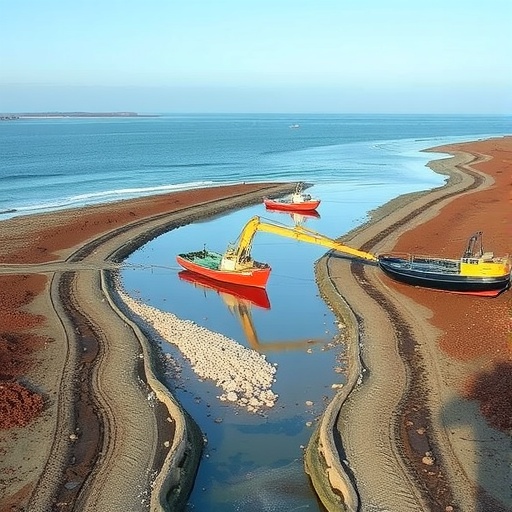
In recent years, the intricate dynamics of coastal ecosystems have drawn significant scientific attention, with researchers striving to understand the delicate balance between natural processes and human interventions. A pioneering study led by Porz, Chen, Yilmaz, and collaborators, published in Nature Communications in 2026, sheds new light on how dredging and dumping—a common practice in coastal management—profoundly alter sediment and organic carbon fluxes along coastal margins. This research marks a critical advancement in marine science, unraveling the complex interactions that govern sediment transport and carbon cycling in coastal waters altered by anthropogenic activities.
Coastal environments serve as vital interfaces between land and sea, where sediment and organic carbon fluxes play pivotal roles in maintaining ecological balance. Sediment dynamics influence habitat formation, nutrient distribution, and even biological productivity, while organic carbon fluxes contribute to the sequestration of carbon, thus affecting global carbon budgets. The study undertaken by Porz and colleagues systematically investigates how manmade interventions, specifically dredging – the excavation of sediment to maintain navigable waterways – and the subsequent dumping of this material, reshape these fluxes in coastal systems.
Central to this research is the recognition that dredging does not merely remove sediment from one area but initiates a cascade of physical and biogeochemical processes that ripple through coastal ecosystems. The authors employed an integrated approach combining in situ measurements, remote sensing data, and advanced modeling to capture the nuanced responses of sediment and carbon fluxes to dredging and dumping activities. Their findings compellingly demonstrate that these interventions disrupt sediment transport pathways, leading to altered deposition patterns, increased turbidity, and shifts in the distribution and fate of organic carbon.
One of the key revelations from the study is the manner in which dredging modifies sediment grain size distributions and alters hydrodynamic regimes in coastal waters. By removing sediment from the seabed, dredging exposes finer particles that are more susceptible to resuspension. This elevates sediment concentrations in the water column, which not only impacts water quality but also influences light penetration, thereby affecting photosynthetic activity in benthic and pelagic organisms. Furthermore, sediment resuspension favors the redistribution of organic carbon bound to particles, potentially increasing its remineralization and release of greenhouse gases such as carbon dioxide and methane.
The role of dumping, often perceived as a byproduct of dredging, emerges as another critical factor in reshaping coastal sedimentary environments. Dumping locations can become hotspots for sediment accumulation, trapping organic carbon and altering benthic habitats. However, the study highlights that these localized depositional zones may also become sites of heightened microbial activity, accelerating the breakdown of organic matter under variable oxygen conditions. This intricate interplay between physical deposition and biogeochemical transformation underscores the complexity of human impacts on coastal carbon cycling.
Importantly, the study’s findings bear significant implications for coastal management and climate change mitigation strategies. Coastal zones are recognized as substantial carbon sinks, contributing to the sequestration of atmospheric carbon dioxide and thus influencing global climate regulation. The disruption of sediment and organic carbon fluxes introduced by dredging and dumping threatens the stability of these sinks. By altering sediment transport and organic carbon burial, these activities may inadvertently transform coastal areas from net carbon sinks into carbon sources, exacerbating greenhouse gas emissions and climate change feedback loops.
The researchers emphasize the need for a paradigm shift in coastal management practices. Traditional dredging and dumping protocols, which often prioritize navigational and infrastructural considerations, must integrate ecological and biogeochemical perspectives. Adaptive management strategies, informed by comprehensive monitoring of sediment and carbon fluxes, are crucial to minimizing adverse effects. Technologies such as precision dredging, timing interventions to minimize ecological disruption, and identifying ecologically appropriate dumping sites can mitigate the negative consequences revealed by this study.
Beyond the immediate scope of sediment and organic carbon fluxes, the study opens avenues for exploring how altered sediment dynamics affect coastal biota, including benthic invertebrates, fish, and microbial communities. Changes in habitat structure and sediment characteristics directly impact biodiversity and ecosystem services such as fisheries productivity and nutrient cycling. The authors advocate for multidisciplinary research that couples sedimentology, microbiology, and ecology to provide holistic insights into coastal ecosystem resilience under anthropogenic stress.
The methodological sophistication of this study should also be highlighted. Leveraging state-of-the-art sediment traps, flow sensors, and carbon flux analyzers, combined with satellite-based sediment plume tracking, the team achieved an unprecedented resolution in monitoring coastal sediments. Coupled with robust computational models simulating sediment transport and organic carbon turnover, the approach sets a benchmark for future investigations into coastal impacts of human activities.
Crucially, this research addresses an often-overlooked feedback mechanism within Earth’s climate system. Coastal processes are intricately linked to broader biogeochemical cycles and climate dynamics, yet their responses to direct anthropogenic disturbances remain under-characterized. By quantifying how dredging and dumping modulate sediment and carbon exchanges, this study provides actionable knowledge for integrating coastal dynamics into global climate models with improved precision.
Moreover, the socio-economic dimensions of dredging activities cannot be ignored. Coastal regions worldwide depend on dredging for port maintenance, flood protection, and land reclamation. Understanding the environmental costs elucidated by this study is essential for balancing developmental goals with ecological sustainability. The authors urge policymakers to consider these scientific insights when designing regulations, incentivizing environmentally sensitive practices, and funding restoration projects that rehabilitate disturbed sedimentary environments.
This work also calls attention to emerging challenges posed by sea level rise and increasing coastal urbanization. As coastal zones become more vulnerable to extreme events and greater sediment input variability, the compounded effects of natural and anthropogenic sediment flux alterations demand close scrutiny. Adaptive strategies that account for changing environmental baselines are vital to safeguarding ecosystem functions and services in the face of accelerating global change.
In summary, Porz, Chen, Yilmaz, and colleagues have made a compelling contribution to marine science by elucidating the multifaceted impacts of dredging and dumping on coastal sediment and organic carbon fluxes. Their integrative experimental design, combined with sophisticated analytical frameworks, establishes a deeper understanding of the complex feedbacks shaping coastal biogeochemistry under human influence. This research not only advances scientific knowledge but also provides essential guidance for sustainable coastal management and climate change mitigation.
As humanity increasingly turns to the oceans for economic resources, infrastructure, and climate resilience, comprehending the consequences of interventions such as dredging becomes imperative. This study is a clarion call to reimagine how we coexist with coastal ecosystems—balancing human needs with the preservation of the ocean’s vital role in Earth’s carbon cycle.
In the broader context of environmental stewardship, this research serves as an exemplar of how cutting-edge science can inform meaningful action. It bridges microscopic sediment interactions and global climatic processes, reminding us that seemingly localized human activities resonate through planetary systems. By fostering awareness and responsibility, the insights gleaned from this work can inspire transformative approaches that secure the health of coastal oceans for generations to come.
Cite Scienmag News
Violet Maxwell. (January 7, 2026). Dredging, Dumping Alter Coastal Sediment and Carbon Fluxes. Scienmag. https://scienmag.com/dredging-dumping-alter-coastal-sediment-and-carbon-fluxes/
Violet Maxwell. "Dredging, Dumping Alter Coastal Sediment and Carbon Fluxes." Scienmag, 7 January 2026, https://scienmag.com/dredging-dumping-alter-coastal-sediment-and-carbon-fluxes/. Accessed 3 September 2026.
Violet Maxwell. "Dredging, Dumping Alter Coastal Sediment and Carbon Fluxes." Scienmag. January 7, 2026. https://scienmag.com/dredging-dumping-alter-coastal-sediment-and-carbon-fluxes/


