


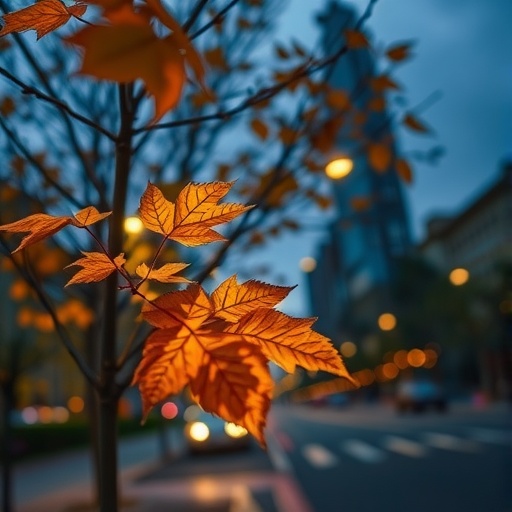
In a groundbreaking study set to reshape our understanding of urban ecosystems, researchers have discovered that increased artificial illumination in city landscapes significantly delays the onset of autumnal foliar senescence in urban trees. The study, led by Chen, Qu, Zohner, and colleagues, unveils how pervasive artificial lighting, an inevitable byproduct of modern urbanization, disrupts the natural phenological cycles of deciduous trees. Published recently in Nature Communications, this revelation has far-reaching consequences not only for urban ecology but also for broader environmental and climatic processes affected by tree phenology.
Autumnal senescence in leaves—the process by which leaves change color and eventually fall—marks a critical phase in the annual life cycle of temperate deciduous trees. It is tightly regulated by environmental cues such as day length (photoperiod), temperature, and light quality. The disruption of this process by artificial lighting introduces novel and complex challenges that urban trees must navigate, potentially altering their physiological behavior, carbon sequestration capacity, and overall health. Although the influence of urban heat islands on tree phenology has been previously documented, this study uniquely isolates artificial light as a significant, independent factor affecting leaf senescence.
The researchers employed an extensive multi-city observational network combined with controlled experimental manipulations to quantify how varying intensities and wavelengths of artificial night lighting influence the timing of leaf senescence. Utilizing remote sensing data alongside in situ phenological monitoring, they documented a consistent pattern across numerous species: trees exposed to elevated levels of nighttime illumination exhibited delayed leaf color change and abscission compared to counterparts in minimally illuminated environments. This delay extended the photosynthetically active period well beyond the expected seasonal timing.
Delving deeper into the mechanistic basis of this phenomenon, the study elucidated how artificial light alters photoreceptor signaling pathways in leaves, particularly those mediated by phytochromes and cryptochromes. These light-sensitive proteins are essential in detecting day length changes that trigger senescence. Continuous or prolonged exposure to artificial light, especially within blue and red wavelength ranges, appears to interfere with the phytochrome-mediated detection of dusk signals, effectively “tricking” the trees into perceiving longer day lengths than naturally occur. This misperception subsequently delays the cellular and biochemical cascades that initiate senescence.
Physiologically, delayed senescence has mixed implications for urban trees. On one hand, an extended growing season can enhance carbon assimilation and growth, potentially offsetting some urban carbon emissions. On the other hand, the decoupling from natural seasonal rhythms may increase tree vulnerability to frost damage due to impaired cold acclimation. Moreover, prolonged leaf retention could escalate water and nutrient demands during periods when resources typically decline, imposing additional stress in already challenging urban environments.
Beyond individual tree physiology, these findings have broader ecosystem-level consequences. Extended photosynthetic activity influences urban carbon cycling, altering the timing and magnitude of carbon uptake and release in cities. It may also affect urban biodiversity, as many dependent organisms—such as insect herbivores and pollinators—synchronize their life cycles to tree phenology. Changes in leaf litter timing can disrupt nutrient cycling and soil microbial communities, with cascading effects on urban ecosystem services.
Importantly, the study highlights that artificial illumination’s impact is not uniform across tree species. Species with differing photoreceptor sensitivities or foliar traits respond variably to artificial lighting, suggesting that urban biodiversity will be differentially affected. This uneven impact calls for species-specific urban forestry strategies to mitigate the unintended ecological consequences of light pollution.
By integrating satellite imagery, field experiments, and molecular analysis, the research team advocates a multi-disciplinary approach to comprehensively address the challenges posed by artificial light pollution. Their findings underscore the need for urban planners and policymakers to reconsider nighttime lighting practices, balancing human safety and aesthetic needs against urban ecological integrity. Technologies such as adaptive lighting schedules, spectral tuning, and shielding could minimize adverse effects on tree phenology while maintaining functional illumination.
Furthermore, the implications extend into the realm of climate modeling. Urban areas represent complex ecological mosaics where altered phenological patterns can feedback into regional climate processes through effects on albedo, evapotranspiration, and greenhouse gas fluxes. Incorporating artificial lighting impacts on vegetation phenology into Earth system models enhances predictive accuracy concerning urban contributions to climate dynamics.
The study’s conclusions also stimulate new avenues for research, including the interaction of light pollution with other urban stressors such as air pollution, soil compaction, and heat islands. Moreover, longitudinal studies are needed to evaluate whether these phenological shifts persist over multiple years and how they affect long-term tree health and urban forest sustainability.
In sum, the research by Chen et al. reveals a previously underappreciated factor influencing urban tree life cycles—an insight that compels a reconsideration of urban environmental management. As cities continue to expand and artificial lighting intensifies, understanding and mitigating its ecological impacts will be essential for fostering resilient urban green spaces. This study marks a critical step toward deciphering the complex interface between human activity and natural biological rhythms in urban settings.
The revelation that artificial light delays autumnal foliar senescence suggests urban illumination is more than a cultural artifact—it is a powerful environmental modifier. With over half the global population residing in urban areas, the ecological consequences of artificial lighting stretch far beyond personal convenience, spotlighting the urgent need for sustainable illumination policies. By harmonizing technological advancement with ecological insight, cities can better support the health and function of their urban forests, securing benefits for climate regulation, biodiversity, and human well-being alike.
Cite Scienmag News
Beatrice Stafford. (January 6, 2026). Artificial Light Delays Urban Autumn Leaf Aging. Scienmag. https://scienmag.com/artificial-light-delays-urban-autumn-leaf-aging/
Beatrice Stafford. "Artificial Light Delays Urban Autumn Leaf Aging." Scienmag, 6 January 2026, https://scienmag.com/artificial-light-delays-urban-autumn-leaf-aging/. Accessed 3 September 2026.
Beatrice Stafford. "Artificial Light Delays Urban Autumn Leaf Aging." Scienmag. January 6, 2026. https://scienmag.com/artificial-light-delays-urban-autumn-leaf-aging/


