


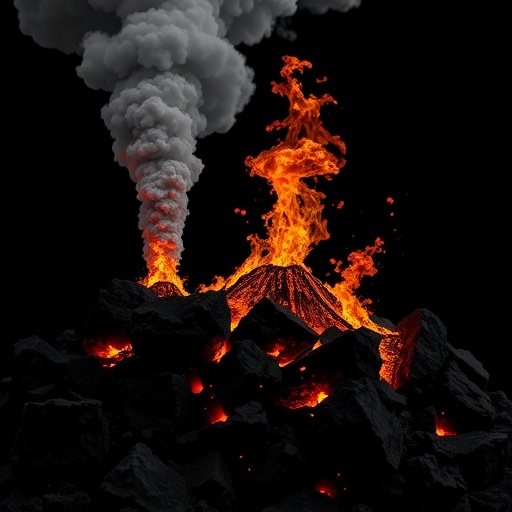
In an era where the world grapples with the pressing challenges of climate change and energy sustainability, the research article titled “Improved POA-LSTM Model Based on Multi-source Gas and Temperature Features for Predicting Key Indicators of Coal Spontaneous Combustion,” authored by Tan, Sui, and Gao, stands as a beacon of innovative thinking. The study addresses an often-overlooked hazard: the spontaneous combustion of coal, which poses risks not only to mining operations but also to environmental safety and public health.
Coal spontaneous combustion remains a critical concern within the mining and energy sectors, as it contributes significantly to emissions and potential accidents. The process involves the self-heating of coal due to a combination of environmental factors, including temperature fluctuations, moisture content, and the presence of volatile gases. Understanding these dynamics is essential for developing predictive models that can mitigate risks associated with spontaneous combustion.
At the heart of the study is the novel POA-LSTM model, a hybrid deep learning framework designed to assimilate and analyze various data sources. The model leverages an ensemble of multi-source data, particularly focusing on gas emissions and temperature variations, to uncover intricate patterns that signal the onset of spontaneous combustion. This approach marks a significant advancement over traditional methods, which often rely on single-factor evaluations or simpler predictive analytics.
One of the primary motivations behind this research is the inadequacy of existing predictive models that fail to account for the complex interplay of factors influencing coal combustion. By integrating multi-source data into the POA-LSTM framework, the researchers aim to enhance the accuracy of predictions, ultimately providing real-time insights for coal mine operators and environmental regulators. This proactive strategy could dramatically reduce the incidence of combustion events and their corresponding environmental impacts.
The researchers meticulously gathered data from various coal mining sites, observing parameters such as gas concentrations, temperature readings, and moisture levels over extended periods. These data points were then used to train the POA-LSTM model, allowing it to learn from historical trends and develop robust predictive capabilities. The rigorous training process involved fine-tuning the model’s architecture to optimize its performance specifically for coal combustion scenarios.
One of the standout features of the POA-LSTM model is its adaptability. It can incorporate real-time data influx, allowing it to adjust predictions as new information becomes available. This capability is particularly crucial, as it enables operators to respond to changing conditions swiftly, potentially averting fires before they escalate. Real-time data integration also supports the dynamic nature of coal mining operations, where conditions can change rapidly due to excavation activities and weather patterns.
Moreover, the research highlights the model’s performance metrics, which surpassed existing benchmarks in predictive accuracy. Through regression testing and validation against controlled datasets, the researchers demonstrated that the POA-LSTM model could predict key indicators of spontaneous combustion with remarkable precision. This enhancement in prediction accuracy paves the way for more reliable risk assessment protocols in the coal mining industry.
The implications of this research extend beyond just improving safety. By minimizing the occurrence of spontaneous combustion, the model could significantly lower the greenhouse gas emissions associated with coal mining. This reduction aligns with global efforts to transition towards cleaner energy sources and minimize the environmental footprint of fossil fuels. In this sense, the research embodies a dual benefit, enhancing operational safety while contributing positively to environmental sustainability.
As the world continues to move toward greener technologies, the findings of this study underscore the importance of innovation in existing industries. The integration of advanced predictive models such as the POA-LSTM reflects a broader trend of applying artificial intelligence in traditional sectors. It serves as a compelling example of how technology can be harnessed to solve age-old problems, ensuring safety and environmental consciousness go hand in hand.
Furthermore, the researchers advocate for the broader application of the POA-LSTM model beyond coal mining. Its versatility suggests potential adaptations for various industries where spontaneous combustion and similar hazards are a concern. These applications could revolutionize safety protocols across numerous sectors, reinforcing the importance of data-driven decision-making in hazard management.
In conclusion, the study by Tan, Sui, and Gao illustrates a remarkable blend of innovation, safety, and environmental stewardship in the realm of coal mining. By developing the POA-LSTM model, they have not only contributed to predictive analytics but also forged a path for the future of mining—one where technology plays an integral role in safeguarding both workers and the environment. As industries worldwide strive to balance productivity with safety and sustainability, this research stands as a testament to the vital role that thoughtful innovation plays in addressing global challenges.
Ultimately, the advancements encapsulated in this paper are more than just a technical achievement; they represent a commitment to responsible mining practices that prioritize safety and environmental preservation. The journey of this research serves as an inspiration for future studies aimed at harnessing technology to address complex environmental challenges, reinforcing the pivotal role of interdisciplinary approaches in creating a sustainable future.
Cite Scienmag News
Eleanor C. (January 4, 2026). Enhanced POA-LSTM Model Predicts Coal Combustion Risks. Scienmag. https://scienmag.com/enhanced-poa-lstm-model-predicts-coal-combustion-risks/
Eleanor C. "Enhanced POA-LSTM Model Predicts Coal Combustion Risks." Scienmag, 4 January 2026, https://scienmag.com/enhanced-poa-lstm-model-predicts-coal-combustion-risks/. Accessed 29 August 2026.
Eleanor C. "Enhanced POA-LSTM Model Predicts Coal Combustion Risks." Scienmag. January 4, 2026. https://scienmag.com/enhanced-poa-lstm-model-predicts-coal-combustion-risks/


