


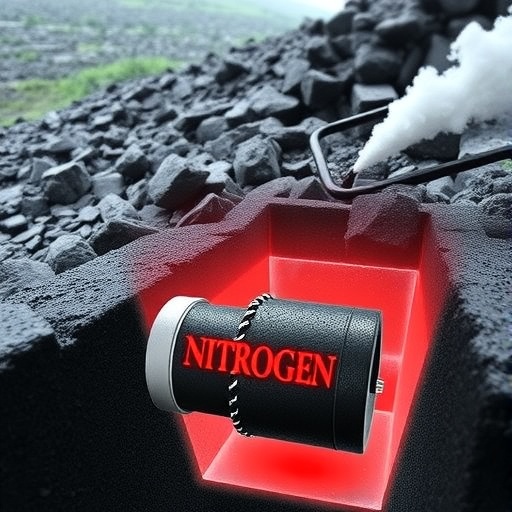
In a groundbreaking study, researchers Zhang, L., Zeng, S., and Ren, T. have made significant advancements in the understanding of seepage characteristics and heat transfer dynamics within coal bodies subjected to stress disturbances when utilizing liquid nitrogen fracturing techniques. This innovative approach could potentially revolutionize methods of resource extraction and enhance the efficiency of operations in coal mining and related fields. The team’s findings, anticipated to be published in 2026 in Natural Resources Research, provide crucial insights that bridge the gap between theoretical understanding and practical application in the realm of geotechnical engineering.
Liquid nitrogen fracturing, a method that harnesses the extreme cooling effects of liquid nitrogen, has emerged as an effective alternative to conventional fracturing techniques. As the coal body is subjected to the cryogenic temperatures induced by nitrogen, researchers observe that not only does the material become more brittle, thereby facilitating the fracturing process, but it also alters the internal dynamics of heat transfer and fluid movement within the coal structure. This phenomenon is particularly intriguing as it allows for a more comprehensive comprehension of how heat and fluid migration interact under various stress conditions.
Heat transfer within geological formations is a critical aspect of how resources are extracted, as it influences both the mechanical properties of the rock and the efficacy of fluid recovery processes. The study highlights the complex interplay between thermal conduction, convection, and radiation that takes place in coal seams during liquid nitrogen application. The researchers meticulously detail how the phase changes of nitrogen are intricately tied to heat dynamics, providing clarity on how to optimize fracturing processes to enhance output while minimizing risks associated with thermal stress.
One of the most exciting implications of this research lies in the model utilized by the researchers to simulate these processes. By employing advanced computational techniques, they simulate scenarios that replicate real-world stresses and temperatures experienced by coal bodies. The accuracy of this model ensures that their findings can be directly applied to field operations, paving the way for more effective and efficient extraction techniques. The transition to a more data-driven approach in monitoring and managing fracturing operations could drastically reduce environmental impact while maximizing resource yield.
Furthermore, this study expands upon previous work related to seepage characteristics. The researchers delve into how liquid nitrogen-induced fractures facilitate improved permeability in coal seams. Enhanced permeability is crucial for efficient fluid flow, and as nitrogen traverses through the created fractures, it interacts with trapped gases and fluids, significantly influencing recovery rates. This finding is vital, as it sheds light on new methodologies for optimizing resource extraction, which could be particularly valuable in an era where energy demands continue to escalate.
In their exploration of fluid dynamics within coal seams, the researchers also underscore the significance of stress disturbance in the application of liquid nitrogen fracturing. Stress disturbances, often inherent in mining operations, create unique challenges that can hinder proper extraction. However, their findings suggest that, when managed effectively, these disturbances may, in fact, serve to enhance the effectiveness of nitrogen fracturing. By understanding the relationship between induced stress and the mechanics of seepage under various conditions, operators can refine their strategies and integrate this knowledge into real-time decision-making processes.
The application of these insights transcends coal extraction alone; it has implications for a variety of industries reliant on the efficient management of geothermal and hydrocarbon resources. By elucidating the properties of heat transfer and fluid seepage under novel conditions, this research lays the groundwork for future studies aiming to address similar challenges in other geological contexts. As we shift towards more sustainable practices in resource extraction, this work offers a fresh perspective on leveraging innovative technologies to enhance both efficiency and environmental safeguards.
Additionally, the researchers emphasize the importance of interdisciplinary collaboration in achieving these findings. The interplay between geology, thermodynamics, and engineering principles played a pivotal role throughout their investigation. As the scientific community increasingly recognizes the complexity of subsurface systems, such collaborative efforts are essential in fostering innovative solutions to contemporary challenges faced in resource management.
The potential for implementation of liquid nitrogen fracturing techniques is immense, especially as the push for cleaner energy sources continues to gain momentum. Researchers posit that integrating these methods could not only improve resource extraction efficiencies but also align with larger environmental goals. By reducing reliance on more invasive mining practices, this technique represents a step towards more sustainable and responsible resource management.
In conclusion, the remarkable findings presented by Zhang, L., Zeng, S., and Ren, T. mark a significant advancement in the field of resource extraction science. Their meticulous research into the seepage characteristics and heat transfer dynamics associated with liquid nitrogen fracturing under stress disturbance conditions outlines a feasible path forward for enhancing coal mining practices. As the industry grapples with the dual challenges of energy demand and environmental sustainability, such innovations could provide the necessary leverage to propel the sector towards a more resilient future.
The anticipation surrounding the official publication of this research in Natural Resources Research is palpable, as it promises not only to enrich academic literature but also to inspire practical applications that could reshape the way we approach resource extraction. Ultimately, this study exemplifies the power of scientific inquiry in addressing the pressing challenges of our time, paving the way for a future where efficiency and sustainability coexist harmoniously.
Zhang, L., Zeng, S., Ren, T. et al. Seepage Characteristics and Heat Transfer Law of Coal Body by Liquid Nitrogen Fracturing Under Stress Disturbance Condition.
Nat Resour Res (2026). https://doi.org/10.1007/s11053-025-10625-4
Cite Scienmag News
Violet Maxwell. (January 3, 2026). Liquefied Nitrogen Fracturing: Coal’s Seepage and Heat Dynamics. Scienmag. https://scienmag.com/liquefied-nitrogen-fracturing-coals-seepage-and-heat-dynamics/
Violet Maxwell. "Liquefied Nitrogen Fracturing: Coal’s Seepage and Heat Dynamics." Scienmag, 3 January 2026, https://scienmag.com/liquefied-nitrogen-fracturing-coals-seepage-and-heat-dynamics/. Accessed 4 September 2026.
Violet Maxwell. "Liquefied Nitrogen Fracturing: Coal’s Seepage and Heat Dynamics." Scienmag. January 3, 2026. https://scienmag.com/liquefied-nitrogen-fracturing-coals-seepage-and-heat-dynamics/


