


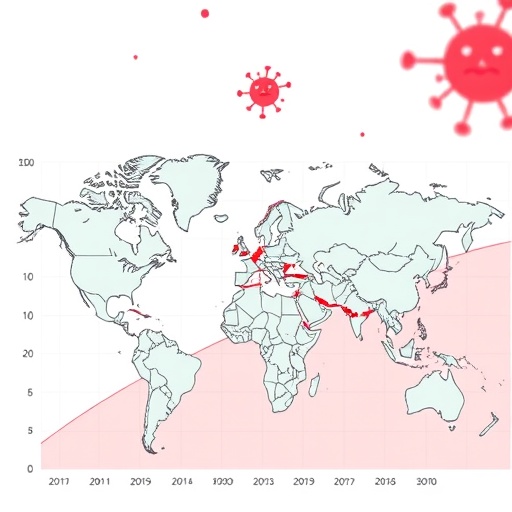
In the face of the growing concern about global health crises posed by infectious diseases, researchers are pursuing innovative solutions to understand and mitigate epidemic outbreaks. A groundbreaking study by Shafqat and colleagues has introduced a novel predictive framework that integrates fractional SIRD models with deep learning methodologies to forecast epidemic dynamics. This research draws from a multi-disciplinary approach, combining mathematical modeling and advanced computational techniques, aiming to enhance our predictive capabilities during public health emergencies.
The study underscores the importance of accurate forecasting in managing outbreaks effectively. Traditional models have often relied on linear assumptions and homogeneous populations, limiting their effectiveness in real-world scenarios where human behavior and environmental factors play substantial roles. With the advent of fractional calculus in modeling, researchers are now better equipped to capture the complexity of epidemic spread. This new approach allows for more precision in reflecting the nonlinear characteristics of transmission dynamics, thereby providing richer insights.
At the core of the study is the SIRD model, which segments the population into susceptible, infected, recovered, and deceased categories. This framework lays the groundwork for understanding the flow of individuals between these states. However, the incorporation of fractional derivatives into the SIRD model adds an additional layer of complexity. It allows the model to account for memory effects and non-local interactions, which are critical in accurately portraying how diseases spread in heterogeneous populations.
Deep learning algorithms serve as a powerful tool in extracting patterns from vast datasets, which traditional statistical techniques might overlook. The researchers employed various neural network architectures, optimizing them to process and analyze historical epidemiological data along with social behavior metrics. This multifaceted data input helps refine the predictive capabilities of the model, enabling it to adapt to new scenarios and provide timely forecasts during an ongoing epidemic.
One of the standout features of this research is its focus on validation and calibration. Through extensive simulations and real-world data testing, the authors implemented rigorous methods to ensure the models they developed are not only theoretically sound but practically applicable. By comparing their predictions against actual outbreak scenarios, they demonstrated the model’s robustness and reliability, a crucial factor for public health authorities relying on data-driven decisions.
A significant advantage of combining fractional SIRD models with deep learning is the enhancement of short-term forecasting accuracy. As public health officials require timely information to deploy resources effectively, this approach can yield near-term predictions about infection peaks and the potential impact of interventions. Whether it’s the effectiveness of vaccination campaigns or the implications of social distancing measures, the refined forecasts can guide critical decisions.
Moreover, this research expands the boundaries of typical epidemic modeling by incorporating socio-economic factors and behavioral changes into the predictive models. Understanding how human interactions shift in response to an outbreak provides another layer of insight, which may be key in adjusting strategies for containment. Social media data, mobility patterns, and public behavior shifts are increasingly being analyzed to enrich the model’s performance.
As we move deeper into an era defined by rapid technological advancements in health sciences, studies like this embody a shift toward more personalized and localized health interventions. Empowering public health officials with timely and accurate analytics is an essential step toward better epidemic preparedness and response.
The results of Shafqat et al.’s study are particularly relevant in light of recent global health emergencies. The COVID-19 pandemic unveiled many shortcomings in existing models, highlighting the urgent necessity for more adaptable and responsive frameworks. The proposed combination of fractional calculus and deep learning aims to rectify these shortcomings, offering a robust tool for predicting future outbreaks.
Additionally, this research sets a precedent for future investigations into the mathematical modeling of infectious diseases. By merging disciplines and enhancing analytical methods, the study presents a pathway toward comprehensive, agile responses to epidemics. It serves as an important reminder that multidisciplinary collaboration is essential in tackling the challenges posed by emerging infectious diseases.
As this study gains recognition, the implications extend beyond academia into practical health policy applications. Policymakers can utilize this research in strategizing public health interventions, resource allocation, and ultimately safeguarding communities from the devastating effects of epidemics.
Looking forward, one can anticipate that the intersection of mathematical modeling and machine learning will become a focal point for future research endeavors in epidemiology. As new technologies evolve, so too will the strategies and methodologies employed to predict and manage public health challenges. The integration of these advanced techniques is poised to change the landscape of epidemic response, paving the way for enhanced global health security.
In conclusion, Shafqat and colleagues have pioneered a potentially transformative approach to epidemic dynamics prediction that synergizes traditional models with cutting-edge machine learning techniques. Their research not only innovates upon existing methodologies but also provides a practical framework that can be adopted globally. As we anticipate future outbreaks, it is through such rigorous and forward-thinking research that we can build a more resilient public health infrastructure.
Shafqat, R., Abuasbeh, K., Trabelsi, S. et al. Epidemic dynamics prediction using fractional SIRD and deep learning.
Sci Rep (2025). https://doi.org/10.1038/s41598-025-34299-3
Cite Scienmag News
Kristina Jarvis. (January 3, 2026). Predicting Epidemic Trends with Fractional SIRD and AI. Scienmag. https://scienmag.com/predicting-epidemic-trends-with-fractional-sird-and-ai/
Kristina Jarvis. "Predicting Epidemic Trends with Fractional SIRD and AI." Scienmag, 3 January 2026, https://scienmag.com/predicting-epidemic-trends-with-fractional-sird-and-ai/. Accessed 3 September 2026.
Kristina Jarvis. "Predicting Epidemic Trends with Fractional SIRD and AI." Scienmag. January 3, 2026. https://scienmag.com/predicting-epidemic-trends-with-fractional-sird-and-ai/


