


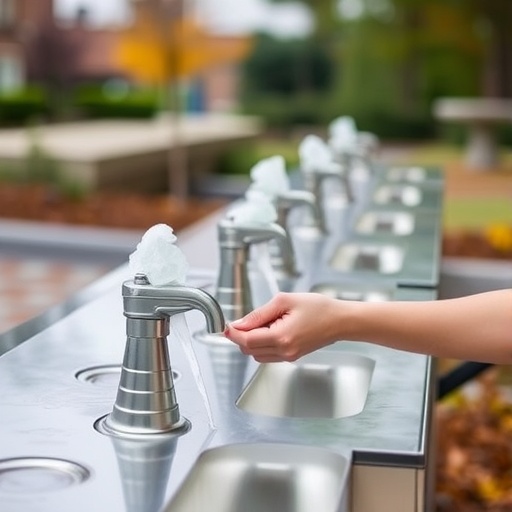
As Europe grapples with escalating urban heat, cities across the continent have responded by installing public drinking fountains, aiming to provide accessible hydration to residents and visitors alike. This practical infrastructural adaptation is a critical measure in mitigating the health risks associated with heat waves, which have become increasingly frequent and severe due to climate change. However, while the physical presence of these fountains is undoubtedly beneficial, recent research unveiled profound psychological barriers that may hinder their effective use. The findings, emerging from studies conducted across German populations, illuminate a significant behavioral hurdle rooted in instinctive pathogen-avoidance mechanisms that influence the public’s willingness to utilize these intended hydration points.
The psychological phenomenon at the heart of this reluctance is contamination aversion—an innate or learned response to perceived risk of infection or germ exposure. This study’s robust datasets, encompassing a representative sample of the German general population as well as a focused cohort of elderly individuals, uncovered a deeply ingrained hesitation to engage with public drinking fountains. Quantitative analysis revealed that each standard deviation increase in individuals’ sensitivity to contamination corresponded to a dramatic reduction in the likelihood of ever having used a drinking fountain: 49% lower odds in the elderly group and 32% lower odds across the general population. These figures underscore how powerful the invisible barriers of perceived microbial threat can be in shaping daily health behaviors.
Understanding the nuances of this contamination aversion is more than an academic exercise; it is a critical step towards designing interventions that could ultimately enhance public health outcomes during heat crises. Notably, the researchers conducted a natural experiment analyzing behavior at 14,128 fountain encounters, which provides a rare real-world behavioral validation beyond self-reported surveys. The intervention involved strategic signage that explicitly communicated the fountains’ safety conditions, highlighting contamination control measures and disinfection procedures. Remarkably, such signage yielded an 82% increase in the odds of individuals drinking directly from the fountain spout and a 37% rise in “cooling behaviors,” such as splashing water on the face or using the fountain to refresh without drinking.
This behavioral shift induced by signage reveals an intriguing interplay between cognitive reassurance and established contamination aversion. By visually signaling safety, the signs alleviate ambiguous fears, encouraging more autonomous and spontaneous usage rather than behavior dictated by social cues or hesitation. Temporal point process modeling of fountain usage data further demonstrated prominent social amplification effects—patterns where individuals’ fountain use was heavily influenced by the actions of others immediately beforehand. However, in the signage condition, these social dependencies weakened, suggesting patrons felt empowered to act independently, unburdened by concern for social norms or indirect pathogen exposure cues.
From a broader perspective, the research highlights that infrastructure alone is insufficient to provoke public use that aligns with intended public health goals. Design strategies must integrate psychological insights about human behavior, particularly regarding contamination fears stemming from both evolutionary and cultural origins. The findings suggest that interventions designed to transparently communicate microbial safety and hygiene measures can directly counteract contamination aversion, thereby enhancing the practical efficacy of public drinking fountains during critical heat events.
Moreover, these results carry significant implications as cities worldwide look towards sustainable, equitable, and resilient urban water provision systems. Establishing trust in public water infrastructure is paramount not only for immediate heat mitigation but also for long-term public health equity, particularly among vulnerable groups like the elderly, who tend to exhibit heightened contamination aversion. The study’s dual focus on both elderly and general populations provides a comprehensive lens on how these psychological factors vary across demographics, emphasizing the need for tailored messaging and infrastructural design.
The use of natural experimental settings combined with advanced temporal modeling further enriches the methodological rigor of the study. By examining over fourteen thousand direct encounters with public fountains, the research accomplishes a granular perspective rarely accessible in social science investigations of public infrastructure use. This methodological approach bridges the gap between controlled lab-based studies on contamination aversion and real-world behavior, offering actionable insights with immediate policy relevance.
Importantly, the findings challenge policymakers and urban planners to consider not only the physical installation of hydration points but also the cognitive and emotional frameworks within which citizens interact with public amenities. Public health campaigns and urban design must be synchronized to dismantle psychological barriers, leveraging clear communication, reassurance, and demonstrable hygiene assurances to foster higher utilization rates. In effect, this would transform the urban landscape into a psychologically safe space that encourages healthy behaviors by design.
As climate-induced heatwaves continue to place unprecedented pressure on urban populations, accessible hydration infrastructure becomes an essential frontline defense. Yet, the success of such interventions is contingent upon a sophisticated understanding of human psychology, including the unconscious avoidance mechanisms that have evolved to protect individuals from disease but may now inadvertently limit life-saving behaviors. This research exemplifies how bridging epidemiology, behavioral science, and urban ecology can produce holistic solutions that better serve public well-being.
Future research building upon these insights might explore additional sensory and informational cues that could mitigate contamination fears, such as realtime water quality displays, public demonstrations of maintenance procedures, or interactive engagement from local health authorities. Moreover, investigating cultural and regional variations in contamination aversion could provide a global framework for designing universally acceptable public hydration infrastructures. Such interdisciplinary and cross-cultural inquiries will be crucial as urban populations worldwide confront the escalating consequences of climate change.
The deliberate integration of psychological safety signals into the design and communication of public water infrastructure may very well serve as a key innovation in public health promotion. Beyond hydration, these principles could extend into other shared urban resources requiring routine human engagement where contamination aversion is a limiting factor. The study thus opens pathways for reimagining how cities can fuse technical infrastructure with behavioral science to cultivate healthier, more resilient communities amidst complex environmental challenges.
In sum, the research conducted in Germany demonstrates that while physical adaptation to rising heat through installing drinking fountains is critical, ensuring their use depends heavily on addressing the invisible psychological barriers rooted in contamination fears. Signage that communicates safety effectively alters these barriers by reducing social dependencies and encouraging independent use. This emphasizes a crucial interdisciplinary insight: successful public health infrastructure must account for human psychological dynamics as integrally as technical design and environmental need.
As urban planners and public health professionals digest these findings, the message is clear—hydration solutions are only as effective as the confidence and comfort they instill in their users. Harnessing behavioral science to complement engineering and infrastructure investments offers a promising avenue toward reducing heat-related morbidity and mortality worldwide. Ensuring widespread and consistent use of public drinking fountains will require ongoing attention to both the tangible and intangible factors influencing human behavior in the urban ecosystem.
This pioneering research not only charts a new understanding of contamination aversion in public infrastructure use but also demonstrates an actionable path forward. By embedding reassurance, clarity, and evidence of safety within the physical environment, cities can promote healthier, more consistent hydration habits. Such integration of psychological mechanisms with infrastructural interventions should become a standard consideration in urban resilience strategies as climate and health landscapes evolve.
Cite Scienmag News
Violet Maxwell. (January 2, 2026). Overcoming Contamination Fears in Drinking Fountain Use. Scienmag. https://scienmag.com/overcoming-contamination-fears-in-drinking-fountain-use/
Violet Maxwell. "Overcoming Contamination Fears in Drinking Fountain Use." Scienmag, 2 January 2026, https://scienmag.com/overcoming-contamination-fears-in-drinking-fountain-use/. Accessed 1 September 2026.
Violet Maxwell. "Overcoming Contamination Fears in Drinking Fountain Use." Scienmag. January 2, 2026. https://scienmag.com/overcoming-contamination-fears-in-drinking-fountain-use/


