


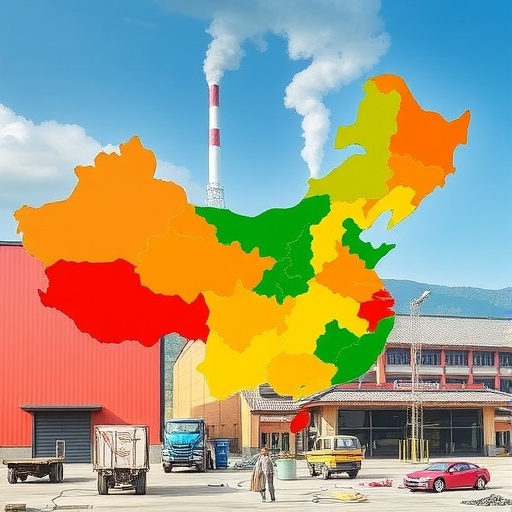
As China’s rapid urbanization transformed its cities over the past two decades, the nation’s hunger for building materials has surged to unprecedented levels. Yet, beneath this concrete and steel boom lies a pressing and insufficiently examined environmental paradox. New research unveils that China’s substantial building material stocks are more than mere physical infrastructure; they are pivotal drivers of embodied carbon emissions intimately tied to the country’s climate ambitions. As China holds 15% of the global building material stock, this stock alone accounts for a staggering 19% of the nation’s total carbon emissions, raising urgent questions about sustainable urban futures.
This emerging narrative is drawn from a groundbreaking high-resolution time-series database meticulously developed to track building material stock across Chinese cities from 2000 to 2019. By painting a granular picture of how urban growth parallels material accumulation, the study reveals how rapid urbanization has propelled per capita building material consumption but crucially does so unevenly across diverse city types and construction categories. Despite the momentum, the pace of material stock growth has decelerated since 2016, signaling potential inflection points but also highlighting persistent challenges in harmonizing urban expansion with carbon neutrality targets.
China’s ongoing urbanization, while a potent engine of economic and social transformation, is forecast to pose significant risks to its climate commitments. The research projects that future urban material demand may consume as much as 12.5% of China’s total carbon budget aligned with the 1.5°C global warming limit, alongside 37.4% of its average annual budget allocation. This scenario underscores a critical tension: the twin imperatives of accommodating urban growth and aggressively cutting carbon emissions are increasingly at odds, demanding carefully calibrated policy and technological responses.
Delving deeper, the study underscores the necessity of targeted urban strategies tailored to the geography and scale of material demand. Aligning low-carbon material production capacity with projected regional consumption is paramount to reducing carbon lock-in from construction activities. Moreover, the burgeoning stocks of building materials point to a vast, if currently underutilized, resource for recycling. Strategic planning for materials recovery from future demolitions could unlock meaningful emissions reductions while supporting circular economy principles.
The intricate relationship between built infrastructure and embodied emissions adds a complex layer to China’s climate mitigation challenge. Buildings and infrastructure, unlike operational energy consumption, hold stockpiled emissions “embedded” from the production and assembly of materials such as cement, steel, glass, and other composites. This embodied carbon footprint is often overlooked yet represents a substantial portion of overall emissions attributable to urban environments, as this analysis vividly demonstrates.
Cities with different trajectories reveal nuanced patterns. Mega-cities and rapidly growing urban centers tend to drive higher per capita stock increases, while smaller or less dynamic cities show more modest growth in building material accumulation. This heterogeneity suggests that blanket national policies may fall short unless they are calibrated to local urban contexts, where material use intensity, construction type, and development pace vary dramatically.
Slowing material stock growth since 2016 perhaps signals the initial impacts of policy shifts, technological innovation, or market saturation, but the current levels of material stock remain immense, embodying carbon liabilities that extend decades into the future. In this light, new construction no longer solely represents economic opportunity but becomes a linchpin for climate risk mitigation. Every new ton of material stock built today locks in carbon that will influence emissions trajectories for generations.
Given the scale of China’s urban expansion — encompassing hundreds of cities undergoing infrastructure upgrades, housing development, and commercial construction — policy focus must pivot toward sustainable material management. This encompasses not only transitioning to low-carbon material production technologies but also optimizing building designs to reduce material intensity and promoting adaptive reuse to extend the lives of existing stocks.
A critical aspect of addressing this challenge lies in developing sophisticated forecasting tools that blend urban growth projections with regional carbon budgets. These models can inform cross-sector collaboration, guiding both industry innovators and policymakers in prioritizing material use aligned with climate goals. Crucially, investment in recycling infrastructure and policy incentives for circular building practices will be vital to divert the flow of materials away from landfills and toward reuse.
This study’s methodical approach to creating a long-term, spatially explicit building material stock database marks a significant advance in urban environmental analysis. By integrating multiple data sources, including construction records, urban expansion metrics, and material flows, the researchers have unlocked new avenues for understanding how urbanization shapes carbon emissions beyond the conventional scope of operational energy consumption.
These insights have global relevance, with lessons applicable to other rapidly urbanizing nations facing similar urban-material-emission conundrums. While China’s scale is unique, its challenges resonate with the broader imperatives of sustainable urban development, low-carbon transitions, and the circular economy. The study provides a clarion call: detailed data-driven insights combined with nuanced urban planning strategies are indispensable tools for meeting ambitious climate targets amid relentless urban growth.
In summary, the intersection of building material stock and embodied carbon emissions presents both a formidable challenge and an opportunity for China’s sustainable urban future. Without deliberate intervention, the “hidden” carbon embedded in materials threatens to undermine climate objectives. However, by leveraging advanced material production technologies, recycling, and regionally adaptive urban policies, China can chart a path representing a major leap forward in decarbonizing its expanding urban fabric.
The findings invite broader dialogue within the scientific, policy, and construction communities on reimagining material use in urban environments. As the world watches China’s urbanization journey, this research illuminates pathways to reconcile development needs and climate imperatives, ultimately shaping cities that are not only larger and more prosperous but fundamentally more sustainable and resilient.
Cite Scienmag News
Sloane Callahan. (January 2, 2026). Building Materials Stock Fuels China’s Carbon Emissions. Scienmag. https://scienmag.com/building-materials-stock-fuels-chinas-carbon-emissions/
Sloane Callahan. "Building Materials Stock Fuels China’s Carbon Emissions." Scienmag, 2 January 2026, https://scienmag.com/building-materials-stock-fuels-chinas-carbon-emissions/. Accessed 9 September 2026.
Sloane Callahan. "Building Materials Stock Fuels China’s Carbon Emissions." Scienmag. January 2, 2026. https://scienmag.com/building-materials-stock-fuels-chinas-carbon-emissions/


