


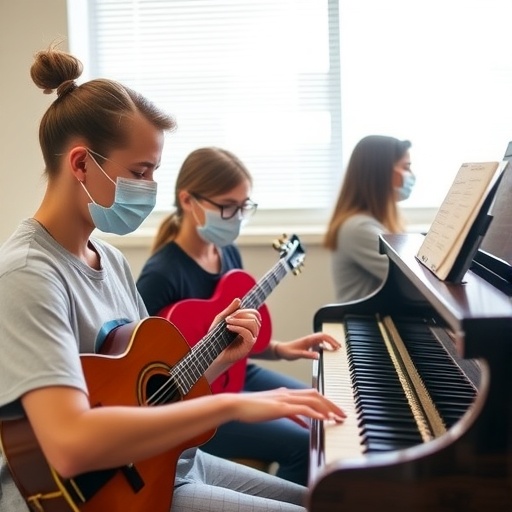
In a groundbreaking study set to redefine the intersection of music and medicine, researchers have unveiled the profound impact of musical instrument practice on the psychomotor and technical skills of novice dental students. Conducted by an esteemed team led by Clouet et al., the prospective controlled study presents compelling evidence that the dexterity required in musical performance could significantly enhance the baseline skills necessary for dental education. This revelation not only opens a new avenue for dental training methodologies but also highlights the neurological connections between music and fine motor skills.
As detailed in their forthcoming article in BMC Medical Education, the researchers meticulously evaluated two groups of dental students—those with musical training and those without. The objective was to assess and compare their psychomotor skills before and after a structured training program in dentistry. By employing a series of rigorous tests aimed at measuring technical proficiency, the study aims to uncover whether musical training can serve as a precursor to excellence in dental practice.
The background of this research stems from the understanding that both musical performance and dental procedures require high levels of precision, coordination, and fine motor control. Musicians exhibit a unique combination of hand-eye coordination, spatial awareness, and memorization skills that are remarkable in their application to complex tasks. Thus, the researchers hypothesized that students who dedicated time to learning musical instruments would naturally outperform their non-musical peers in psychomotor-focused assessments.
Participants were selected from a pool of exceptionally motivated first-year dental students, a crucial time when foundational skills in dentistry are being established. The study divided the participants into two distinct cohorts: one comprised of students who had at least five years of formal training in a musical instrument, and the other group without any musical education. This distinction allowed researchers to draw more fluid comparisons between the two populations without the confounding factors of varying levels of natural aptitude.
As the study progressed, students engaged in various psychomotor tasks designed to simulate dental procedures, including cavity preparations and tooth extractions. The evaluations were conducted at predetermined intervals to ensure a comprehensive understanding of skill development. Each student’s performance was recorded meticulously, with judges trained to use standardized grading rubrics that would yield replicable and reliable results.
The analyses revealed startling successes among the musically trained students, who tended to complete tasks with greater speed and accuracy relative to their non-musical counterparts. Not only did these students exhibit a higher level of technical skill proficiency, but they also demonstrated improved cognitive processing abilities, enhancing their overall performance in time-sensitive situations. This correlation raised questions regarding how embedded musical practices could forge pathways for academic success across various disciplines, including those demanding scientific rigor such as dentistry.
Interestingly, the subtleties of how music influences brain function were brought to light. Neuroscientific research illustrates that engaging with music activates a plethora of brain regions involved in motor control, emotional regulation, and cognitive development. This study lends credence to the theory that the neural pathways developed through music education may seamlessly transfer to fine motor skill execution—an essential component in dental procedures where the precision of hand movements is paramount.
Furthermore, the implications of these findings extend beyond the walls of dental education. The potential of integrating music curricula into various academic programs could foster spatial-temporal reasoning and enhance problem-solving capabilities across a multitude of disciplines. Specifically, educators are urged to reconsider traditional learning environments and seek interdisciplinary approaches that mesh the arts and sciences to develop well-rounded, dexterous professionals.
While the research delineates a profound connection between musical training and enhanced psychomotor skills, it also advocates for further investigation into how these findings can be translated into practical applications within dental curricula. A pivotal inquiry remains: How can dental schools leverage these outcomes to craft a more robust training program that incorporates musical education or exercises focused on enhancing musicality among students?
In conclusion, the implications of Clouet et al.’s study are vast and inspiring, proposing a novel perspective on the artistic dimensions that can enrich the training of future healthcare professionals. As dental students embark on their practical journeys, the understanding that musical training can enhance their competencies heralds an innovative shift in educational methodologies. Whether through rigorously designed curricula or simple advocacy for the arts, fostering a musical environment could foster the next generation of skilled dentists who bring both science and artistry to the table.
As the world eagerly anticipates the publication of this enlightening research, the dental community will undoubtedly watch closely to see how these insights will be implemented in academic settings. Such integrative practices could revolutionize the approach to dental education and ultimately contribute to enhanced patient care outcomes by producing more skilled and well-rounded practitioners.
Clouet, R., Gogendeau, C., Tourtelier, J. et al. Impact of musical instrument practice on baseline psychomotor and technical skills in novice dental students: a prospective controlled study.
BMC Med Educ (2025). https://doi.org/10.1186/s12909-025-08468-x
Cite Scienmag News
Courtney Benton. (December 31, 2025). Musical Practice Enhances Skills in Dental Students. Scienmag. https://scienmag.com/musical-practice-enhances-skills-in-dental-students/
Courtney Benton. "Musical Practice Enhances Skills in Dental Students." Scienmag, 31 December 2025, https://scienmag.com/musical-practice-enhances-skills-in-dental-students/. Accessed 6 September 2026.
Courtney Benton. "Musical Practice Enhances Skills in Dental Students." Scienmag. December 31, 2025. https://scienmag.com/musical-practice-enhances-skills-in-dental-students/


