


In a groundbreaking study poised to reshape the understanding of healthcare accessibility, researchers have recently shed light on the impact of decentralizing exercise-based cardiac rehabilitation services on patient proximity to care facilities. This study, led by Bihrmann, Zwisler, Søndergaard, and colleagues, delves deep into the geographical disparities that patients with cardiac conditions face when seeking life-saving rehabilitation—a critical component in post-cardiac event recovery. By deploying a repeated cross-sectional analysis utilizing detailed individual-level register data, the authors explore how shifting cardiac rehabilitation services from centralized to more dispersed locations influences the distance patients must travel to access rehabilitation programs.
Cardiac rehabilitation is a well-established cornerstone in managing cardiovascular disease, providing tailored exercise regimens designed to restore and enhance cardiac function and overall health. Despite its recognized benefit, access often remains uneven, exacerbated by geographic, socioeconomic, and infrastructural barriers. Enter decentralization—a healthcare strategy intended to redistribute medical services away from urban hospital hubs into community clinics or satellite centers, theoretically bringing care closer to patients and encouraging participation. Yet, understanding the true impact of such systemic changes requires meticulous evaluation, particularly through robust population-level data.
The novelty of this study lies precisely in its methodological approach. Utilizing individual-level registers, which capture patient addresses and healthcare utilization patterns, the researchers measured the geographic distance from each cardiac patient to the nearest rehabilitation facility, both before and after the decentralization reforms. By examining two distinct cross-sectional snapshots over time, they could assess spatial equity trends and discern whether decentralizing services concretely diminished disparities in travel burden across different regions.
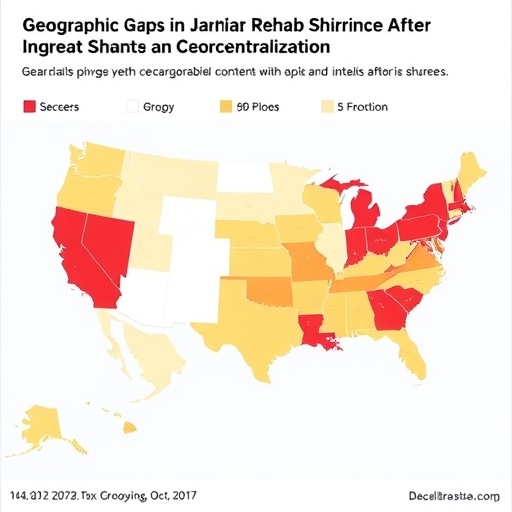
The image accompanying the article visually encapsulates these findings. It depicts cumulative distribution curves of distances to cardiac rehabilitation before and after the decentralization initiative, stratified by patient subgroups such as income level, age, and urban versus rural residence. These curves reveal significant shifts—most notably, a marked reduction in distance for patients living in previously underserved rural locales, signaling enhanced accessibility in these communities. Conversely, some urban populations experienced negligible change, underscoring nuanced spatial dynamics.
An underlying motivation for decentralizing cardiac rehabilitation is the persistent underutilization of outpatient rehabilitation programs—often less than half of eligible patients enroll—due in part to travel-related barriers. The study’s authors emphasize that reducing physical distance to services is a crucial step toward improving attendance rates and thereby improving long-term cardiovascular outcomes. This is especially vital considering that cardiac rehabilitation reduces mortality rates, hospital readmissions, and enhances quality of life.
The research also subtly interrogates equity from a socioeconomic standpoint. Historically, lower-income patients have disproportionately borne the brunt of access inequalities due to poorer transportation options and the uneven distribution of healthcare infrastructure. Post-decentralization data indicate a narrowing of these geographical disparities, suggesting that care restructuring may be an effective policy lever for addressing social determinants of health. Importantly, the longitudinal aspect of the analysis allows for causal inferences, reinforcing the link between service decentralization and improved geographic proximity.
Critically, the study design accounts for potential confounders such as population density changes, healthcare policy shifts, and demographic trends over time. Employing sophisticated geospatial analytical techniques, the authors ensure that observed improvements in proximity are attributable to decentralization rather than extraneous factors. This methodological rigor lends credibility to their conclusions and demonstrates the power of integrating geographic information systems (GIS) with health registers in health services research.
However, proximity alone does not guarantee improved participation or outcomes. The researchers caution that further work is necessary to evaluate whether the decreased distances translate into greater rehabilitation uptake and better clinical prognoses. Factors such as provider capacity, program quality, patient motivation, and social support interplay complexly with geographic access, suggesting a multifaceted approach is essential for optimizing rehabilitation delivery.
The societal implications of these findings are significant. Policymakers and healthcare planners now possess empirical evidence demonstrating that decentralizing cardiac rehabilitation can mitigate geographic access disparities. This insight may fuel continued efforts toward decentralizing other chronic disease management programs, including diabetes care and pulmonary rehabilitation. By bridging the spatial divide, healthcare systems move closer to achieving equitable service distribution—a pivotal step toward health justice.
The study also speaks to the broader challenge of rural healthcare provision, where patients frequently confront structural disadvantages. Innovative models such as mobile clinics, tele-rehabilitation, and community health worker programs might complement decentralization efforts, ensuring that patients in remote areas receive comprehensive, culturally competent care. Integration with digital health technologies further promises to transcend physical barriers, heralding a new era of accessible cardiac rehabilitation.
Moreover, as cardiovascular disease remains a leading cause of morbidity and mortality worldwide, optimizing rehabilitation accessibility is essential in light of aging populations and increasing disease burden. The research underscores how health infrastructure planning can evolve in response to demographic shifts and epidemiological trends, enhancing resilience and adaptability of healthcare delivery systems.
In sum, this comprehensive analysis validates decentralization as a potent strategy to promote geographic equity in cardiac rehabilitation. Beyond geography, it ignites vital conversations about how to design patient-centered healthcare environments that accommodate diverse needs while leveraging data-driven insights. The path forward will require multidisciplinary collaboration, harnessing health informatics, urban planning, and behavioral science to convert geographic gains into tangible health improvements.
As the healthcare landscape grows increasingly complex, studies like this illuminate pathways toward more just, accessible, and efficient care. By bridging gaps—not only physical but also systemic—the decentralization of cardiac rehabilitation services heralds a transformative shift with the promise of saving lives and narrowing health disparities across societies. Future research will undoubtedly follow, tracing the downstream effects of enhanced access on patient adherence, clinical outcomes, and health economics.
This pioneering work, accessible through the International Journal for Equity in Health, sets a precedent for employing granular register data to interrogate spatial disparities in health service delivery. Its findings will resonate far beyond cardiac care, informing global efforts to democratize health access and dismantle longstanding inequities. As barriers fall, heart patients around the world may find themselves closer—not just in distance but in opportunity—to the vital care they deserve.
Cite Scienmag News
Celia A. (December 29, 2025). Geographic Gaps in Cardiac Rehab Shrink After Decentralization. Scienmag. https://scienmag.com/geographic-gaps-in-cardiac-rehab-shrink-after-decentralization/
Celia A. "Geographic Gaps in Cardiac Rehab Shrink After Decentralization." Scienmag, 29 December 2025, https://scienmag.com/geographic-gaps-in-cardiac-rehab-shrink-after-decentralization/. Accessed 29 August 2026.
Celia A. "Geographic Gaps in Cardiac Rehab Shrink After Decentralization." Scienmag. December 29, 2025. https://scienmag.com/geographic-gaps-in-cardiac-rehab-shrink-after-decentralization/


