


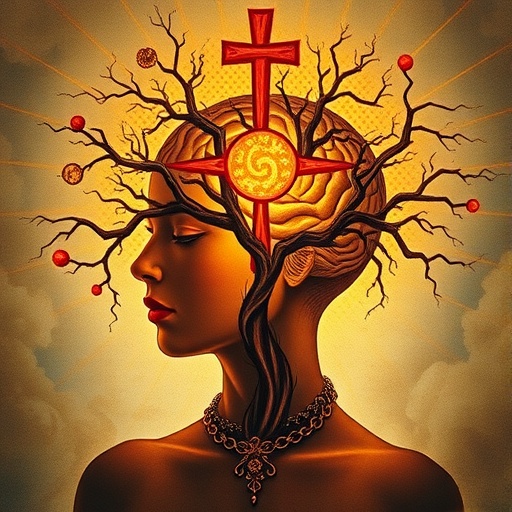
In a groundbreaking exploration of the intersection between faith and neuroscience, L. Williams has delved into the perplexing realms of schizophrenia and demon possession in his upcoming publication for the journal Pastoral Psychology. The work, titled “Between Spirit and Synapse: Reconciling Christian Theology and Neuroscience in Schizophrenia and Demon Possession,” promises to stir discussions among theologians, mental health professionals, and the general public alike. It raises compelling questions about how modern science can provide insight into traditional beliefs and experiences that, at first glance, may seem irreconcilable.
Williams begins his argument by examining the historical context of spiritual possession and its idealization within various religious frameworks. Across cultures and epochs, phenomena interpreted as demonic possession have frequently been linked to behaviors that modern psychology recognizes as symptomatic of mental illness, particularly schizophrenia. This historical interplay creates a backdrop for evaluating how certain spiritual experiences could be characterized through the lens of contemporary neuroscience.
At the heart of Williams’s analysis lies a significant focus on the brain’s role in shaping human experience. By dissecting neural processes and how they can manifest as altered states of consciousness—often described in religious contexts—Williams invites readers to reconsider their definitions of possession and spiritual awakening. The brain, with its intricate system of neurons and synapses, is portrayed as a conduit for experiences that have long been deemed mystical or otherworldly.
Moreover, the book addresses the stigma surrounding mental health issues, particularly in religious contexts where such conditions might be viewed through a lens of moral failing or spiritual deficiency. Williams advocates for a more compassionate approach, urging faith communities to embrace a model of understanding that legitimizes both medical and spiritual narratives. This dual approach fosters an environment where individuals suffering from schizophrenia can seek help without the fear of being deemed “possessed” or “sinful.”
In examining demon possession from a clinical angle, Williams introduces various case studies that highlight the overlap between the clinical symptoms of schizophrenia and traditional accounts of possession. These case studies serve as a bridge, connecting anecdotal experiences with empirical research, thus validating both spiritual and psychological accounts of reality. By doing so, Williams hopes to encourage a dialogue that respects the lived experiences of individuals while also leaning into scientific explanations that demystify their experiences.
A key aspect of the discussion revolves around the neural correlates of mystical experiences. Williams points out that certain brain regions, when activated, can lead to profound sensations of transcendence, communion, or the presence of another being. This neural activation could align with the experiences reported in spiritual practice or demon possession narratives. By grounding spiritual experiences in neuroscience, Williams proposes that faith and science need not stand in opposition but can coexist and complement each other.
The conversation moves towards therapeutic implications, advocating for integrative treatment models where spiritual care is synchronized with psychiatric approaches. Williams argues that mental health professionals would benefit from a theological understanding of their patients, enabling them to address not only clinical symptoms but also spiritual struggles. Such a holistic approach can lead to more enriching and multifaceted healing experiences that validate the whole person rather than reducing them to mere diagnoses.
Furthermore, the notion of faith as a potential facilitator of healing is examined thoroughly. Within the text, Williams posits that engaging with one’s faith—through prayer or rituals—can significantly impact mental well-being. This interplay between spiritual practice and mental health recovery highlights the importance of nurturing one’s faith as a component of comprehensive care.
As mental health continues to be a critical issue globally, Williams’s work could not be more timely. The mental health epidemic requires a rethinking of traditional responses, particularly within religious communities that may have historically misunderstood psychological conditions. By challenging antiquated notions of possession and offering a framework that incorporates modern psychological understanding, Williams encourages a broader acceptance of mental health realities.
In conclusion, “Between Spirit and Synapse” positions itself as an essential text for anyone interested in the domains of theology, psychology, and neuroscience. Williams’s work calls for an uplifting reexamination of faith and its role in mental health, positioning it not as a foreign adversary to scientific progress, but as a complementary force that can help shape a more compassionate understanding of the human experience.
The implications of Williams’s research extend beyond academic discourse. They ripple into the everyday lives of individuals struggling with mental health issues, faith leaders guiding their communities, and policymakers devising mental health strategies. In cultivating a dialogue that bridges the gap between science and spirituality, this work seeks to promote understanding, healing, and integration.
In the end, the reconcilement of Christian theology and neuroscience is portrayed not merely as an academic exercise but as a profound opportunity for societal growth. Williams’s vision for the future is one where compassion supersedes stigma and acceptance eclipses misunderstanding, allowing individuals to navigate their journeys through the dual lenses of faith and science.
Williams, L. Between Spirit and Synapse: Reconciling Christian Theology and Neuroscience in Schizophrenia and Demon Possession. Pastoral Psychol (2025). https://doi.org/10.1007/s11089-025-01291-7
Cite Scienmag News
Cassandra Pierce. (December 29, 2025). Bridging Theology and Neuroscience in Schizophrenia. Scienmag. https://scienmag.com/bridging-theology-and-neuroscience-in-schizophrenia/
Cassandra Pierce. "Bridging Theology and Neuroscience in Schizophrenia." Scienmag, 29 December 2025, https://scienmag.com/bridging-theology-and-neuroscience-in-schizophrenia/. Accessed 4 September 2026.
Cassandra Pierce. "Bridging Theology and Neuroscience in Schizophrenia." Scienmag. December 29, 2025. https://scienmag.com/bridging-theology-and-neuroscience-in-schizophrenia/


