


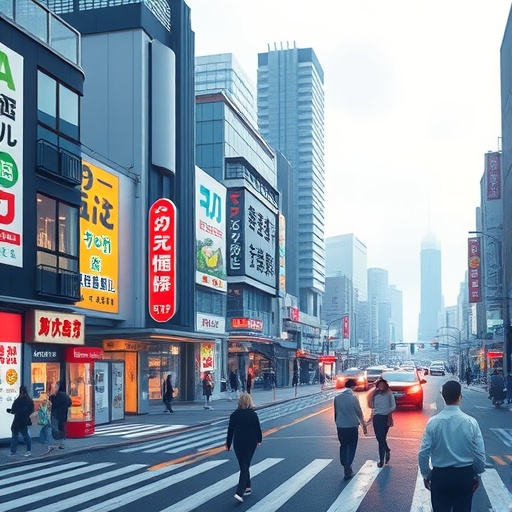
During the COVID-19 pandemic, urban risk perceptions have dramatically affected the subjective well-being of residents worldwide. A new study by Lin and Jin investigates these differential impacts, especially focusing on the diverse experiences of both Korean and foreign residents in Seoul. This research reveals critical insights into how urban life quality mediates the relationship between perceived risks and individual mental health during an unprecedented global crisis.
The pandemic has forced people to rethink their environments, particularly in metropolitan settings like Seoul, which boast large, densely packed populations. As residents grappled with the uncertainty regarding the virus’s spread and the effectiveness of government measures, their perceptions of urban risks heightened dramatically. This led to a pronounced impact on their mental health and overall feeling of well-being.
The study sheds light on stark contrasts between Korean residents who are familiar with the urban landscape and foreign residents who might find themselves less accustomed to rapid changes in their surroundings. While both groups experienced anxiety related to COVID-19, Korean residents typically leveraged social infrastructures and cultural practices that promote community support, thereby cushioning their subjective well-being. On the other hand, foreign residents faced additional layers of challenges, including possible language barriers, cultural disparities, and limited access to crucial information.
Researchers collected data through a comprehensive survey, assessing how urban risk perception influenced mental health outcomes. They utilized standardized measures such as the WHO-5 Well-Being Index to quantify subjective well-being. The findings were revealing; they show thoughtful patterns indicating that those who perceived their urban environment as risky reported lower mental health ratings. This negative correlation highlights the power of perception in shaping experiences, particularly in high-stress situations like the pandemic.
Quality of urban life emerged as a crucial mediating factor in this study. For individuals living in environments where public services were effective and accessible, subjective well-being remained comparatively higher. The authors suggest that urban policies promoting well-maintained public health infrastructure can buffer the adverse effects of perception-based anxiety. Conversely, in neighborhoods where public support systems faltered, distress levels intensified, leading to a more profound decline in mental health for all residents.
Interestingly, the study also hints at how communal resources play a significant role in navigating health crises. Examples of strong local networks, such as neighborhood volunteer groups and social media initiatives, have been pivotal in fostering a sense of belonging. These resources were not universally accessible, particularly for foreign residents who reported feelings of isolation and lack of community cohesion as exacerbating factors to their overall well-being.
Moreover, behavior adaptations among residents were noted throughout the study, revealing how urban risk perception influenced daily routines and lifestyle choices. Many individuals pivoted dramatically in their daily interactions, altering their commuting habits, shopping practices, and recreational activities to avoid perceived risks. This behavioral shift, driven by fear and caution, contributed to a further decrease in social interactions, particularly among foreign residents who might have relied more heavily on public spaces for community connection prior to the pandemic.
The deep dives into both qualitative and quantitative data reveal that urban perception and quality of life are intricately intertwined. Urban design, governmental responses, and community engagement have collectively shaped the lived experiences of individuals in Seoul during COVID-19. As the study posits, cities must strive to not only improve physical infrastructure but also prioritize communal bonds and psychological interventions that address perceived risks directly.
As metropolitan areas recover from long-standing challenges imposed by the pandemic, the insights from Lin and Jin’s research provide foundational knowledge for urban planners, health professionals, and policymakers. With a clear outline of the intersecting influences of urban risk perception on well-being, cities can develop comprehensive strategies that do not only aim at economic recovery but also focus on individual mental health.
In conclusion, the findings from this rigorous study underscore an urgent need for cities worldwide to innovate and adapt their urban policies. The mediating role of quality of urban life highlights an essential dimension of public health that could forge pathways for resilience amidst crises. As the world continues to face uncertainties from the pandemic, understanding these dynamics becomes imperative for promoting holistic community well-being in urban settings.
In the wake of the study, it is evident that fostering a sense of community, improving access to information, and strengthening local resources will be vital in enhancing subjective well-being among both Korean and foreign residents as societies continue to rebuild after COVID-19.
While we navigate post-pandemic life, the lessons learnt about urban risk perceptions and their effects on mental health must remain at the forefront of urban planning discussions. Future researchers should expand on these findings to further elucidate the complex relationship between urban settings, risk perception, and overall satisfaction in life.
The holistic approach presented by Lin and Jin could serve as a template for future studies in urban psychology and public health, aiding communities grappling with similar challenges, turning insights into actionable plans that promote equity and mental health in cities globally.
Cite Scienmag News
Glenn Wilkins. (December 29, 2025). Urban Risks and Well-Being: Insights from Seoul. Scienmag. https://scienmag.com/urban-risks-and-well-being-insights-from-seoul/
Glenn Wilkins. "Urban Risks and Well-Being: Insights from Seoul." Scienmag, 29 December 2025, https://scienmag.com/urban-risks-and-well-being-insights-from-seoul/. Accessed 1 September 2026.
Glenn Wilkins. "Urban Risks and Well-Being: Insights from Seoul." Scienmag. December 29, 2025. https://scienmag.com/urban-risks-and-well-being-insights-from-seoul/


