

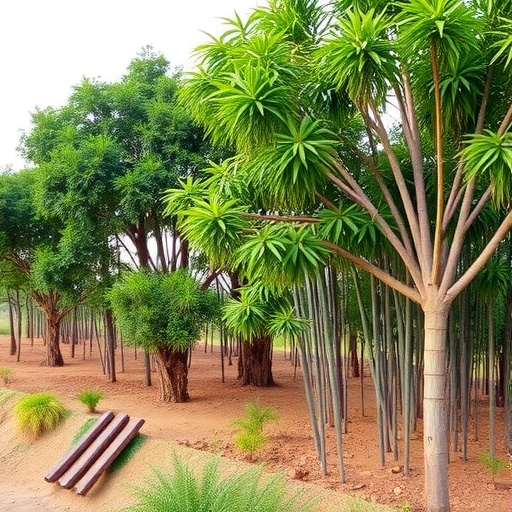
In the ever-evolving landscape of environmental science, researchers are continuously seeking methods to better understand and manage our natural resources. A notable study conducted by Kumar, Ravula, and Reddy, published in the journal “Environmental Monitoring and Assessment,” delves into the life cycle assessment and carbon balance of eucalyptus and bamboo plantations in semi-arid regions of India. This research sheds light on the critical role that these specific plantations play in environmental sustainability, particularly in relation to carbon sequestration and overall ecosystem health.
The research focuses on two types of biomass: eucalyptus, a fast-growing tree species known for its rapid growth and versatility, and bamboo, a resilient and sustainable alternative that has garnered attention for its potential in combating deforestation. Both of these plant types have gained significant popularity in the context of reforestation, making them essential for developing sustainable forestry practices. The study highlights how their respective growth patterns, environmental impacts, and resource requirements can influence the overall carbon footprint associated with their cultivation.
Life cycle assessment (LCA) is a comprehensive methodology that evaluates the environmental impacts associated with all stages of a product’s life, from raw material extraction through to production, usage, and disposal. This method is especially crucial in understanding the long-term effects of land-use changes due to agricultural practices. The researchers meticulously assessed the carbon balance of eucalyptus and bamboo plantations, analyzing factors such as biomass accumulation, soil carbon changes, and emissions associated with land preparation and management.
Eucalyptus has been widely recognized for its economic benefits, but this research extends beyond economic value, investigating its ecological footprint. The study found that while eucalyptus plantations can sequester carbon effectively due to their rapid growth rates, they also have significant implications for biodiversity and soil health. The authors emphasize the importance of considering these ecological impacts alongside carbon sequestration rates when evaluating the sustainability of eucalyptus cultivation.
On the other hand, bamboo’s role as a sustainable crop is increasingly recognized due to its fast growth and ability to thrive in a variety of conditions. The study emphasizes how bamboo not only captures carbon effectively but also enhances soil quality and prevents erosion. In semi-arid regions, where soil degradation is a pressing concern, bamboo presents a viable solution for improving both ecological integrity and agricultural productivity. The authors advocate for the integration of bamboo into agroforestry systems as an effective strategy for enhancing carbon stocks while supporting local livelihoods.
As climate change continues to be a pressing global challenge, understanding the capabilities of different plant species to sequester carbon becomes essential. The findings from this study highlight the need for targeted reforestation strategies in semi-arid regions, emphasizing that simply planting trees is not enough. A fine balance must be struck between fostering rapid growth and ensuring ecological integrity to create sustainable landscapes that can support both natural ecosystems and human communities.
The researchers utilized a combination of field measurements, remote sensing, and modeling techniques to provide a comprehensive assessment of carbon stocks associated with eucalyptus and bamboo plantations. By employing advanced methodologies, they were able to provide insights into the net carbon balance over time, accounting for both carbon sequestration and emissions. This rigorous approach strengthens the credibility and applicability of their findings, creating a framework for future studies in similar ecological contexts.
Notably, the study reveals stark differences in carbon dynamics between the two planting systems, with bamboo showing a more favorable outcome in terms of net carbon storage. This finding has significant implications for policy-makers and land-use planners aiming to promote sustainable agricultural practices in semi-arid climates. Incorporating bamboo into regional land-use frameworks can lead to enhanced ecosystem services while contributing to climate change mitigation efforts.
The authors also discussed the social dimensions surrounding the cultivation of these plants. The accessibility of bamboo as a crop, due to its minimal input requirements and rapid growth, makes it an attractive option for local communities. Furthermore, engaging local populations in the cultivation and management of bamboo resources can foster economic opportunities and enhance community resilience against climate-change-induced challenges.
In addition to discussing carbon dynamics, the study recognizes the importance of integrating socio-economic factors into environmental assessments. A holistic view of sustainability encapsulates not only environmental and carbon considerations but also how agricultural practices impact local communities. This comprehensive approach can ultimately lead to more informed decision-making processes that align ecological goals with human welfare.
In conclusion, the research conducted by Kumar and colleagues adds valuable knowledge to the ongoing discourse around sustainable land management practices in semi-arid regions. By highlighting the distinct attributes of eucalyptus and bamboo, the study serves as a crucial reminder that not all reforestation efforts yield the same ecological benefits. Emphasizing the significance of carbon sequestration, biodiversity preservation, and socio-economic implications, their findings pave the way for future studies aimed at optimizing land-use strategies in the context of climate resilience.
In a world grappling with climate uncertainties, this study underscores the pressing need for multi-faceted approaches to land management. By favoring both efficiency in carbon sequestration and biodiversity enhancement, we can strive to create a harmonious balance between human needs and ecological stability. As further research continues to unveil the intricate connections between plant species and their environments, the imperative to adopt sustainable practices in agriculture and forestry will only grow stronger.
As researchers move forward, it is hoped that their compelling findings will inspire new policies and initiatives aimed at fostering sustainable practices that prioritize environmental integrity while supporting economic growth and community resilience. The interplay between ecology and economy is delicate, yet it is through studies like these that we can begin to understand and navigate this complexity in pursuit of a more sustainable future for our planet.
Subject of Research: Life cycle assessment and carbon balance of eucalyptus and bamboo plantations in semi-arid regions.
Article Title: Life cycle assessment and carbon balance of eucalyptus and bamboo plantations in Semi-Arid, India.
Article References:
Kumar, M., Ravula, R., Reddy, G.C. et al. Life cycle assessment and carbon balance of eucalyptus and bamboo plantations in Semi-Arid, India.
Environ Monit Assess 198, 67 (2026). https://doi.org/10.1007/s10661-025-14861-2
Image Credits: AI Generated
DOI: https://doi.org/10.1007/s10661-025-14861-2
Keywords: carbon sequestration, eucalyptus, bamboo, life cycle assessment, sustainable forestry, semi-arid regions, environmental impact, biodiversity, climate change, agroforestry, ecosystem services, land management.


