


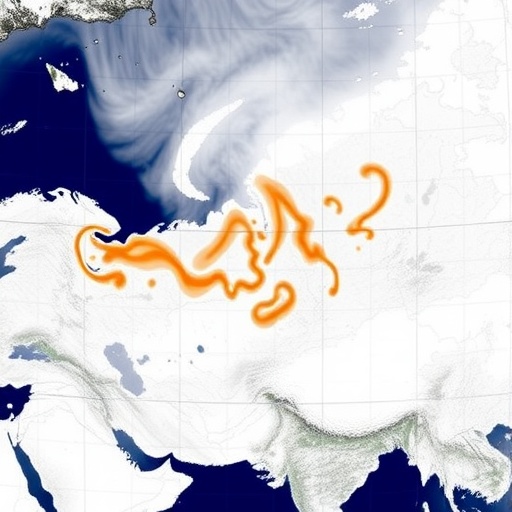
In an era marked by escalating climate crises, new research has unveiled a paradoxical phenomenon in the subpolar North Atlantic that could be significantly influencing wildfire activity thousands of kilometers away in Eastern Siberia. The groundbreaking study published in Nature Communications by Zeng, Wang, Chen, and colleagues presents compelling evidence that multi-decadal cooling trends in the subpolar North Atlantic may have exacerbated the severity and frequency of recent wildfires in this vulnerable region of northeastern Russia. This discovery challenges conventional narratives focused predominantly on warming trends and underscores the intricate complexity of the Earth’s climate system and its cascading effects on distant ecosystems.
The subpolar North Atlantic, a crucial oceanic region characterized by its role in the Atlantic Meridional Overturning Circulation (AMOC), has long fascinated climatologists due to its influence on regional and global climate. Over the past several decades, this area has experienced notable episodes of cooling that contrast with the general trend of Arctic and global warming. While previous studies have attributed Eastern Siberian wildfire activity largely to increased local temperatures and aridity linked to climate change, this latest investigation points to a previously underappreciated forcing mechanism rooted in ocean-atmosphere interactions far from the fire zones themselves.
Utilizing state-of-the-art climate models alongside an extensive array of observational data spanning several decades, Zeng et al. meticulously trace the propagation of cooling signals from the subpolar North Atlantic across the Arctic and into the heart of Eastern Siberia. Their analysis reveals that decadal-scale cooling in the ocean can instigate shifts in atmospheric circulation patterns, ultimately resulting in prolonged periods of dry, warm conditions ideal for wildfire ignition and expansion. This finding resonates with the concept of teleconnections, where localized climate anomalies can exert outsized impacts on remote environments, complicating efforts to predict and mitigate wildfire risk.
One of the key mechanisms highlighted involves the modulation of the Siberian High pressure system, a major atmospheric feature influencing weather patterns in northern Asia. The study demonstrates that cooling in the North Atlantic can strengthen and alter the positioning of this high-pressure system, enhancing atmospheric stability and reducing precipitation in Eastern Siberia. Consequently, vegetation becomes desiccated, and the likelihood of fire ignition due to natural causes or human activities rises steeply. These synergistic effects magnify the intensity of wildfire seasons, contributing to the catastrophic blazes witnessed in recent years.
Further contributing to the complexity is the interplay between the subpolar North Atlantic cooling and Arctic sea ice dynamics. The researchers suggest that cooling trends can influence sea ice extent and thickness, which in turn affect heat fluxes and atmospheric circulation. Reduced sea ice cover in some seasons paradoxically aligns with the multi-decadal oceanic cooling phase, collectively fostering conditions conducive to extreme wildfire events. This intricate feedback loop illustrates how marine and cryospheric processes jointly sculpt terrestrial climate risk profiles in ways that remain only partially understood.
The implications of these findings extend far beyond the scientific community, highlighting urgent challenges for environmental management and policy-making in Siberia and similar boreal forest regions. Wildfires in this vast landscape contribute significantly to carbon emissions and have profound impacts on indigenous communities, biodiversity, and global climate feedbacks. Recognizing the role of remote oceanic cooling as an aggravating factor demands a reevaluation of fire risk assessments, particularly as natural climate variability superimposes itself on anthropogenic warming.
Moreover, this research invites a broader discourse about the limits of focusing solely on surface air temperature increases as predictors for wildfire behavior. The intricate cause-effect chains elucidated by the study advocate for integrated climate modeling approaches that encompass oceanic, atmospheric, and cryospheric components. Such methodologies are vital for capturing the full spectrum of drivers influencing wildfire regimes, which are increasingly erratic and extreme in the context of global climate change.
The methodology employed by Zeng and colleagues exemplifies cutting-edge climate science. By combining in situ measurements, satellite data, and advanced Earth system models capable of resolving decadal variability, the team reconstructs a coherent narrative linking oceanic processes to terrestrial wildfire patterns. This interdisciplinary approach sets a new benchmark for investigating large-scale teleconnection phenomena and offers a template for similar studies in other critical regions.
Additionally, the study sheds light on the potential predictability of wildfire-prone years in Eastern Siberia by monitoring ocean temperature anomalies in the subpolar North Atlantic. This prospective capability could revolutionize early warning systems, providing stakeholders with crucial lead times to implement risk mitigation strategies such as controlled burns, resource mobilization, and community preparedness. Given the escalating cost and frequency of wildfires globally, enhancing predictive capacity is a priority in climate adaptation efforts.
Despite these advances, the authors acknowledge limitations and uncertainties inherent in their analysis. The chaotic nature of climate systems, compounded by incomplete observational records and model imperfections, necessitates ongoing research. In particular, disentangling the relative contributions of anthropogenic forcing versus natural variability to the observed cooling patterns remains an open question with significant policy ramifications. Nevertheless, the current findings mark a vital step toward unraveling the complex web of climate influences on wildfire dynamics.
Looking forward, the integration of paleoclimate records may prove invaluable in contextualizing the observed decadal cooling events within longer-term climate variability cycles. By examining proxies such as sediment cores and tree rings, researchers could uncover historical precedents of similar oceanic-atmospheric interactions and their ecological impacts. Such insights would deepen understanding of the resilience and vulnerability of Siberian boreal forests under fluctuating climate regimes.
The interaction between subpolar North Atlantic cooling and wildfire activity also stresses the interconnectedness of Earth’s systems, reminding us that interventions in one sector can cascade across distant ecosystems. For instance, shifts in shipping routes or offshore resource extraction affecting the North Atlantic could unintentionally influence terrestrial wildfire risk thousands of miles away. This underscores the need for holistic environmental governance embracing the planetary-scale interdependencies illuminated by contemporary climate science.
Communicating these findings to the public and policymakers is essential to galvanize support for multidisciplinary climate research and adaptive forest management. The dramatic and counterintuitive nature of the study’s conclusions offers a compelling narrative for science outreach, helping audiences appreciate the depth and complexity behind wildfire phenomena often sensationalized in the media. Such knowledge empowers communities to advocate for science-based solutions grounded in a comprehensive understanding of the Earth system.
Ultimately, the research conducted by Zeng, Wang, Chen, and their team exemplifies the cutting edge of climate science aimed at deciphering the intricate and sometimes surprising linkages that define our planet’s evolving climate landscape. By revealing how subpolar North Atlantic decadal cooling may have intensified recent Eastern Siberian wildfires, they expand our grasp of climate variability’s multifaceted impacts. This new perspective challenges researchers, resource managers, and policymakers alike to rethink conventional approaches and develop more nuanced strategies to address the intertwined challenges posed by climate change and wildfire risk in boreal ecosystems.
As climatic extremes become the new normal, insights from this study will play a pivotal role in shaping future research trajectories and informing adaptation policies tailored to the unique vulnerabilities and feedback mechanisms of high-latitude regions. In a world increasingly shaped by these global teleconnections, understanding the subtle interplay between ocean temperatures and terrestrial fire regimes is not only an academic endeavor but a societal imperative for safeguarding natural landscapes, human livelihoods, and planetary health.
Zeng, Y., Wang, J., Chen, S. et al. Subpolar North Atlantic decadal cooling may have aggravated recent Eastern Siberian wildfires. Nat Commun (2025). https://doi.org/10.1038/s41467-025-66520-2
Cite Scienmag News
Violet Maxwell. (December 24, 2025). Subpolar Cooling May Worsen Eastern Siberian Wildfires. Scienmag. https://scienmag.com/subpolar-cooling-may-worsen-eastern-siberian-wildfires/
Violet Maxwell. "Subpolar Cooling May Worsen Eastern Siberian Wildfires." Scienmag, 24 December 2025, https://scienmag.com/subpolar-cooling-may-worsen-eastern-siberian-wildfires/. Accessed 4 September 2026.
Violet Maxwell. "Subpolar Cooling May Worsen Eastern Siberian Wildfires." Scienmag. December 24, 2025. https://scienmag.com/subpolar-cooling-may-worsen-eastern-siberian-wildfires/


