


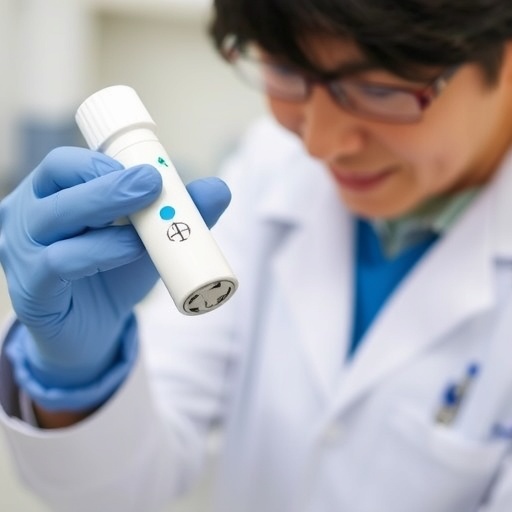
Neonatal hyperbilirubinemia remains a pervasive and challenging condition worldwide, often leading to severe neurological impairments or even mortality when undiagnosed and untreated. Traditionally, the quantification of total serum bilirubin (TSB)—a critical biomarker for jaundice and bilirubin overload—has relied on sophisticated hospital-based analyzers. These state-of-the-art instruments offer precise and reliable measurements but are encumbered by high costs, technical complexity, and limited accessibility, particularly in resource-constrained settings. In a groundbreaking study published in Pediatric Research, a collaborative team of researchers has evaluated the Bilistick System 2.0 Point-of-Care (POC) device as a transformative alternative, bringing laboratory-grade bilirubin measurement capacity directly to the bedside.
The Bilistick POC represents a paradigm shift in neonatal care, aiming to decentralize diagnostic capabilities without sacrificing accuracy or efficiency. Unlike conventional analyzers that require extensive infrastructure, highly trained personnel, and substantial financial investment, the Bilistick device is designed to be portable, user-friendly, and cost-effective. This innovation has the potential to revolutionize how neonatal jaundice is managed worldwide, particularly in low- and middle-income countries where hospital-based testing may not be readily available or feasible. The study meticulously compares the TSB values obtained from the Bilistick POC against those from the gold standard hospital analyzers under real-world clinical conditions, thus probing the device’s practical utility and reliability.
Central to the study is the rigorous collection and analysis of paired blood samples from neonates suspected of hyperbilirubinemia. Researchers procured TSB readings using both the Bilistick System 2.0 and traditional laboratory analyzers, ensuring that variables such as sample handling, timing, and patient demographics were consistently controlled. The comparative assessment relied on state-of-the-art statistical methods, including Bland-Altman plots and correlation coefficients, to ascertain the concordance between the two modalities. Impressively, the Bilistick POC demonstrated strong agreement with hospital analyzers, boasting negligible bias and narrow limits of agreement, thus validating its precision across a wide range of bilirubin concentrations.
Technical evaluation of the Bilistick System 2.0 sheds light on its operative mechanisms. The device utilizes a proprietary microfluidic cartridge and photometric detection technology to quantify total serum bilirubin rapidly. The process mandates only a minimal volume of capillary blood, typically obtained via heel prick, which is advantageous for neonatal patients who often have limited blood volume. Once the sample is introduced into the cartridge, optical sensors assess the bilirubin concentration through spectrophotometric measurement of light absorbance at specific wavelengths, a method that closely parallels hospital laboratory protocols but adapted for bedside use. This technological miniaturization encapsulates cutting-edge biomedical engineering principles aimed at enhancing clinical utility without compromising analytic fidelity.
Importantly, this clinical study also underscores the bilateral benefits of the Bilistick POC in terms of workflow and healthcare economics. By obviating the need for sample transport to centralized labs and accelerating test turnaround times, the device affords timely clinical decision-making, which is vital in neonatal care where delays can exacerbate neurological damage. Furthermore, its deployment can substantially reduce operational costs associated with equipment maintenance, reagent supply chains, and laboratory technician staffing. These cost savings are especially consequential in settings where healthcare resources are scarce and budgets constrained, potentially democratizing access to crucial bilirubin measurement and improving outcomes for millions of newborns globally.
From a practical standpoint, the user interface of Bilistick System 2.0 was rated highly by frontline healthcare workers participating in the study, highlighting its intuitive design and minimal training requirements. The device’s portability permitted its use in various hospital areas, including outpatient clinics and emergency rooms, extending its reach beyond the confines of laboratory spaces. Field usability assessments further revealed the device’s robustness under varying environmental conditions, demonstrating resilience to typical challenges in lower-resource contexts, such as fluctuating power supply and limited refrigeration. This adaptability constitutes a critical advantage over traditional analyzers, which often demand stringent environmental controls.
The study’s findings carry significant implications for neonatal healthcare protocols worldwide. Given that hyperbilirubinemia affects over 60% of term newborns and even higher proportions of preterm infants, the ability to promptly and accurately assess TSB at the point of care is transformative. Early detection of severe hyperbilirubinemia enables timely phototherapy or exchange transfusion interventions, preventing irreversible brain injury (kernicterus) and associated morbidity. The Bilistick POC’s proven reliability positions it as a valuable adjunct or alternative to hospital laboratory testing, with the potential to standardize neonatal jaundice screening protocols across diverse healthcare systems.
Moreover, this research contributes to the broader discourse on decentralization of diagnostic testing in modern medicine. The successful validation of Bilistick System 2.0 exemplifies how engineering ingenuity and clinical need can converge to produce scalable solutions that bridge gaps in healthcare delivery. Such innovations align with global health goals aiming to improve maternal and child health outcomes by leveraging point-of-care technologies that can be deployed in resource-limited areas, thereby mitigating healthcare disparities. The study’s real-world approach to comparing device performance also provides a template for rigorous evaluation of other emergent POC diagnostics.
In the era of precision medicine and rapid diagnostics, the integration of point-of-care devices like the Bilistick System 2.0 into neonatal care frameworks signals a shift toward more personalized, timely, and accessible clinical interventions. By enabling bedside measurements with hospital-analogous accuracy, these technologies empower healthcare providers to act decisively, minimizing the window of uncertainty that often accompanies centralized laboratory testing. The scalability of such devices also opens avenues for large-scale screening programs, potentially catching cases earlier and reducing the public health burden associated with hyperbilirubinemia complications.
Despite its promising performance, the study acknowledges certain limitations inherent to point-of-care testing. For instance, while Bilistick POC demonstrated excellent reliability across most bilirubin ranges, extreme outliers in values warrant confirmatory testing in some clinical scenarios. Additionally, the need for consumable cartridges introduces a logistical variable that requires attention in supply chain management, especially in remote settings. Future iterations of the device may focus on further miniaturization, multiplexing capabilities, and integration with electronic health records to optimize workflow and data management.
The researchers advocate for continued post-market surveillance and broader clinical implementation studies to further validate Bilistick’s efficacy across varied demographic and geographic populations. Longitudinal studies tracking clinical outcomes associated with POC-guided management of neonatal hyperbilirubinemia could elucidate real-world impacts on morbidity and mortality. Moreover, health economic analyses are essential to quantify cost-effectiveness and inform stakeholder investment decisions in adopting this technology at scale.
Intriguingly, the Bilistick platform could serve as a foundation for expanding point-of-care testing beyond bilirubin. Leveraging its microfluidic and photometric technologies, it may be adapted to quantify other neonatal biomarkers such as hemoglobin, glucose, or infection markers, creating a multiparametric neonatal platform. This versatility would further enhance its utility in comprehensive newborn health assessments, supporting early diagnosis and intervention for diverse conditions.
Overall, this seminal study heralds a new dawn in neonatal diagnostic technology, demonstrating that robust, hospital-comparable bilirubin measurement can be achieved outside conventional laboratory settings. The implications span clinical, operational, and economic domains, cultivating optimism for improved neonatal survival and neurodevelopmental outcomes worldwide. As healthcare systems increasingly embrace innovation, devices like Bilistick System 2.0 exemplify the tangible benefits achievable when technology is thoughtfully aligned with clinical realities and global health equity priorities.
Emboldened by these findings, clinicians, researchers, and policymakers may converge to champion the wider adoption of point-of-care bilirubin testing, cementing a critical step forward in neonatal care. The Bilistick System 2.0 embodies how precision, portability, and practicality are no longer mutually exclusive but rather synergistic facets of next-generation medical diagnostics. Its deployment promises to transform the landscape of neonatal hyperbilirubinemia management, saving lives and preventing devastating neurological sequelae on a global scale.
Cite Scienmag News
Harold Sullivan. (December 23, 2025). Point-of-Care Bilirubin: Efficient Alternative to Hospital Tests. Scienmag. https://scienmag.com/point-of-care-bilirubin-efficient-alternative-to-hospital-tests/
Harold Sullivan. "Point-of-Care Bilirubin: Efficient Alternative to Hospital Tests." Scienmag, 23 December 2025, https://scienmag.com/point-of-care-bilirubin-efficient-alternative-to-hospital-tests/. Accessed 3 September 2026.
Harold Sullivan. "Point-of-Care Bilirubin: Efficient Alternative to Hospital Tests." Scienmag. December 23, 2025. https://scienmag.com/point-of-care-bilirubin-efficient-alternative-to-hospital-tests/


