


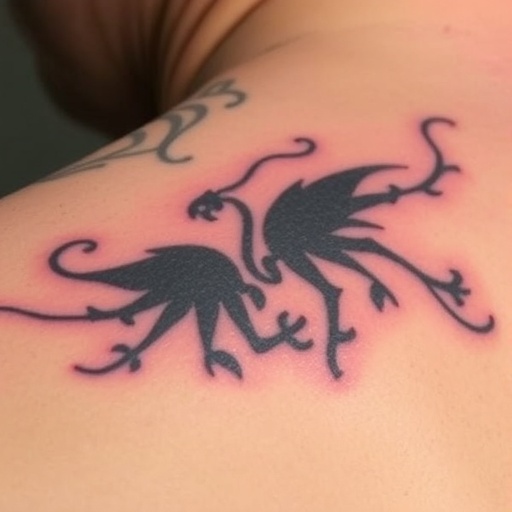
In a groundbreaking study that merges forensic science and cultural anthropology, researchers have unveiled compelling insights into the prevalence and forensic utility of tattoos in unidentified decedents in Johannesburg, South Africa. This pioneering work, spearheaded by Keyes and Gilbert, offers a detailed exploration of how body art, often perceived merely as a form of personal or cultural expression, can serve as a crucial forensic marker, aiding in the identification process in forensic investigations.
The study delves into a critical challenge faced by mortuary and forensic teams worldwide: the identification of unknown individuals. In South Africa, where a high volume of unidentified bodies complicates judicial and humanitarian processes, conventional identification methods such as fingerprints and dental records often fall short due to degradation or absence of records. Here, tattoos emerge as unique biometrics—immortalized on skin, they bear cultural, personal, and sometimes criminal signatures that herald identity and social narratives.
Keyes and Gilbert meticulously catalogued tattoo prevalence in a substantial cohort of unidentified decedents, revealing intriguing statistical and morphological patterns. Their analysis indicates that a significant proportion of these decedents bore tattoos, each distinct in style, symbolism, and anatomical placement. Such diversity not only underscores the rich tapestry of local subcultures but also validates tattoos as forensic signposts.
The forensic significance of tattoos extends beyond their mere presence. The intricate typology of tattoos documented—ranging from culturally resonant motifs such as indigenous Zulu and Xhosa symbols to globalized iconography like skulls and script—provides crucial leads. Tattoos often persist well beyond the point where other identifying features may have been compromised by trauma or decomposition, making them indispensable in forensic examinations and victim identification.
From a technical standpoint, Keyes and Gilbert utilized advanced imaging techniques combined with thorough ethnographic documentation to maximize the identification potential of tattoos. High-resolution photography, followed by digital enhancement, allowed for detailed examination of tattoo pigments, line work, and degradation patterns. This rigorous method supports the establishment of a standardized tattoo database, potentially integrated with existing forensic identification systems.
Notably, the research scrutinizes the context in which tattoos appear on unknown decedents. Anatomical mapping revealed prevalent locations such as forearms, backs, and chests—areas less prone to post-mortem damage. The recurring presence of certain motifs in these locations hints at their possible sociocultural functions, including membership in specific social groups, prisons, or gangs, which further sharpens the investigative lens for forensic experts.
One of the study’s most impactful contributions is the proposition of tattoos as dynamic forensic identifiers, capable of evolving databases as new societal trends in body art emerge. Tattoos, unlike static identifiers such as DNA or dental records, carry within them the pulse of living cultures and subcultures, constantly adapting with artistic innovation and social transformations. This characteristic offers forensic science a real-time cultural lens with which to approach identification challenges.
Moreover, the study addresses the inherent challenges posed by tattoos in forensic settings. Variables such as fading, over-tattooing, and removal attempts can obscure identification efforts. To circumvent these, the authors advocate for technological enhancements like multispectral imaging and machine learning algorithms. These tools are designed to decode and reconstruct obscured tattoos, thereby augmenting identification accuracy dramatically.
Ethical considerations also feature prominently in the discussion. While the forensic value of tattoos is undeniable, respecting the cultural meanings and sensitivities surrounding certain body art is paramount. The authors emphasize the need for culturally informed protocols when interpreting tattoos, ensuring that forensic practices do not inadvertently perpetuate stereotypes or bias.
The implications of this research extend beyond forensic science. The detailed documentation of tattoo prevalence and patterns in Johannesburg’s unidentified population provides a sociological snapshot of urban youth culture, migration trends, and subcultural affiliations. This multifaceted approach transforms a ostensibly clinical forensic tool into a window on social dynamics and identity formation.
Further, the study underscores the imperative of cross-disciplinary collaboration in forensic investigations. By bridging forensic pathology, anthropology, and digital imaging sciences, Keyes and Gilbert illustrate how integrated methodologies enrich our capacity to humanize unidentified decedents, moving beyond scientific inquiry to a profoundly human mission.
Importantly, their work sets a precedent for future studies in similar urban settings confronting high rates of unidentified deaths. The replicability of their methods—combining ethnographic tattoo classification with state-of-the-art forensic imaging—creates a robust framework adaptable to various global contexts, promising to enhance the identification process on multiple fronts.
In conclusion, the 2025 study by Keyes and Gilbert stands as a landmark contribution to forensic medicine. It brings to light the nuanced interplay between cultural expression and forensic utility, advocating for tattoos as vital identifiers amidst the complex challenge of unidentified decedents. Their findings propel the discourse surrounding forensic identification forward, illuminating new pathways where art, identity, and science converge to bring closure to families and justice to communities.
Cite Scienmag News
Ophelia Keating. (December 23, 2025). Tattoos Aid Identification of Johannesburg’s Unidentified Dead. Scienmag. https://scienmag.com/tattoos-aid-identification-of-johannesburgs-unidentified-dead/
Ophelia Keating. "Tattoos Aid Identification of Johannesburg’s Unidentified Dead." Scienmag, 23 December 2025, https://scienmag.com/tattoos-aid-identification-of-johannesburgs-unidentified-dead/. Accessed 5 September 2026.
Ophelia Keating. "Tattoos Aid Identification of Johannesburg’s Unidentified Dead." Scienmag. December 23, 2025. https://scienmag.com/tattoos-aid-identification-of-johannesburgs-unidentified-dead/


