


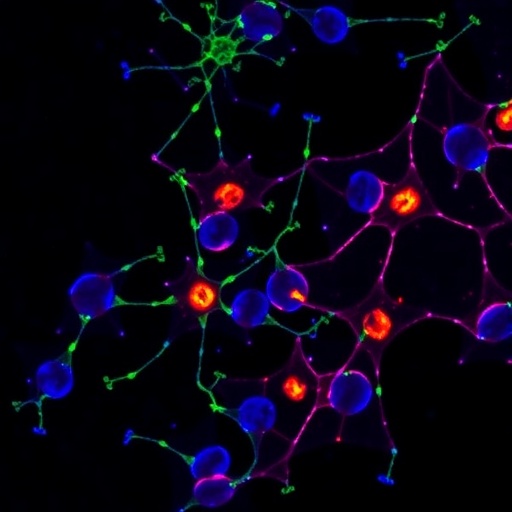
In a groundbreaking study published in Nature Communications, researchers have unveiled the intricate cellular communication network driving the severe inflammatory skin condition known as generalized pustular psoriasis (GPP). This research highlights the pivotal interplay between neutrophils and keratinocytes, orchestrated primarily through IL-36 and TNFSF15 signaling pathways, providing fresh insights into the molecular choreography underpinning one of the most distressing dermatological disorders.
Generalized pustular psoriasis represents a rare yet devastating form of psoriasis characterized by widespread pustule formation, systemic inflammation, and a dramatic impact on patients’ quality of life. While previous studies have implicated immune dysfunction, the precise cellular interactions and signaling networks fueling the relentless inflammatory cascade remained elusive. The new findings published by Jiang et al. unravel these complexities, underscoring the dynamic crosstalk between key immune and skin-resident cells.
At the heart of this discovery lies the identification of a communication axis between neutrophils—an abundant class of innate immune cells—and keratinocytes, which constitute the primary cell type of the epidermis. Neutrophils are typically rapid responders to infection and injury, but their unregulated activation in GPP leads to tissue damage and pustule formation. The study reveals that a critical bidirectional signaling network enables neutrophils and keratinocytes to amplify inflammatory signals exponentially, thus sustaining chronic skin inflammation.
Central to this pathological dialogue are the cytokines IL-36 and TNFSF15. IL-36 members, part of the IL-1 family, have been increasingly recognized as potent inducers of skin inflammation. The research team demonstrated that IL-36 cytokines act as a molecular “switch,” stimulating keratinocytes to produce chemokines and antimicrobial peptides that recruit and activate neutrophils. Concurrently, neutrophils secrete TNFSF15, a member of the tumor necrosis factor superfamily, which reinforces IL-36 expression in keratinocytes, establishing a rigorous feedback loop.
Using a combination of transcriptomic profiling, in vitro co-culture systems, and in vivo psoriatic skin models, the researchers meticulously dissected this cellular conversation. Their data suggest that disrupting either IL-36 or TNFSF15 signaling markedly attenuates neutrophil infiltration and inflammatory damage. This not only consolidates the functional indispensability of this axis but also identifies these molecules as promising therapeutic targets.
From a technical perspective, the research employed single-cell RNA sequencing to delineate cell-type-specific gene expression in psoriatic lesions. This high-resolution approach allowed the team to pinpoint the activation states of neutrophils and keratinocytes and to map the spatial dynamics of cytokine production within the inflamed skin microenvironment. The ability to resolve these interactions at a single-cell level represents a significant methodological advancement in understanding complex tissue inflammation.
Moreover, the investigation extended to exploring downstream signaling cascades initiated by IL-36 and TNFSF15 engagement. Activation of NF-κB and MAPK pathways in keratinocytes was found to be instrumental in propagating the inflammatory phenotype, leading to increased expression of pro-inflammatory mediators and chemotactic factors. These findings consolidate the notion that intracellular signaling triggered by these cytokines is essential for maintaining the inflammatory milieu characteristic of GPP.
The biological implications of this study are profound, especially considering the clinical challenges posed by GPP. Current treatments often rely on broad immunosuppressive agents that carry substantial risks and variable efficacy. The elucidation of the IL-36/TNFSF15 axis paves the way for the development of targeted therapeutics that could selectively interrupt critical inflammatory loops without compromising systemic immunity.
In addition, the work sheds light on the heterogeneity within psoriatic lesions. By resolving the temporal dynamics of neutrophil-keratinocyte interactions, the researchers identified phases where intervention could be particularly effective, such as early neutrophil recruitment or cytokine amplification stages. This temporal dimension adds a layer of sophistication for designing future clinical trials and personalized medicine strategies.
The study also raises intriguing questions about the role of the skin microbiome and environmental triggers in modulating the IL-36/TNFSF15 network. Although the current research focused predominantly on cellular and molecular interactions, the authors speculate that microbial factors or physical insults might initiate or exacerbate the inflammatory crosstalk, further fueling GPP flares. Future investigations integrating microbiology and immunology will be critical to fully understanding disease etiology.
Another key highlight is the reciprocal nature of the neutrophil-keratinocyte dialogue, emphasizing that keratinocytes are far from passive structural cells. Instead, they act as active participants and amplifiers of immune responses through cytokine production and recruitment signals. This paradigm shift has broad implications for other inflammatory skin diseases where similar cellular dynamics might be at play.
The translational potential of targeting the identified cytokine pathways has already attracted attention from pharmaceutical developers. Early-stage clinical trials exploring IL-36 receptor antagonists or TNFSF15 inhibitors could revolutionize GPP management, moving away from generalized immunosuppression toward precise molecular intervention. Such therapies hold promise not only for symptom attenuation but potentially for altering disease course and preventing relapse.
This comprehensive investigation by Jiang and colleagues thus represents a landmark contribution to dermatological immunology. It provides a detailed mechanistic framework that links cell communication networks to clinical manifestations, offering hope for more effective, targeted interventions in generalized pustular psoriasis. One can anticipate that these findings will catalyze further research into cytokine-mediated inflammatory pathways across diverse autoimmune and autoinflammatory conditions.
In conclusion, the discovery of the dynamic neutrophil-keratinocyte communication network centered on IL-36 and TNFSF15 signals a new era in understanding and treating generalized pustular psoriasis. It exemplifies how integrative approaches combining advanced molecular biology techniques and clinical insights can unravel the complexities of chronic inflammation. As this field advances, the prospects for tailored therapies and improved patient outcomes become increasingly attainable.
This research not only deepens our understanding of skin immunopathology but also underscores the intricate nature of cellular dialogue in maintaining tissue homeostasis—or tipping the balance toward disease. By decoding these conversations at the molecular level, scientists herald novel avenues to intercept aberrant inflammation in the skin and potentially beyond.
Cite Scienmag News
Ophelia Keating. (December 23, 2025). Neutrophil-Keratinocyte IL-36 Network Drives Psoriasis Inflammation. Scienmag. https://scienmag.com/neutrophil-keratinocyte-il-36-network-drives-psoriasis-inflammation/
Ophelia Keating. "Neutrophil-Keratinocyte IL-36 Network Drives Psoriasis Inflammation." Scienmag, 23 December 2025, https://scienmag.com/neutrophil-keratinocyte-il-36-network-drives-psoriasis-inflammation/. Accessed 3 September 2026.
Ophelia Keating. "Neutrophil-Keratinocyte IL-36 Network Drives Psoriasis Inflammation." Scienmag. December 23, 2025. https://scienmag.com/neutrophil-keratinocyte-il-36-network-drives-psoriasis-inflammation/


