


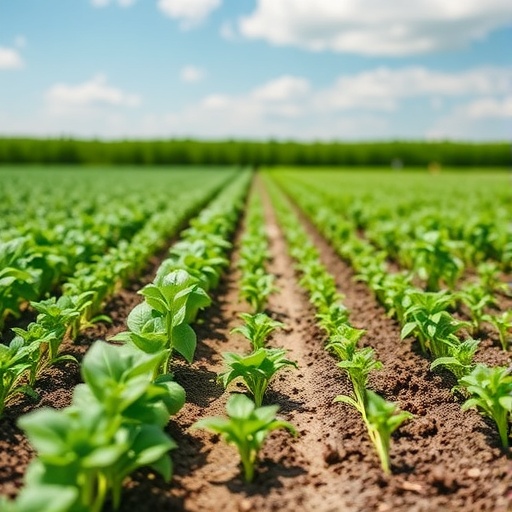
The agricultural landscape is undergoing a significant transformation as researchers dive into sustainable practices that enhance productivity while minimizing environmental harm. In a groundbreaking study led by Saghaï, Smith, Vico, and their team, published in Commun Earth Environ, the researchers explore the intricate relationship between crop rotations and nitrogen losses via denitrification, offering insights that could reshape farming practices globally. This paper sheds light on how diverse crop rotations can serve as a practical solution to mitigate yield-scaled nitrogen losses, which are increasingly becoming a pressing concern across the agricultural sector.
At the core of their research lies the paradox of nitrogen management in modern agriculture. As crop productivity has consistently increased to meet the demands of a growing global population, so too have the volumes of nitrogen fertilizers applied to cultivated soils. However, this rise in nitrogen input has not been without its consequences. Denitrification, a microbial process that converts nitrate into nitrogen gas, often results in substantial nitrogen losses from the soil, diminishing the effectiveness of fertilizers and potentially leading to environmental issues such as waterway eutrophication.
The research team employed a comprehensive method, utilizing field experiments across varying climates and soil types to assess the impact of diverse crop rotations on nitrogen dynamics. By incorporating a multitude of organic and inorganic crops in rotation, the researchers were able to observe measurable differences in nitrogen retention and loss. The results reveal a clear correlation: farms that employed intricate crop rotations experienced significantly lower nitrogen losses when compared to those relying on monocropping practices.
One of the remarkable findings from the study was the identification of specific crop combinations that not only enhanced yields but also improved nitrogen uptake efficiency. For instance, interspersing legumes with cereals fostered a unique soil microbial community that actively participated in nitrogen cycling, leading to a reduction in available nitrates subject to denitrification. This synergy not only bolstered crop health and productivity but also showcased an innovative agronomic strategy that holds the potential to safeguard nitrogen resources.
Moreover, the study highlighted the ecological implications of crop diversity. By reducing reliance on synthetic fertilizers, diverse rotations can diminish the agricultural carbon footprint, contributing to a more sustainable ecosystem. The researchers underscored that a diverse planting strategy not only enhances the resilience of soil health but also supports broader biodiversity, creating habitats for various beneficial organisms that can further aid in nutrient cycling.
As the research team discussed their findings, they emphasized the economic viability of these practices. Farmers often hesitate to replace traditional monoculture systems due to perceived risks and uncertainties associated with new methods. However, the evidence presented reveals that adopting diverse crop rotations can lead to improved yield stability and reduced input costs in the long run. This revelation is essential, particularly in a time when farmers are increasingly feeling the financial strains imposed by fluctuating market prices and environmental regulations.
The implications of the study are far-reaching. In addition to benefitting individual farmers, widespread adoption of diverse crop rotation strategies could contribute to national and global food security. With a focus on sustainable agriculture, these practices have the potential to help countries meet their climate commitments while simultaneously ensuring that food systems remain robust and capable of supporting their populations.
Furthermore, the research opens up vital discussions regarding agricultural policy. Policymakers can drive change by incentivizing sustainable practices through subsidies or grants for farmers who engage in diverse crop rotations. Such incentives could encourage a shift away from conventional farming paradigms, promoting an environmentally friendly approach to agriculture that aligns with both economic and ecological goals.
While the study lays a solid foundation for understanding the benefits of diverse crop rotations, it also raises critical questions about the barriers to adoption. Will farmers be willing to embrace change, particularly in regions where monocropping has been the predominant approach? Local agricultural extension services can play a pivotal role in addressing these concerns by providing training and resources designed to educate farmers about the advantages of crop diversity.
Interestingly, the research suggests that public awareness and education regarding the positive impacts of sustainable agriculture will play a crucial role in facilitating this transition. Engaging consumers about the benefits of produce derived from diverse crop systems could lead to greater demand for such products, providing a market-driven solution that encourages farmers to adopt these practices.
The study’s findings are indeed timely, coinciding with a global push toward sustainable agriculture amid the challenges posed by climate change, dwindling natural resources, and the need for food security. By illustrating that diverse crop rotations can effectively offset nitrogen losses, the research not only provides a solution for enhancing agricultural sustainability but ignites a conversation about the future of farming itself.
In conclusion, the work of Saghaï and colleagues serves as a clarion call for a new vision in agriculture—one that emphasizes ecological balance while maintaining productivity. As the community of scientists and farmers embraces these findings, the hope is that diverse crop rotations will become the norm rather than the exception, paving the way for a resilient and sustainable future in food production.
The sweeping implications of this research provide an optimistic outlook for agriculture, one that illuminates the pathway towards sustainable practices founded on science, innovation, and collaboration. It is now up to the agricultural community, supported by policymakers and educators, to transform these insights into actions that will ensure the vitality of our agricultural systems for generations to come.
Saghaï, A., Smith, M.E., Vico, G. et al. Diverse crop rotations offset yield-scaled nitrogen losses via denitrification.
Commun Earth Environ (2025). https://doi.org/10.1038/s43247-025-03116-0
Cite Scienmag News
Alan Morgan. (December 23, 2025). Diverse Crop Rotations Reduce Nitrogen Losses from Denitrification. Scienmag. https://scienmag.com/diverse-crop-rotations-reduce-nitrogen-losses-from-denitrification/
Alan Morgan. "Diverse Crop Rotations Reduce Nitrogen Losses from Denitrification." Scienmag, 23 December 2025, https://scienmag.com/diverse-crop-rotations-reduce-nitrogen-losses-from-denitrification/. Accessed 3 September 2026.
Alan Morgan. "Diverse Crop Rotations Reduce Nitrogen Losses from Denitrification." Scienmag. December 23, 2025. https://scienmag.com/diverse-crop-rotations-reduce-nitrogen-losses-from-denitrification/


