


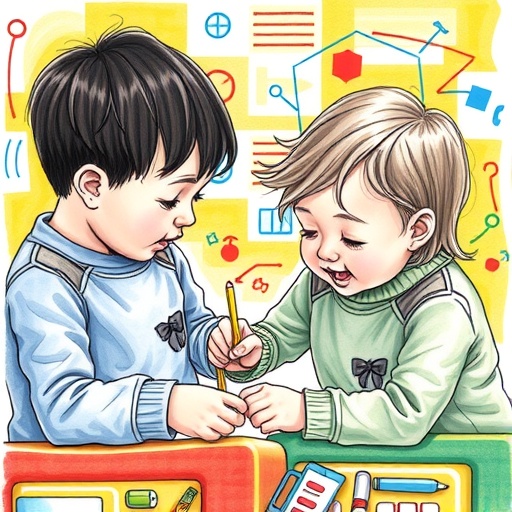
Research has continuously emphasized the interconnected nature of various cognitive processes. Among these, the relationship between language and drawing has emerged as a focal point, particularly in understanding the behaviors and skills of children on the autism spectrum. A further exploration of this relationship promises to shed light on the techniques that educators and caregivers can use to foster communication and creativity. In this context, the study conducted by Servi and Baştuğ provides pivotal insights into how these two domains interact in autistic children, revealing the hidden depths of their capabilities.
The study examines children diagnosed with autism, a neurodevelopmental disorder that significantly affects communication and social interaction skills. Notably, the literature points out that autistic individuals may exhibit divergent styles of communication, leading to unconventional expression modes. This study focuses on how drawing may serve not merely as a creative outlet but as a complementary language, thereby offering children an alternate pathway to convey their thoughts and feelings. Through artistic expression, these children might unlock a form of communication that transcends verbal limitations.
Drawing can often be a therapeutic activity, especially for children on the autism spectrum, who may face challenges in verbalizing emotions. The research highlights that drawing allows children to express complex ideas visually, mitigating the frustration that often accompanies spoken communication barriers. In their art, the children utilize imagery to convey stories, emotions, and experiences, suggesting that drawing plays a substantial role in their cognitive and emotional development. By examining the products of their drawings, one can glean insights into their inner worlds, possibly leading to improved interaction with peers and adults.
The study delves deeper into the structuring of language within the context of drawing. Servi and Baştuğ argue that drawing might facilitate skill acquisition in language through the shared experience and narrative creation. Art provides a unique medium where the child can map visual elements to linguistic properties, encouraging a dialogic interaction between drawing and language. As children articulate their thoughts through their drawings and then narrate these stories, this interplay potentially enhances their verbal skill set.
Furthermore, the paper identifies patterns in how children utilize symbols and structure their drawings when they possess specific linguistic abilities. For instance, children who exhibit advanced language skills might engage in more complex, thematic drawings, interlacing narrative layers that reflect their linguistic capabilities. Conversely, children with more limited verbal skills may create simpler drawings, focusing on basic symbols that represent their immediate feelings. These observations underscore how each child’s artistic expression mirrors their cognitive and linguistic development stages.
Interestingly, the researchers have also noted that children with autism often benefit from activities that merge verbal and non-verbal communication. For instance, incorporating storytelling into drawing activities appears to enhance their engagement and comprehension of language. The outcomes indicate that dynamic interactions combining both verbal narration and visual representation lead to an enriched learning experience, bolstering their language development.
A significant axis of discussion in the study revolves around the potential for utilizing drawing as an educational tool to bridge communication gaps. Its findings could reshape curriculum designs in early childhood educational contexts, advocating for the incorporation of art-based activities as a staple for language development in children on the autism spectrum. The study outlines practical strategies that educators can employ, such as drawing prompts that encourage narrative creation or collaborative storytelling exercises that tap into shared artistic expression.
Moreover, the research highlights the role of caregivers, suggesting that parents and guardians can facilitate this bridge between drawing and language outside a structured educational setting. By providing children with diverse materials and opportunities for free drawing, caregivers foster an environment that supports both artistic exploration and communicative expression. These recommendations aim to encourage parents to engage in conversations about their children’s artwork, seeing the process as a dialogue rather than merely an outcome.
Additionally, the implications of the research extend to the broader scope of disability studies and the understanding of neurodiversity. By reframing the conversation around autism, the study underscores the importance of viewing these children through a lens of capability rather than deficiency. It calls upon society to celebrate their unique methods of expression, which can potentially enrich collective cultural narratives in ways previously unexamined.
Overall, this research from Servi and Baştuğ shines a much-needed light on the correlation between language acquisition and artistic expression in children with autism. It reinforces the idea that drawing can serve as a bridge, enabling meaningful communication pathways. The findings advocate for a more integrated approach to education, therapy, and parenting that embraces multi-modal forms of expression.
The study is likely to stimulate further research exploring various dimensions of the relationship between art and language in neurodiverse populations. As understanding deepens, it could lead to innovative educational practices that not only enhance verbal skills but also celebrate alternative modes of communication, paving the way for more inclusive environments.
In conclusion, the synthesis of drawing and language reveals profound insights into the cognitive worlds of autistic children. The transformative potential from their creative expressions presents a unique opportunity to revolutionize supportive practices across educational settings, reminding us all of the power inherent in diversity of thought and expression. The call to action is clear: we must continue to explore and expand upon these findings, forging a path towards understanding and inclusion for all.
Servi, C., Baştuğ, Y.E. The Relationship Between Language and Drawing in Autism.
Early Childhood Educ J (2025). https://doi.org/10.1007/s10643-025-02096-2
Cite Scienmag News
Courtney Benton. (December 22, 2025). Exploring Language and Drawing Connections in Autism. Scienmag. https://scienmag.com/exploring-language-and-drawing-connections-in-autism/
Courtney Benton. "Exploring Language and Drawing Connections in Autism." Scienmag, 22 December 2025, https://scienmag.com/exploring-language-and-drawing-connections-in-autism/. Accessed 4 September 2026.
Courtney Benton. "Exploring Language and Drawing Connections in Autism." Scienmag. December 22, 2025. https://scienmag.com/exploring-language-and-drawing-connections-in-autism/


