


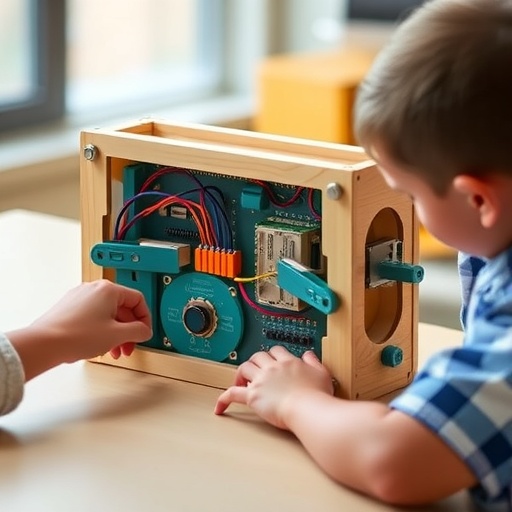
In the rapidly evolving landscape of educational tools, the introduction of innovative methodologies is critical for engaging today’s learners. The latest research presented by Rathor et al. positions FloBlocks as a transformative solution for tangible block programming in educational settings. This novel tool addresses a significant gap in current programming education by offering a budget-friendly and extensible platform that can adapt to a variety of learning environments and needs. As educators and institutions strive to equip students with essential coding skills, FloBlocks emerges as a formidable player in the field, promising to harness the power of physical interactions in teaching complex programming concepts.
The rise of coding as a fundamental skill in the 21st century has prompted educational technologists to search for effective ways to introduce programming to students at a young age. Traditional programming methods often involve abstract concepts that can be challenging for newcomers to grasp. In this context, tangible block programming presents a unique solution by allowing learners to manipulate physical blocks, thus creating a more immersive and hands-on learning experience. Rathor and colleagues have designed FloBlocks to optimize this methodology, offering a highly interactive approach that is likely to captivate and inspire students.
One of the main advantages of FloBlocks lies in its affordability. Educational institutions around the world face budget constraints that can limit their ability to adopt new technologies. With FloBlocks, educators can integrate a comprehensive programming curriculum without breaking the bank. The tool’s cost-effective nature does not compromise its functionality; in fact, it ensures that a diverse range of students can access this invaluable learning resource. Furthermore, affordability ensures that FloBlocks can be deployed across different educational settings, from underfunded schools to advanced institutions.
In addition to its cost-effectiveness, FloBlocks is designed to be extensible. This aspect is crucial in an educational context where curriculum needs may evolve over time. Rathor et al. have ensured that the tool can easily accommodate updates and new features, providing educators with the flexibility to adapt their teaching methods as required. Whether educators wish to integrate new programming languages, tools, or methodologies, FloBlocks can evolve alongside these changes, ensuring it remains relevant and effective for years to come.
The core functionality of FloBlocks is rooted in its tangible block programming interface, which allows students to create programs by physically stacking and connecting blocks. Each block represents a specific programming command or function, and when combined, they create a sequence of instructions that the system can execute. The tactile nature of this approach helps demystify complex programming concepts, enabling students to see the immediate impact of their actions in real time. This hands-on aspect not only fosters understanding but also stimulates students’ critical thinking and problem-solving skills.
Another significant feature of FloBlocks is its ability to cater to a diverse range of learning styles. Recognizing that students learn differently, Rathor et al. have designed the tool to be inclusive and adaptable. Visual learners benefit from seeing the blocks and the relationships between them, while kinesthetic learners engage through the physical manipulation of the blocks. Additionally, auditory learners can benefit from verbal instructions and feedback generated by the system. By accommodating various learning styles, FloBlocks enhances the educational experience for all students, fostering an environment where every learner can thrive.
Furthermore, FloBlocks encourages collaboration among students, which is a vital component of effective learning. In many educational settings, a collaborative approach can lead to enhanced understanding and retention of knowledge. With FloBlocks, students can work in small groups to construct programs, negotiate solutions, and critique each other’s work. This collaborative environment fosters communication skills, teamwork, and social interaction—key competencies that will serve students well in their future careers.
The researchers also focus on the importance of feedback in the learning process. FloBlocks includes features that provide instant feedback to students as they build their programs. This immediate reinforcement allows learners to understand what works and what doesn’t in real-time, thereby increasing their engagement and motivation. The integration of immediate feedback into the educational experience provides crucial support for learners, enabling them to adjust their approaches and learn from their mistakes swiftly.
The research also delves into the integration of FloBlocks with other educational resources and platforms. In today’s interconnected world, the ability to blend different tools and technologies is vital. Rathor et al. have made FloBlocks compatible with various software programs, allowing educators to create a cohesive digital ecosystem for learning. This adaptability enhances FloBlocks’ utility, making it a valuable addition to any curriculum that aims to prepare students for a technology-driven future.
Additionally, this research highlights the scalability of FloBlocks—its design can be implemented in classrooms of differing sizes and types. Whether in a small after-school program or a large academic institution, FloBlocks can easily adjust to the number of students and available space. This adaptable scalability ensures that educators can utilize FloBlocks effectively in a variety of contexts, further enhancing its role as a dynamic educational tool.
The frictionless integration of FloBlocks into existing curricula signifies a shift towards more hands-on, engaging programming education. As digital literacy becomes an increasingly important requirement in the job market, tools like FloBlocks will play a crucial role in equipping students with the skills necessary to excel in a tech-savvy world. By making programming accessible, enjoyable, and productive, Rathor et al. believe FloBlocks can revolutionize the way programming is taught in schools.
As we look to the future, the impact of tools like FloBlocks on education cannot be overstated. Their role in making programming concepts approachable for younger generations opens up new pathways for learning that transcend traditional educational boundaries. In this rapidly changing landscape, FloBlocks serves as a beacon of possibility, heralding a future where every student has access to the skills and knowledge needed to succeed in a digital age.
In conclusion, the research surrounding FloBlocks highlights the importance of innovation in educational technology. The combination of affordability, extensibility, tangible interaction, and collaborative features positions FloBlocks as a transformative tool in programming education. As educators adopt this revolutionary resource, we witness the potential for a generation of learners prepared to thrive in an increasingly complex, tech-driven world. The implications of FloBlocks extend far beyond individual classrooms, impacting the broader educational sphere and encouraging the development of more inclusive, engaging, and effective learning environments.
As the landscape of education continues to evolve, tools like FloBlocks will be essential in ensuring that students not only learn but also embrace the excitement of programming and coding. With an emphasis on hands-on learning and adaptability, the future of educational programming looks brighter than ever with solutions like FloBlocks leading the way.
Rathor, D., Mehta, G., Lad, A. et al. FloBlocks: an affordable and extensible tool for tangible block programming in education.
Discov Educ (2025). https://doi.org/10.1007/s44217-025-01064-7
Cite Scienmag News
Courtney Benton. (December 22, 2025). Affordable Tangible Programming Tool Revolutionizes Education. Scienmag. https://scienmag.com/affordable-tangible-programming-tool-revolutionizes-education/
Courtney Benton. "Affordable Tangible Programming Tool Revolutionizes Education." Scienmag, 22 December 2025, https://scienmag.com/affordable-tangible-programming-tool-revolutionizes-education/. Accessed 4 September 2026.
Courtney Benton. "Affordable Tangible Programming Tool Revolutionizes Education." Scienmag. December 22, 2025. https://scienmag.com/affordable-tangible-programming-tool-revolutionizes-education/


