


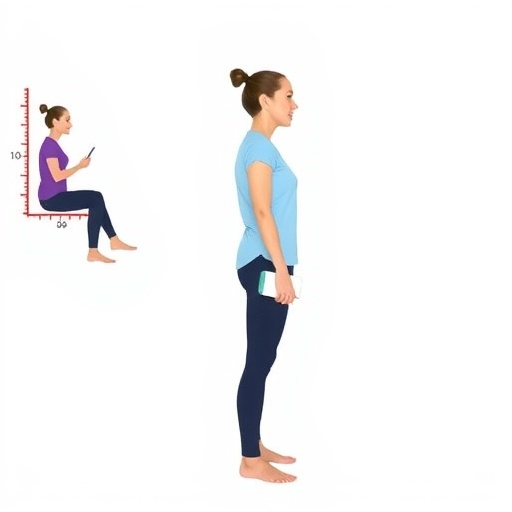
In an era of technological advancement, the integration of smartphones into healthcare has opened up new avenues for monitoring and assessing patient functionality. A recent study has explored this frontier by examining the utilization of a common smartphone to analyze the Chair Sit-to-Stand Test (CSTST), a fundamental measure of mobility and physical function, particularly among elderly individuals. The researchers, led by A. Sher, M. Rashid, and A. Lotfi, present compelling evidence on how cycle metrics and strategy detection can transform the landscape of automated physical assessments.
Recognizing the increasing incidence of mobility impairments in aging populations, the researchers turned their attention to the Chair Sit-to-Stand Test, a pivotal evaluation that offers insights into a person’s lower-limb strength and overall balance. The traditional execution of this test typically requires time-consuming observation and expert analysis, which can be burdensome in clinical settings. By leveraging smartphone technology, the study aims to simplify this process while improving accuracy and efficiency in real-time assessments.
The methodology deployed in this research is both innovative and effective, utilizing the built-in sensors of smartphones to capture vital motion data during the CSTST. The smartphone’s accelerometer and gyroscope play crucial roles in monitoring the angular velocity and acceleration of the sitting and standing movements. By analyzing this data, researchers can discern patterns that correlate with different performance strategies adopted by individuals during the test. This not only grounds the analysis in algorithmic precision but also highlights the potential for widespread application in various healthcare settings.
Cycle metrics formed an integral part of the analysis framework. These metrics encompass elements such as duration, timing, and the dynamics of each sit-to-stand action. By quantifying these aspects, the study delineates how variations in individual performance can be systematically categorized. For instance, faster transitions may signify better strength and balance, whereas prolonged periods can indicate potential mobility issues or muscular weakness. This granularity of data empowers clinicians to make better-informed decisions.
In addition to cycle metrics, the research emphasizes the necessity of strategy detection in enhancing the reliability of mobility assessments. Each test-taker exhibits unique strategies when performing the CSTST, influenced by their physical condition and psychological state. By employing sophisticated algorithms to map these strategies, the smartphone application can automatically classify movements, alerting practitioners to possible concerns about a patient’s health and eliminating subjective biases often associated with manual assessments.
One of the most notable advantages of utilizing smartphone technology in this context is scalability. The widespread ownership of smartphones offers an unprecedented opportunity for mass screening of mobility issues. Health professionals could deploy this application in various settings, from hospitals to rehabilitation centers, even extending its utility for home-based assessments. This flexibility could significantly reduce healthcare costs while promoting early detection of mobility problems and ultimately leading to timely interventions.
These developments resonate with the ongoing shift toward patient-centered care. By empowering individuals to take control of their mobility assessments through tools they are familiar with, there is potential for improved patient engagement and adherence to rehabilitation protocols. The research posits that when patients have immediate feedback on their performance, they may become more proactive in addressing their health concerns, affirming the crucial link between technology and behavioral change.
The implications of this research extend beyond mere mobility assessments. The methodologies outlined could serve as templates for monitoring numerous other physical tasks, thereby expanding the smartphone’s role in ongoing health tracking. In particular, the ability to assess functional capacity in conditions such as post-surgery recovery, chronic disease management, and even sports rehabilitation could redefine how we approach health diagnostics.
Moreover, the relatively low cost of smartphone technology compared to traditional medical equipment makes this solution particularly appealing for resource-limited settings. Public health initiatives aimed at enhancing physical activity levels among aging populations could benefit substantially from this approach. Whether through community programs or elder care residences, leveraging smartphones as diagnostic tools could foster a culture of health awareness and active living.
As the study points to the future of health assessments, it also underscores challenges to be addressed. Potential issues such as data privacy, the need for robust validation in diverse populations, and the proper training of healthcare professionals in interpreting smartphone-generated data must be carefully navigated. Continuous refinement of the algorithms used in the application will also be essential to ensure accuracy in dynamic real-life settings.
The authors of the study are optimistic about the integration of such technology into clinical practice. They envision a holistic healthcare environment where data collected through smartphones not only aids in mobility assessments but forms part of a broader digital health ecosystem. This interconnectedness could pave the way for more integrated approaches in managing various health conditions, ultimately enhancing overall patient outcomes.
In conclusion, the exploration of cycle metrics and strategy detection for automated Chair Sit-to-Stand Test analysis using a single smartphone stands at the cutting edge of biomedical engineering. This promising research encapsulates the dynamic interplay between technology and healthcare, offering a glimpse into a future where mobility assessments are not just feasible but efficient and empowering. With further research and community engagement, this innovation could herald a new era in preventive healthcare, enhancing the well-being of countless individuals around the world.
Sher, A., Rashid, M., Lotfi, A. et al. Cycle Metrics and Strategy Detection for Automated Chair Sit-to-Stand Test Analysis Employing a Single Smartphone.
Ann Biomed Eng (2025). https://doi.org/10.1007/s10439-025-03943-4
Cite Scienmag News
Ophelia Keating. (December 22, 2025). Automated Sit-to-Stand Test Analysis Using Smartphone Metrics. Scienmag. https://scienmag.com/automated-sit-to-stand-test-analysis-using-smartphone-metrics/
Ophelia Keating. "Automated Sit-to-Stand Test Analysis Using Smartphone Metrics." Scienmag, 22 December 2025, https://scienmag.com/automated-sit-to-stand-test-analysis-using-smartphone-metrics/. Accessed 3 September 2026.
Ophelia Keating. "Automated Sit-to-Stand Test Analysis Using Smartphone Metrics." Scienmag. December 22, 2025. https://scienmag.com/automated-sit-to-stand-test-analysis-using-smartphone-metrics/


