


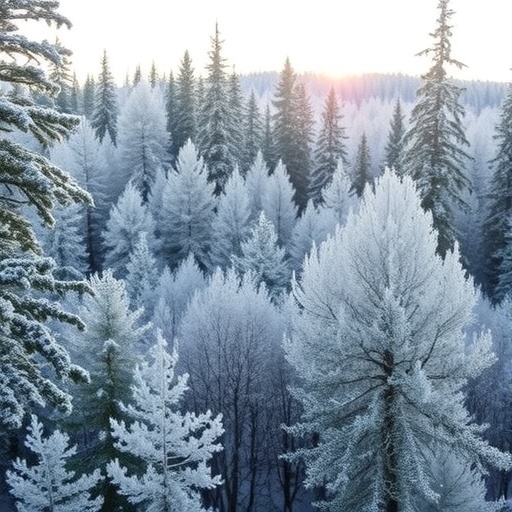
In a groundbreaking new study published in Nature Communications, researchers have unveiled compelling evidence that continuous frost events inflict significantly greater damage on forest growth across the Northern Hemisphere than isolated frost episodes. This revelation not only deepens our understanding of how climatic stressors affect terrestrial ecosystems but also raises urgent questions about forest resilience and carbon cycling in the face of ongoing climate variability.
Forests cover vast expanses of the Northern Hemisphere and serve as critical carbon sinks, mitigating the accumulation of greenhouse gases in the atmosphere. The integrity of their growth cycles is intimately tied to climatic conditions, including temperature fluctuations that dictate seasonal rhythms. Frost, characterized by temperatures dropping below the freezing point, disrupts physiological processes in trees, particularly during vulnerable phases such as leaf emergence and cambial activity.
Previous research primarily concentrated on isolated frost events—singular cold snaps that occur sporadically and impose limited stress on vegetation. However, the study led by Yang, Tao, Chen, and their colleagues shifts the paradigm by meticulously analyzing the cumulative impacts of continuous frost—prolonged sequences of freezing conditions without significant reprieve. Their work systematically compares growth responses across diverse forest types and geographies, leveraging satellite data, dendrochronology, and climate records over multiple decades.
By integrating high-resolution spatiotemporal datasets, the team identified that continuous frost episodes trigger a cascade of physiological disruptions far more severe than those caused by occasional frost. Continuous exposure to subzero temperatures compromises photosynthetic capacity by damaging chloroplast membranes and inhibiting stomatal function. Moreover, sustained frost constrains water uptake by roots due to soil freezing, exacerbating drought-like conditions internally even when external moisture is sufficient.
At the cellular level, frost-induced ice formation within tissues causes mechanical injury and cellular rupture, which continuous frost worsens by hindering repair mechanisms. As a result, trees undergo prolonged periods of metabolic slowdown, reducing carbon assimilation and growth increment. The study highlights that during multiple consecutive frost days, the cumulative stress surpasses a critical threshold beyond which recovery becomes protracted and growth deficits accumulate year after year.
The investigators employed dendrochronological techniques to analyze tree ring widths as proxies for historical growth trends, correlating these with frost event patterns derived from meteorological data. Their results demonstrate a marked decline in annual radial growth aligned specifically with periods characterized by continuous frost, whereas years with isolated frost events showed relatively minor growth impact. This pattern was consistent across coniferous and deciduous forests situated in boreal and temperate zones.
In addition to physiological and growth repercussions, the authors emphasize ecological consequences. Forests subjected to repeated continuous frost events exhibit increased vulnerability to pest outbreaks and secondary infections, as frost-damaged tissues create entry points for pathogens. This compound stress could shift forest composition over longer timescales, favoring frost-tolerant or generalist species over more vulnerable taxa, potentially altering biodiversity and ecosystem function.
From a climate feedback perspective, reduced forest growth implies diminished carbon sequestration capacity, which may in turn accelerate atmospheric CO2 accumulation, feeding into a vicious cycle of climate change and increased frost variability. The study calls for incorporating these nuanced frost impacts into predictive models that forecast forest carbon dynamics and climate interactions, a gap hitherto underappreciated.
Importantly, this research has implications for forest management and conservation strategies. Understanding the heightened risk posed by continuous frost can inform adaptive practices such as assisted species migration, selective breeding for frost resistance, and targeted silvicultural interventions designed to bolster resilience. Such measures will be critical to maintaining forest health and ecosystem services in an era of intensified climatic disturbances.
Furthermore, the findings underscore the need for enhanced monitoring infrastructures capable of detecting frost event patterns at finer temporal scales. Remote sensing technologies, coupled with ground-based observations, provide a powerful toolkit for real-time assessment and early-warning systems that can mitigate damage by informing timely interventions.
The study also opens avenues for exploring the mechanistic underpinnings of frost tolerance among different tree species, facilitating genetic and molecular biology approaches to identify key traits associated with frost resilience. Insight into gene expression changes and protective biochemical pathways activated during continuous frost exposures could pave the way for biotechnological innovations.
In conclusion, the novel evidence presented by Yang and colleagues compellingly redefines our perception of frost impact on Northern Hemisphere forests. By highlighting the disproportionately detrimental effect of continuous frost relative to isolated frost episodes, this work prompts a reevaluation of ecological vulnerability in the context of climate change. It challenges scientists, policymakers, and forest managers alike to prioritize strategies that acknowledge the complex and cumulative nature of frost stress for sustaining forest ecosystems and their invaluable contributions to global environmental stability.
Cite Scienmag News
Violet Maxwell. (December 21, 2025). Continuous Frost Reduces Northern Forest Growth More. Scienmag. https://scienmag.com/continuous-frost-reduces-northern-forest-growth-more/
Violet Maxwell. "Continuous Frost Reduces Northern Forest Growth More." Scienmag, 21 December 2025, https://scienmag.com/continuous-frost-reduces-northern-forest-growth-more/. Accessed 3 September 2026.
Violet Maxwell. "Continuous Frost Reduces Northern Forest Growth More." Scienmag. December 21, 2025. https://scienmag.com/continuous-frost-reduces-northern-forest-growth-more/


