


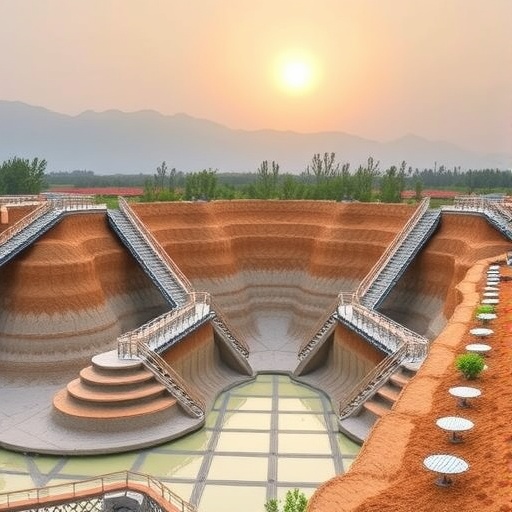
In a groundbreaking study, researchers from China have revealed that ecological restoration initiatives in the Mu Us Sandyland are effectively reversing terrestrial water storage losses. This significant finding holds remarkable implications for water management strategies in arid and semi-arid regions around the globe. The research team, led by Zhou, H., Sun, Y., and Chen, J., has provided compelling evidence that concerted efforts in ecological rehabilitation can yield positive outcomes, even in ecosystems previously believed to be on a path of irreversible degradation.
The Mu Us Sandyland has long been recognized as a fragile ecosystem, characterized by its sandy terrain and challenging climatic conditions. Over the decades, human activities such as overgrazing, deforestation, and land-use changes have contributed to substantial declines in terrestrial water storage. The ramifications of this loss are profound, affecting not only the local biodiversity but also the livelihoods of communities that depend on natural resources. Recognizing these challenges, the Chinese government, along with various stakeholders, has initiated extensive ecological restoration programs aimed at rehabilitating the landscape.
At the core of this research is the innovative application of ecological restoration techniques. The study analyzed the effectiveness of various methods, including afforestation, controlled grazing, and the re-establishment of native vegetation, in enhancing water retention capabilities of the land. By restoring vegetation cover, the researchers observed improved soil structure and moisture retention, which consequently increased terrestrial water storage. This revitalization of the soil ecosystem is crucial for mitigating adverse effects caused by climate change and human activities.
Long-term monitoring of the Mu Us Sandyland has provided the research team with invaluable data. Through the use of remote sensing technology and ground-based measurements, they were able to quantify changes in terrestrial water storage over the course of the restoration projects. The findings indicate a significant increase in water storage capacity, illustrating that thoughtfully designed ecological interventions can produce measurable benefits in a relatively short time frame. This trend is encouraging, particularly in light of the escalating challenges posed by desertification and water scarcity.
One key aspect of the study is the identification of the mechanisms driving the restoration effects. The researchers noted that increased vegetation not only enhances water infiltration but also reduces surface runoff, leading to greater groundwater recharge. This interconnectedness highlights the importance of a holistic approach to ecosystem management, where each component of the environment contributes to overall water security. Such insights are critical for guiding future restoration efforts, ensuring they are rooted in scientific understanding and adaptive management practices.
Further, the study underscores the socio-economic benefits of ecological restoration. By improving water availability, the researchers anticipate a positive impact on local agricultural practices, which could bolster food security and enhance the livelihoods of community members reliant on farming. The ability to harness natural resources sustainably aligns with the broader objectives of sustainable development, particularly in regions facing acute water stress. The implications of these findings beckon policymakers to acknowledge the value of ecological restoration as a viable solution to environmental degradation.
The research also raises important questions about the scalability of such restoration projects. While the Mu Us Sandyland showcases promising results, extrapolating these findings to other dryland regions necessitates further investigation. Different regions may exhibit unique climatic and geological conditions that could influence restoration outcomes. As such, the research team advocates for localized studies to tailor restoration practices effectively, ensuring the best fit for specific environmental contexts.
Moreover, the technological advancements in monitoring and data collection used in this study present a model for future research. Utilizing tools such as satellite imagery and geographic information systems (GIS) allows for comprehensive assessments of ecological changes over time. This methodological framework could pave the way for more extensive studies that involve diverse ecosystems around the world, thereby promoting a global dialogue on best practices for ecological restoration.
The urgency of addressing water scarcity cannot be overstated, particularly in the face of climate change which threatens to exacerbate existing vulnerabilities. The Mu Us Sandyland serves as an example of how proactive restoration initiatives can transform landscapes and enhance natural resources. Consequently, the researchers call for increased investments in similar ecological endeavors, urging governments, NGOs, and private sectors to collaborate towards achieving sustainable ecological outcomes.
In conclusion, the evidence provided by Zhou, H., Sun, Y., and Chen, J. reinforces the notion that ecological restoration should be a cornerstone of environmental policy. The results from the Mu Us Sandyland illustrate the potential for restoring ecosystems to play a critical role in improving water storage, enhancing biodiversity, and supporting human livelihoods. As the global community grapples with the dual crises of biodiversity loss and water insecurity, the lessons from this research can provide vital guidance in shaping a more sustainable future.
Furthermore, as ecosystems continue to feel the pressure of anthropogenic stresses, the importance of restoring balance within these systems becomes ever more critical. The interplay between plant communities and water cycles is a delicate one, and the restoration of natural processes may serve as both a remedy and a safeguard against impending environmental challenges.
In essence, the pathway to ecological health hinges upon our willingness to learn and adapt. As we stand at this crossroads, the findings emerging from the Mu Us Sandyland could reverberate through scientific and policy circles alike, encouraging a renewed commitment to ecological restoration efforts that address not only the symptoms but also the root causes of environmental decline.
In a world where the consequences of ecological neglect are becoming increasingly apparent, embracing the ethos of restoration could spark a much-needed paradigm shift. The homage to nature’s resilience serves as a reminder that healing our planet is indeed possible, and ecological restoration could be the key to unlocking a sustainable future.
This research serves as an urgent clarion call for a comprehensive reassessment of our environmental strategies. If we are to safeguard our planet for future generations, it is imperative that we recognize the intrinsic value of healthy ecosystems and invest in their restoration and preservation at every opportunity.
Cite Scienmag News
Violet Maxwell. (December 21, 2025). Restoration Boosts Water Storage in China’s Mu Us Sandyland. Scienmag. https://scienmag.com/restoration-boosts-water-storage-in-chinas-mu-us-sandyland/
Violet Maxwell. "Restoration Boosts Water Storage in China’s Mu Us Sandyland." Scienmag, 21 December 2025, https://scienmag.com/restoration-boosts-water-storage-in-chinas-mu-us-sandyland/. Accessed 4 September 2026.
Violet Maxwell. "Restoration Boosts Water Storage in China’s Mu Us Sandyland." Scienmag. December 21, 2025. https://scienmag.com/restoration-boosts-water-storage-in-chinas-mu-us-sandyland/


