


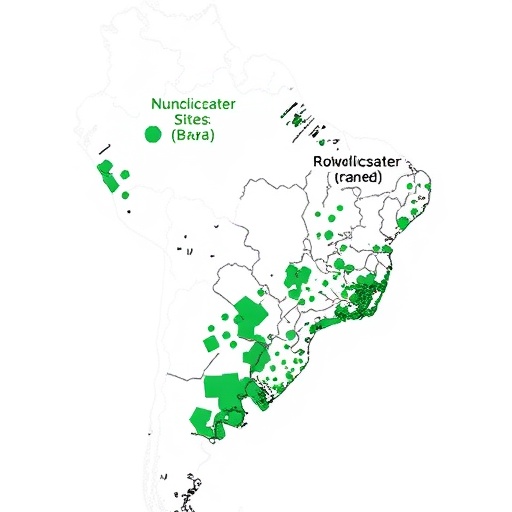
Groundwater contamination by chlorinated solvents presents a formidable challenge worldwide, and Brazil stands at a pivotal crossroads in addressing this environmental crisis. Recent comprehensive research has unveiled critical insights into the management of groundwater systems tainted by these hazardous substances, offering a beacon of hope for safeguarding public health and natural ecosystems. The study spearheaded by Pino and colleagues delves into the multifaceted issues surrounding chlorinated solvent pollution across Brazil, dissecting both the technical complexities and strategic responses that frame this enduring problem.
Chlorinated solvents such as trichloroethylene (TCE), perchloroethylene (PCE), and carbon tetrachloride (CTC) have long been employed in industrial activities ranging from degreasing to chemical manufacturing. Their persistence and toxicity have led to widespread groundwater contamination, especially in regions with intensive industrial legacies. Brazil’s extensive industrial development, coupled with often lagging environmental regulation enforcement, has culminated in significant contamination hotspots. These substances, known for their resistance to natural degradation, infiltrate aquifers and impose severe risks to water quality, posing threats not just to ecosystems but also to millions of people dependent on groundwater for domestic use.
The article provides an in-depth overview of the sources, pathways, and fate of chlorinated solvents in Brazil’s subsurface environments. It unveils the challenges posed by the complex hydrogeological settings found throughout the country—from fractured bedrock aquifers in the southeast to alluvial deposits in the Amazon basin. Each of these environments reacts differently to contamination, influencing how pollutants move and how remediation technologies must be tailored. Such variability complicates the establishment of universal management protocols and requires site-specific, scientifically informed approaches grounded in hydrogeological expertise.
Central to the study is an exploration of existing management strategies and remediation efforts implemented in Brazil. Traditional pump-and-treat methods, often the frontline defense, have shown limited long-term success in many instances due to the tenacity of chlorinated solvents and their tendency to generate dense non-aqueous phase liquid (DNAPL) zones that are difficult to fully eradicate. The authors emphasize the need for integrated remediation approaches combining physical, chemical, and biological techniques customized to the unique contamination dynamics of each site.
Emerging technologies such as in situ chemical oxidation (ISCO) and enhanced bioremediation are gaining traction within Brazil’s environmental management community. ISCO involves injecting strong oxidants directly into the contaminated zones, accelerating the breakdown of solvents into harmless byproducts. Similarly, bioremediation leverages indigenous or engineered microbial populations capable of reductive dechlorination to degrade contaminants anaerobically. Both methods offer promising avenues to overcome the limitations of conventional strategies, yet their deployment requires rigorous site characterization and monitoring to assure efficacy and avoid unintended consequences.
The study further underscores the critical importance of robust regulatory frameworks and institutional capacities in tackling groundwater contamination. Brazil’s environmental agencies face the daunting task of harmonizing industrial development objectives with public health imperatives while navigating complex political, economic, and social landscapes. The research highlights gaps in monitoring networks, enforcement mechanisms, and inter-agency coordination that often hinder comprehensive management. Strengthening these institutional pillars is essential to transforming scientific knowledge into actionable policies and ensuring long-term sustainability of water resources.
Community engagement emerges as a vital component in the remediation journey. In numerous regions impacted by chlorinated solvent contamination, local populations lack awareness of the risks or access to alternative water sources. The research advocates for environmental education, transparent communication, and participatory decision-making processes to empower affected communities. Moreover, incorporating traditional knowledge and local experiences can enrich scientific assessments and foster collaborative stewardship of groundwater resources.
Interdisciplinary collaboration stands out as another cornerstone highlighted by the authors. Addressing chlorinated solvent pollution transcends the boundaries of geosciences, chemistry, and engineering, demanding contributions from public health experts, social scientists, economists, and policymakers. The integration of diverse expertise facilitates holistic evaluations of contamination impacts and optimizes resource allocation for remediation efforts. The study calls for intensified partnerships between academia, government, industry, and civil society to co-develop innovative solutions.
Quantitative modeling of contaminant transport and fate plays a pivotal role in managing these complex sites. Advanced numerical models simulating the subsurface behavior of chlorinated solvents enable predictions of plume evolution, risk assessments, and evaluations of remediation outcomes. The research illuminates recent advances in modeling approaches tailored to Brazil’s hydrogeological contexts, integrating site-specific data on geology, hydrology, and contaminant chemistry. These tools are indispensable for proactive decision-making and adaptive management in dynamic environmental conditions.
One particularly compelling aspect of the study is the examination of legacy contamination and its protracted impacts. Many industrial sites were contaminated decades ago, and solvents have persisted in aquifers through slow desorption and diffusion processes. Legacy pollution not only burdens contemporary environmental management efforts but also complicates future land use planning and economic development. The authors stress the necessity of long-term monitoring programs and the implementation of sustainable remediation goals that consider both immediate risk reduction and future aquifer recovery trajectories.
In addition to emphasizing Brazilian case studies, the research contextualizes these challenges within global perspectives. Lessons drawn from international remediation projects reveal common hurdles and successes that can inform Brazil’s evolving groundwater management paradigms. This global outlook fosters knowledge exchange on emerging technologies, governance models, and community involvement practices, enriching Brazil’s capacity to confront its chlorinated solvent contamination crisis with tested and innovative strategies.
The economic dimensions of groundwater contamination management also receive considerable attention. Remediation typically entails significant costs, and the allocation of financial resources often reflects competing priorities. The authors probe into cost-benefit analyses and funding mechanisms, advocating for frameworks that balance economic feasibility with environmental and public health benefits. Investing in prevention and early intervention is portrayed as a prudent approach to minimizing long-term liabilities and ensuring equitable access to clean water.
Furthermore, the research advocates for the incorporation of emerging data science and remote sensing technologies to enhance contamination detection and monitoring. High-resolution spatial data and real-time sensor networks offer unprecedented capabilities for tracking pollutant behavior and ecosystem responses. These cutting-edge tools provide timely insights that can drive more agile and informed management decisions, streamlining remediation projects and reducing uncertainties associated with subsurface investigations.
The study culminates with a call for national-level strategies that integrate scientific advances, policy reforms, and community participation. It envisions a future in which Brazil not only addresses the current ramifications of chlorinated solvent contamination but also establishes resilient groundwater management systems capable of adapting to evolving environmental and societal demands. By fostering science-based governance, cross-sector collaborations, and public engagement, the country can transform a daunting environmental challenge into an opportunity for sustainable water stewardship.
This groundbreaking overview by Pino et al. thus marks a significant milestone in environmental science, offering a comprehensive roadmap to confront one of Brazil’s most pressing groundwater contamination issues. It serves as an inspiring model for other nations grappling with similar legacies of hazardous pollution. As societies worldwide strive to balance industrial advancement with environmental preservation, the insights from Brazil’s experience amplify the global discourse on protecting vital groundwater resources from insidious chlorinated solvents for generations to come.
Cite Scienmag News
Violet Maxwell. (December 19, 2025). Groundwater Management of Chlorinated Solvent Sites in Brazil. Scienmag. https://scienmag.com/groundwater-management-of-chlorinated-solvent-sites-in-brazil/
Violet Maxwell. "Groundwater Management of Chlorinated Solvent Sites in Brazil." Scienmag, 19 December 2025, https://scienmag.com/groundwater-management-of-chlorinated-solvent-sites-in-brazil/. Accessed 4 September 2026.
Violet Maxwell. "Groundwater Management of Chlorinated Solvent Sites in Brazil." Scienmag. December 19, 2025. https://scienmag.com/groundwater-management-of-chlorinated-solvent-sites-in-brazil/


