


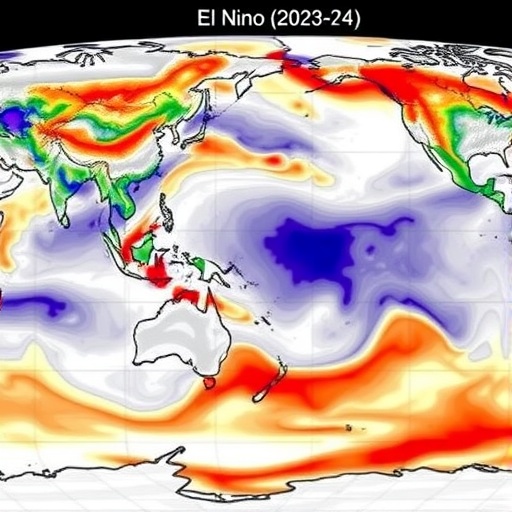
In a groundbreaking analysis published in Commun Earth Environ, researchers led by Ning Jiang have revealed significant insights related to the atypical warming pattern observed during the potent El Niño event of 2023-2024. This research is particularly notable as it identifies the ways in which this intense El Niño phenomenon is expected to catapult global temperatures beyond the critical threshold of 1.5°C above pre-industrial levels. As climate change continues to dominate scientific discourse, this work adds another layer of urgency to our understanding of El Niño’s role in global climate dynamics.
The El Niño Southern Oscillation (ENSO) is a natural climate pattern that drastically affects atmospheric and oceanic conditions worldwide. Historically, strong El Niño events have been associated with significant global temperature increases, but this specific occurrence exhibits atypical characteristics that warrant closer examination. Jiang’s research emphasizes that the warming observed in the current El Niño is not merely a repeat of past events. Instead, it presents a unique amalgamation of climate variables that could signal a new era of global climatic conditions.
Located at the center of this discussion is the 2023-2024 El Niño episode, which is characterized by unusually high sea surface temperatures in the central and eastern Pacific Ocean. These temperature anomalies are not only significant in magnitude but also in their spatial extent. Sociopolitical responders and climate scientists alike have turned their attention to the potential long-term impacts of these temperature variations on weather patterns, ecosystems, and human health across the globe.
In examining the current El Niño, researchers have discovered that its warming pattern deviates considerably from typical cycles. A notable aspect of this El Niño event is its interplay with ongoing climate change, making its implications particularly startling. In a world that has already warmed by approximately 1.2°C since pre-industrial times, an additional spike driven by this El Niño could lead to unforeseen consequences. The study anticipates further connections between this climatic event and extreme weather patterns, exacerbating issues such as droughts, floods, and tropical storms.
The research team utilized a combination of historical climate data, satellite observations, and advanced climate models to assess the effects of the 2023-2024 El Niño. Their results indicate that the current event not only aligns with existing climate patterns but also introduces new variables that complicate predictions for future climate scenarios. For instance, the team’s models suggest that the intensity and duration of this El Niño could overshadow previous events, leading to a record high in global temperature averages.
Moreover, the findings have implications for global climate policies, underscoring the necessity for heightened preparedness and adaptive strategies as the world grapples with climate change. As global temperatures inch closer to the 1.5°C mark, policymakers are urged to consider the far-reaching impacts of a strong El Niño. The research underlines that without substantial reductions in greenhouse gas emissions, we may surpass this threshold more frequently, increasing the likelihood of severe climate repercussions.
The study also discusses the potential socio-economic impacts of the El Niño anomaly. From agricultural productivity declines to increased risks of natural disasters, the consequences could ripple across sectors and populations worldwide. Rural economies, heavily reliant on predictable weather patterns, may face unprecedented challenges, including crop failures and water scarcity. As scientists project warmer global temperatures driven by this El Niño, the potential for geopolitical tensions surrounding resources increases significantly.
Furthermore, the researchers stress the importance of continued monitoring and research efforts. They argue that understanding the dynamics of events like El Niño is crucial for creating effective climate adaptation strategies. Continued investment in climate science is essential to unravel the complexities of these phenomena. More comprehensive approaches will not only improve the accuracy of climate forecasts but will also offer insights that can be utilized by governments and organizations in risk management.
In conclusion, the atypical warming pattern associated with the 2023-2024 El Niño serves as a stark reminder of the intricate relationship between natural climate variability and anthropogenic climate change. The research conducted by Jiang and colleagues provides compelling evidence that this El Niño could redefine climate norms and challenge existing thresholds for global action. Moving forward, a keen understanding of these dynamics will be indispensable in combating the challenges that lie ahead, framing a crucial conversation at the intersection of climate science, environmental stewardship, and sustainable development.
As humanity stands on the brink, faced with the potential to witness unprecedented climate outcomes, the findings of this study will undoubtedly shape our understanding of the relationship between natural climate phenomena and long-term global temperature trajectories.
Cite Scienmag News
Violet Maxwell. (December 17, 2025). 2023-24 El Niño Drives Global Temperatures Higher. Scienmag. https://scienmag.com/2023-24-el-nino-drives-global-temperatures-higher/
Violet Maxwell. "2023-24 El Niño Drives Global Temperatures Higher." Scienmag, 17 December 2025, https://scienmag.com/2023-24-el-nino-drives-global-temperatures-higher/. Accessed 3 September 2026.
Violet Maxwell. "2023-24 El Niño Drives Global Temperatures Higher." Scienmag. December 17, 2025. https://scienmag.com/2023-24-el-nino-drives-global-temperatures-higher/


