

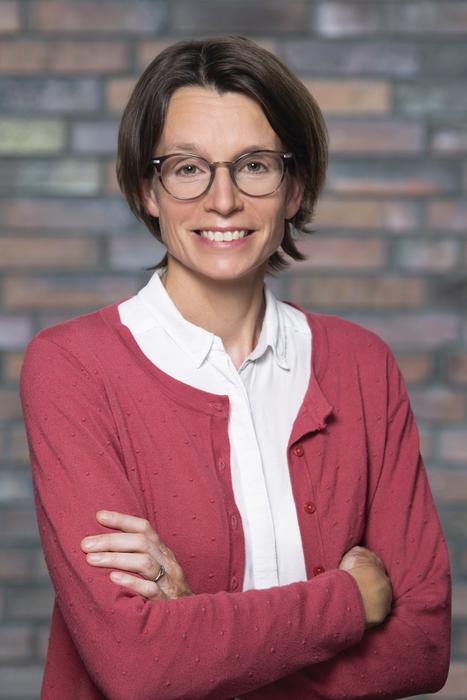
How can artificial intelligence and machine learning be used for innovative research in the field of soft matter? Frauke Gräter, the current Head of the Molecular Biomechanics group at the Heidelberg Institute for Theoretical Studies (HITS) and Professor of Molecular Biomechanics at Heidelberg University, will research these and other topics as the new Director at the MPI for Polymer Research starting July 1, 2024.

Credit: © HITS
How can artificial intelligence and machine learning be used for innovative research in the field of soft matter? Frauke Gräter, the current Head of the Molecular Biomechanics group at the Heidelberg Institute for Theoretical Studies (HITS) and Professor of Molecular Biomechanics at Heidelberg University, will research these and other topics as the new Director at the MPI for Polymer Research starting July 1, 2024.
Frauke Gräter has made an international name for herself through her outstanding scientific contributions, particularly in the field of molecular biomechanics. Her academic career is distinguished by positions at prestigious institutions all over the world. After studying chemistry at the Universities of Tübingen, Kyoto, and Heidelberg, she completed her doctorate at the Max Planck Institute for Biophysical Chemistry in Göttingen. She spent her postdoctoral period at the Department of Chemistry at Columbia University in New York and at the Max Planck Institute in Göttingen. In Shanghai, she led her first group “Protein Mechanics and Evolution” at the MPG-CAS Partner Institute for Computational Biology (PICB), after which she continued her scientific career at HITS in Heidelberg as a group leader and later as a professor at the University of Heidelberg.
Frauke Gräter’s primary research interest is the fundamental question of how mechanical forces influence biochemical processes in living organisms. With her interdisciplinary approach, which includes experimental methods, high-performance computing, and molecular simulation techniques, she has made new discoveries in areas ranging from blood coagulation to materials research on spider silk and collagen. Her work has received numerous awards, including the “PRACE Ada Lovelace Award for HPC” and an ERC Consolidator Grant from the European Research Council, further confirming her status as a leading scientist in her field.
As the new director, Frauke Gräter will not only contribute her scientific expertise, but also her vision for the future of the Institute. Her previous experience in leading research groups and her active participation in scientific collaborations form the basis for innovative cooperation.
“I’m looking forward to working and researching at the MPI for Polymer Research in the future and to driving forward my own research projects as well as developing joint research projects with the other departments at the Institute,” says Gräter.
The concepts and methods developed by Frauke Gräter ideally complement the ongoing experimental work in the Institute’s other five departments. In particular, the study of the structure formation of materials under non-equilibrium conditions is hugely relevant at the MPI-P. In the future, this should make it possible to produce materials with complex, life-like properties that can communicate with biological systems by receiving and processing signals. There are also plans to use artificial intelligence to predict chemical processes and electron transfer in material systems.
“We are delighted to have gained a top-class scientist for our Institute in Frauke Gräter,” states Prof. Mischa Bonn, Managing Director of the Institute. “Her expertise offers our Institute tremendous added value for the understanding and development of new material systems.”
The appointment of Frauke Gräter is a real boon for the Max Planck Society and promises a continuation of the tradition of excellent research, as well as new impulses and perspectives.
Cite Scienmag News
Neil Sanderson. (June 25, 2024). Frauke Gräter appointed new director at the Max Planck Institute for Polymer Research. Scienmag. https://scienmag.com/frauke-grater-appointed-new-director-at-the-max-planck-institute-for-polymer-research/
Neil Sanderson. "Frauke Gräter appointed new director at the Max Planck Institute for Polymer Research." Scienmag, 25 June 2024, https://scienmag.com/frauke-grater-appointed-new-director-at-the-max-planck-institute-for-polymer-research/. Accessed 4 September 2026.
Neil Sanderson. "Frauke Gräter appointed new director at the Max Planck Institute for Polymer Research." Scienmag. June 25, 2024. https://scienmag.com/frauke-grater-appointed-new-director-at-the-max-planck-institute-for-polymer-research/

