

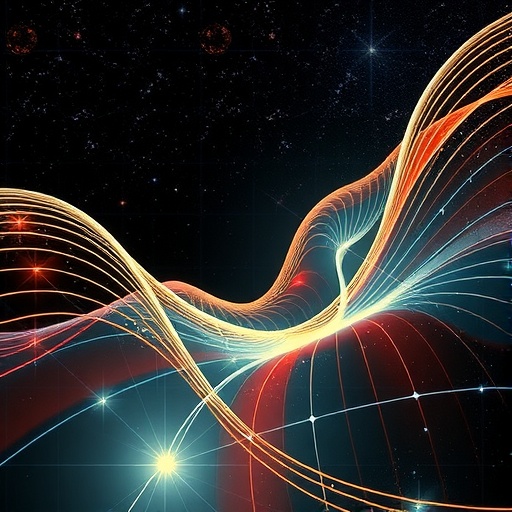
The Fabric of Reality: Scientists Unravel the Mysteries of Warped Braneworlds, Hinting at a Deeper Cosmic Structure
Prepare yourselves, cosmic explorers, for a journey into the very heart of existence, a realm where our familiar universe might be naught but a shimmering membrane floating in a vaster, more profound cosmic ocean. In a groundbreaking study published in the European Physical Journal C, a dynamic duo of theoretical physicists, S. Bhattacharyya and S. SenGupta, have delved into the enigmatic world of warped braneworlds, offering a tantalizing glimpse into the conditions that could stabilize these exotic cosmic structures. Their meticulous analysis, far from being confined to the sterile pages of academic journals, carries profound implications for our understanding of gravity, the universe’s expansion, and perhaps even the elusive nature of dark energy. Imagine, if you will, our universe as a slice of bread in an infinitely larger loaf of spacetime. This “brane” contains all the particles and forces we know, but the extra dimensions, the fundamental architecture of the cosmos, exist in the “bulk” – the space beyond our membrane. This is the essence of braneworld theory, a sophisticated framework that attempts to reconcile the seemingly disparate realms of quantum mechanics and general relativity.
For decades, theoretical physicists have grappled with the immense disparity in strength between gravity and the other fundamental forces. While electromagnetism, the strong nuclear force, and the weak nuclear force are remarkably robust, gravity, despite its dominion over celestial bodies, appears woefully weak at the subatomic level. Braneworld scenarios offer a compelling solution to this cosmic puzzle by proposing that gravity might “leak” into these extra dimensions, effectively diluting its strength within our accessible three spatial dimensions. This leakage would explain why gravity seems so feeble compared to its subatomic counterparts, a discrepancy that has long vexed physicists and has been a persistent thorn in the side of many grand unified theories seeking to bring all fundamental forces under a single, elegant umbrella. The quest to unify these forces has been a defining characteristic of modern physics, and braneworld models represent a bold and imaginative step in that direction, offering a novel perspective on the hierarchy problem.
The core of Bhattacharyya and SenGupta’s research lies in understanding a critical aspect of these braneworlds: modulus stabilization. Imagine our brane not as a rigid, unchanging entity, but as something that can fluctuate, warp, and stretch. These fluctuations, particularly those related to the size and shape of the extra dimensions which are often referred to as moduli, can have dramatic consequences for the physics we observe. If these moduli are not properly controlled, a braneworld could rapidly expand or collapse, rendering it inherently unstable and incapable of hosting the universe we inhabit. The researchers meticulously investigated the mathematical conditions under which these fundamental moduli can be stabilized, preventing such catastrophic cosmic events. This stabilization is not merely an academic concern; it is a prerequisite for any viable braneworld scenario that aims to describe our universe. Without it, these exotic cosmic structures would be ephemeral and incapable of sustaining the physical laws we have so painstakingly uncovered.
Their analysis delves into the intricate dance of energy and matter on the brane and within the bulk. By carefully considering the interplay of gravitational fields and matter distributions, they have identified specific configurations and conditions that act as cosmic anchors, holding the extra dimensions in a stable configuration. Think of it like stretching a rubber sheet and ensuring it doesn’t snap back or sag uncontrollably. The researchers are essentially mapping out the precise tension and weight distribution needed to keep that sheet perfectly taut and flat, allowing us to perceive it as a stable surface. This involves exploring the potential energy landscapes of these braneworlds, identifying the lowest energy states which correspond to the most stable configurations, much like a ball naturally rolling to the lowest point in a valley.
The implications of this work extend far beyond the theoretical. If warped braneworlds are indeed a feature of our cosmos, and if the conditions for their stabilization can be met, it opens up a universe of possibilities for understanding some of the most profound cosmic mysteries. For instance, the accelerating expansion of our universe, a phenomenon attributed to the enigmatic dark energy, could potentially find an explanation within these warped dimensions. The subtle warping of spacetime in the bulk might exert an outward pressure, driving this cosmic acceleration. This offers a compelling alternative to the standard cosmological model, which posits the existence of a mysterious dark energy component without a clear fundamental origin.
Furthermore, the very nature of gravity might be re-envisioned. Instead of a fundamental force emanating from point masses, gravity in a braneworld scenario could be a manifestation of the geometry of these extra dimensions. The curvature and fluctuations of the bulk spacetime could dictate how objects interact gravitationally on our brane. This provides a more holistic and integrated picture of the universe, where gravity is not an isolated force but an emergent property of a more complex, higher-dimensional reality. The researchers are essentially exploring the cosmic blueprint, seeking to understand the fundamental design principles that govern spacetime itself, moving beyond the limitations of our perceived three-dimensional existence.
The mathematical rigor employed in their study is immense, involving complex tensor calculus and differential geometry, tools essential for navigating the curved landscapes of spacetime. They have, in essence, derived a set of cosmic “rules of engagement” that dictate how a braneworld can persist and evolve without succumbing to the chaotic forces of instability. These rules are not arbitrary; they emerge from the fundamental principles of physics, the very bedrock upon which our understanding of the universe is built. The beauty of their work lies in its ability to translate these abstract mathematical concepts into tangible, observable phenomena, hinting at a reality far richer and more interconnected than we currently comprehend.
The concept of stabilization is paramount. Without it, any hypothetical braneworld would be fleeting, a transient ripple in the cosmic fabric that quickly dissipates. The conditions identified by Bhattacharyya and SenGupta are akin to finding the precise recipe for a stable cosmological soufflé; too much or too little of any ingredient, and the entire structure collapses. Their work provides a crucial check on theoretical models, ensuring that the exotic universes they describe are not only mathematically consistent but also physically plausible within the grand narrative of cosmic evolution. This rigorous approach is what elevates their research from mere speculation to a significant contribution to our scientific understanding.
One of the most exciting aspects of this research is its potential to shed light on the fundamental constants of nature. Why do these constants have the values they do? In a braneworld scenario, it’s conceivable that the physical properties of our brane are intrinsically linked to the geometry and dynamics of the bulk. The stabilization of the moduli could, in turn, fix the values of these fundamental constants, explaining their seemingly arbitrary yet precise nature. This would be a monumental step towards a “theory of everything,” a single framework that unifies all physical phenomena and explains why the universe is the way it is. The search for a unified theory has been a driving force in physics for centuries, and braneworlds offer a compelling avenue for exploration in this enduring quest.
The researchers have meticulously explored how different types of matter and energy residing on the brane can influence the stability of the extra dimensions. For instance, the presence of specific scalar fields, hypothetical entities that permeate spacetime, can act as stabilizing agents or, conversely, destabilizing forces. Their work quantifies these effects, providing a detailed map of the parameter space within which a stable braneworld can exist. Imagine these scalar fields as cosmic engineers, capable of fine-tuning the geometry of spacetime to ensure its long-term viability. This intricate interplay between matter, energy, and spacetime geometry is at the heart of their investigation.
Their findings also have direct connections to the elusive nature of quantum gravity. The unification of quantum mechanics, which describes the subatomic world, and general relativity, which governs gravity on large scales, remains one of the holy grails of physics. Braneworld theories, by embedding gravity in a higher-dimensional framework, offer a promising avenue for bridging this gap. The stabilization mechanisms they uncover could provide clues about how quantum gravitational effects manifest themselves on our brane, potentially leading to testable predictions that could be verified through future experiments or cosmological observations. The quest to reconcile these two pillars of modern physics is a monumental challenge, and braneworlds offer a fresh perspective.
The implications for cosmology are enormous. If warped braneworlds are a reality, our understanding of the early universe, the Big Bang, and the subsequent evolution of cosmic structures would need to be re-evaluated. The geometry of the bulk could have played a crucial role in shaping the initial conditions of our universe, influencing everything from the distribution of matter to the magnitude of cosmic inflation. The ripples in spacetime generated by the stabilization process could even be imprinted on the cosmic microwave background radiation, the faint afterglow of the Big Bang, offering a potential observational signature of these higher dimensions. This is where the frontiers of theoretical physics meet the observational capabilities of our ever-improving telescopes.
Bhattacharyya and SenGupta’s work emphasizes the interconnectedness of seemingly disparate physical phenomena. The stability of our universe, the strength of gravity, the acceleration of cosmic expansion, and even the values of fundamental constants might all be intricately linked through the architecture of these higher dimensions. This holistic perspective challenges us to move beyond our anthropocentric view of the cosmos and to consider a reality that is far more complex and wondrous than we might have initially imagined. The universe, in this view, is a single, unified entity, with all its seemingly independent phenomena being facets of a deeper, underlying structure.
The paper acts as a beacon, guiding future theoretical and experimental investigations. It provides a solid theoretical foundation for exploring braneworld scenarios and pinpoints specific areas where further research is needed. Scientists will now be able to use these conditions as a benchmark when developing new models or designing experiments aimed at probing the nature of spacetime at its most fundamental level. This is the true power of scientific inquiry; one discovery opens the door to countless new questions and avenues for exploration, pushing the boundaries of human knowledge ever forward. The journey outwards from this research is destined to be a thrilling one for physicists.
In essence, Bhattacharyya and SenGupta have not just published a research paper; they have drawn a more detailed map of the cosmic ocean, revealing the hidden currents and gravitational tides that might govern the stability of our very existence. Their work is a testament to the enduring power of human curiosity and the relentless pursuit of understanding the universe, from the smallest subatomic particles to the grandest cosmic structures. It is a compelling narrative that reminds us that the reality we perceive might just be one of many layers, and that profound truths lie waiting to be discovered in the invisible architecture of spacetime itself, pushing the boundaries of our cosmic comprehension.
Bhattacharyya, S., SenGupta, S. Analyzing the general conditions for modulus stabilization in a warped braneworld.
Eur. Phys. J. C 85, 1430 (2025). https://doi.org/10.1140/epjc/s10052-025-15170-1
Cite this news
SCIENMAG. (December 16, 2025). Brane Worlds: Stabilizing Moduli in Warped Dimensions. https://scienmag.com/brane-worlds-stabilizing-moduli-in-warped-dimensions/
SCIENMAG. "Brane Worlds: Stabilizing Moduli in Warped Dimensions." Scienmag, 16 December 2025, https://scienmag.com/brane-worlds-stabilizing-moduli-in-warped-dimensions/. Accessed 28 August 2026.
SCIENMAG. "Brane Worlds: Stabilizing Moduli in Warped Dimensions." Scienmag. December 16, 2025. https://scienmag.com/brane-worlds-stabilizing-moduli-in-warped-dimensions/


