


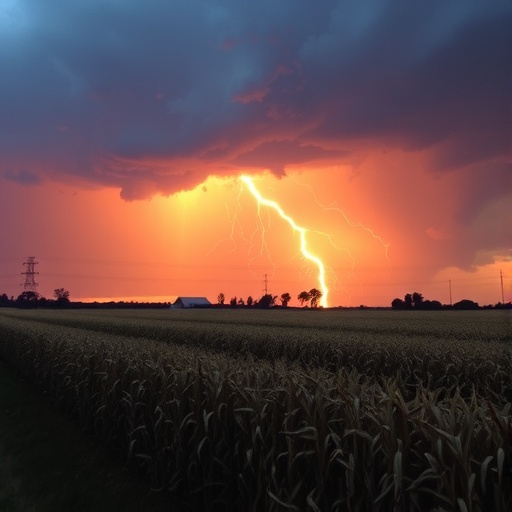
In a groundbreaking study, researchers captured the intricate relationship between agricultural activities and intense weather phenomena, specifically focusing on how moisture emanating from the US Corn Belt is significantly boosting the frequency and intensity of convective storms. This research sheds light on the vital role that regional agricultural practices play in shaping atmospheric conditions, which ultimately contributes to more severe weather events. By providing an in-depth analysis of the dynamics at play, this study not only highlights the intersection of agriculture and meteorology but also raises crucial questions about the broader implications of climate change in the agricultural heartland of the United States.
The findings presented in this research offer a new perspective on the contributions of human activities to the increased intensity of convective storms. Convection—the process of heat and moisture rising through the atmosphere—is central to the formation of thunderstorms. The authors, led by Zhang et al., utilized advanced climate modeling techniques to explore how moisture from the Corn Belt, a region known for its vast corn fields, travels into the atmosphere and influences weather patterns. Their results suggest that agricultural practices, particularly irrigation and land-use changes, are impacting the local and regional climate, with significant ramifications for storm development.
One of the core elements of this study is the identification of how plant transpiration and soil moisture contribute to atmospheric moisture levels. The Corn Belt is characterized by extensive corn production, which involves significant water usage and more complex interactions with the atmosphere than previously understood. The researchers employed sophisticated models to simulate conditions, revealing that the moisture generated from irrigation and natural processes is a potent contributor to humid air masses that fuel thunderstorms. This finding challenges traditional views that often regard agricultural areas merely as contributors to greenhouse gas emissions without considering their role in local weather systems.
The authors elucidate the physical mechanisms behind moisture transport, highlighting how the water vapor released into the atmosphere can lead to the formation of convective cells that result in severe thunderstorms. These storms are notorious for their ability to produce heavy rains, damaging winds, and hail, which can have devastating impacts on both communities and agriculture. Understanding how moisture influences storm tracks and intensities opens up new avenues for predicting the timing and strength of these weather events, which is crucial for both disaster preparation and crop management.
As climate patterns continue to evolve due to anthropogenic factors, the implications of this study cannot be overstated. The researchers draw attention to the importance of adapting agricultural practices to mitigate adverse weather impacts. They suggest that adopting sustainable methods, such as no-till farming and crop rotation, could be beneficial not only for soil health but also for regulating local climate conditions. By promoting practices that enhance soil moisture retention and reduce surface runoff, farmers can potentially decrease the intensity of storms fueled by excessive evaporation and transpiration.
The research also has far-reaching consequences for policymakers and agricultural planners. As the climate continues to change, there is a pressing need for informed policies that can mitigate the adverse effects of intense weather patterns on food production. By integrating findings from studies like this into policy development, stakeholders can make better decisions regarding water management, land use, and emergency preparedness. Policymakers should prioritize funding for innovative agricultural practices and research that aim to strike a balance between productivity and environmental sustainability.
In addition to its implications for agriculture, this research contributes to the broader discussion on climate resilience. Communities vulnerable to extreme weather events, particularly those in the Midwest, must adapt to the increasing likelihood of severe storms as a consequence of changes in atmospheric moisture levels. Local governments and organizations must collaborate with scientists to develop strategies to enhance community resilience, from improving infrastructure to implementing early warning systems for severe weather.
While the study revolves around the specific impacts of the Corn Belt, it raises questions about similar regions worldwide that rely heavily on agriculture. There is an urgent need to investigate how local practices elsewhere contribute to atmospheric changes and extreme weather, particularly in regions experiencing rapid agricultural expansion. By examining these connections, the scientific community can work towards establishing global frameworks for sustainable agriculture that consider not only local economies but also global weather patterns.
As the climate crisis accelerates, initiatives aimed at educating farmers and regional stakeholders on the consequences of their practices will be pivotal. Targeted outreach and training can empower farmers to adopt strategies that mitigate their impact on weather patterns while also promoting more resilient farming practices. Empowering local communities with knowledge about the relationship between moisture, agriculture, and storm intensity can serve as a catalyst for positive change in the face of climate change.
In summary, the research conducted by Zhang and colleagues provides compelling evidence of the influence of moisture from the US Corn Belt on the intensity of convective storms. By elucidating the intricate dynamics between agriculture and atmospheric conditions, this study presents a vital discussion on the role of human activity in climate change. The implications are clear: as we continue to navigate the challenges of a changing climate, understanding and adapting our agricultural practices is essential. The intersections of farming, weather, and climate must remain at the forefront of scientific inquiry and policy development to secure a sustainable future for both agriculture and local communities.
The findings of this study represent only the beginning of a larger conversation about agricultural innovation, climate adaptation, and environmental stewardship. Through continued research, collaboration, and active engagement with stakeholders, it is possible to forge pathways that not only address the immediate needs of farmers and their communities but also forge resilience in a rapidly changing climate landscape.
As this research paves the way for future inquiries into how agricultural systems shape global weather patterns, it becomes increasingly clear that the ways we approach farming in relation to the environment will fundamentally influence the stability of weather conditions for generations to come. The path forward lies in a deepening understanding of these interconnected systems, synthesis of scientific knowledge, and a collective commitment to stewardship of the land we depend upon.
In conclusion, the work of Zhang et al. offers an essential examination of a crucial nexus between agriculture and the atmosphere. By uncovering these dramatic interactions, this study not only enhances our understanding of storm intensification in climatic terms but also calls for a re-evaluation of agricultural practices and their consequences on communities and ecosystems alike. The challenge now lies in bridging the gap between this knowledge and effective action to mitigate the serious impacts anticipated in our increasingly volatile climate.
Zhang, Z., Prein, A.F., He, C. et al. Moisture from US Corn Belt fuels more intense convective storms.
Commun Earth Environ (2025). https://doi.org/10.1038/s43247-025-03089-0
Cite Scienmag News
Violet Maxwell. (December 16, 2025). Corn Belt Moisture Intensifies Convective Storms. Scienmag. https://scienmag.com/corn-belt-moisture-intensifies-convective-storms/
Violet Maxwell. "Corn Belt Moisture Intensifies Convective Storms." Scienmag, 16 December 2025, https://scienmag.com/corn-belt-moisture-intensifies-convective-storms/. Accessed 4 September 2026.
Violet Maxwell. "Corn Belt Moisture Intensifies Convective Storms." Scienmag. December 16, 2025. https://scienmag.com/corn-belt-moisture-intensifies-convective-storms/


