


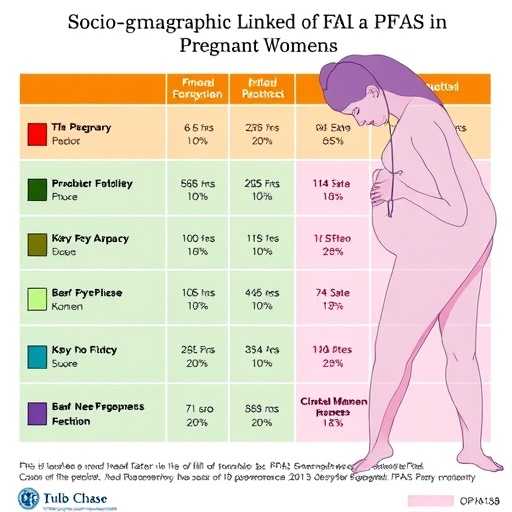
In a groundbreaking study released in late 2025, researchers have mapped the complex landscape of per- and polyfluoroalkyl substances (PFAS) exposure across the United States, revealing persistent contamination in the blood serum of a broad cross-section of the population. This biomonitoring data, drawn from an expansive consortium analysis involving pregnant women from diverse racial, ethnic, and socioeconomic backgrounds, underscores the urgent public health challenge posed by these persistent environmental chemicals. PFAS, often dubbed “forever chemicals” due to their resistant carbon-fluorine bonds, have been detected ubiquitously, raising alarm bells about their potential impacts, especially on vulnerable populations like fetuses and newborns.
PFAS have pervaded modern environments primarily due to their historic utility in consumer products, manufacturing, and firefighting foams, where their resistance to heat, water, and oil has been prized for decades. Their persistence, however, also means that once released, PFAS accumulate in soil, water, and living organisms, making elimination from ecosystems and human bodies extraordinarily difficult. This recent study harnesses data from the Environmental influences on Child Health Outcomes (ECHO) program, incorporating a public-use dataset that provides unmatched granularity regarding individual exposure patterns, factors that influence PFAS blood levels, and emerging demographic trends.
Exposure analysis highlights a disturbing reality: PFAS contamination is not just an isolated geographic or industrial problem, but a widespread phenomenon affecting individuals across urban, suburban, and rural areas alike. Importantly, this work draws attention to disproportionate exposure levels among certain racial groups, including non-Hispanic populations, suggesting environmental justice concerns that intertwine with structural inequalities. The delineation of sociodemographic predictors indicates how access to environment, housing, education, and diet intricately influence toxicant burdens on individuals.
One of the study’s most compelling findings relates to dietary intake, particularly fish consumption, which emerged as a significant correlate of elevated PFAS blood levels. This connection is biologically plausible given bioaccumulation in aquatic food chains—a mechanism where fish and other marine organisms concentrate PFAS from contaminated waters. For populations relying heavily on fish for nutrition, this pathway poses a heightened risk, indicating that regulatory efforts must not only target environmental emissions but also the food systems that transmit these chemicals to humans.
Pregnant women, by virtue of biological vulnerability and potential implications for fetal development, represent a focal subgroup in this research. The ability of PFAS to cross the placental barrier and accumulate in cord blood has been documented in earlier studies, but this large dataset affirms that such exposure remains widespread despite ongoing regulatory efforts. The developmental and immune effects associated with prenatal PFAS exposure—ranging from altered birth weight to immune dysfunction—underscore a pressing need to identify and mitigate upstream exposure sources to protect the next generation.
Interestingly, the study also finds that higher educational attainment correlates with increased PFAS serum concentrations. This counterintuitive result invites reflection on consumer behaviors, product usage, and lifestyle factors that may influence chemical exposure. It suggests that awareness and socioeconomic status alone do not guarantee reduced toxic uptake; instead, exposure risk is multifactorial, potentially influenced by consumption of certain goods, geographic residence, and occupational environments associated with higher education brackets.
Regulatory landscapes have evolved over the years, with some PFAS compounds phased out or restricted, while replacement chemistries enter the market. However, this study highlights a critical concern: as legacy PFAS levels decline somewhat, emerging alternatives may still pose health risks yet to be fully characterized. Biomonitoring remains indispensable, providing empirical data on aggregate human exposure trends that regulatory frameworks can use to adapt and prioritize interventions. This dynamic interplay between regulation, industrial innovation, and public health surveillance forms the backbone of contemporary chemical safety governance.
Furthermore, this research contributes to the nuanced understanding of how racial, ethnic, and socioeconomic disparities map onto environmental exposure patterns. Such disparities often stem from systemic factors including residential segregation near contaminated sites, differences in occupational risks, and access to information or medical resources. Integrating sociodemographic data into environmental health research advances efforts to achieve environmental justice by informing targeted remediation strategies and community outreach programs.
Technological advancements in analytical chemistry enable detection of PFAS at increasingly lower concentrations, revealing the extent of contamination that historically went unnoticed. This precision in measurement triggers reexaminations of what constitutes “safe” levels of exposure, especially given the subtle yet compounding health effects PFAS can induce at low doses. The study leverages state-of-the-art mass spectrometry techniques to quantify multiple PFAS congeners, enriching data reliability and comparability across different cohorts.
In the context of public health communication, these findings demand innovative approaches to effectively disseminate complex chemical exposure information to diverse audiences. Communicating risks related to subtle, chronic exposures—particularly among populations that may not see themselves as at-risk—poses an ongoing challenge. The research team emphasizes culturally sensitive messaging that balances urgency with empowerment, encouraging protective behaviors while advocating systemic change.
Society’s reliance on PFAS-laden products—from non-stick cookware to waterproof textiles—undercuts straightforward elimination strategies. Consequently, the study’s recommendation to investigate consumer product determinants of exposure is timely. Such investigations may identify modifiable behaviors or product substitutions that reduce intake, especially in vulnerable groups like pregnant women. Collaboration across sectors including public health, industry, and consumer advocacy becomes critical to devise feasible, scalable solutions.
Emerging evidence suggests immunotoxic effects of PFAS exposure, with implications for vaccine response and susceptibility to infectious diseases, further amplifying the public health stakes. Pregnant women and young children exposed to these chemicals could face compounded risks, which justifies prioritizing this population for intervention and policy focus. Longitudinal cohort studies enabled by initiatives like ECHO are expected to illuminate how prenatal exposures translate into long-term health trajectories.
Overall, the persistence of PFAS exposure depicted in this comprehensive study challenges assumptions about the efficacy of current environmental regulations and consumer awareness campaigns. It calls for multilayered approaches that combine stringent regulatory action with enhanced biomonitoring, public education, and research into safer chemical alternatives. Contextualizing PFAS exposure within broader environmental health frameworks will be key to mitigating their insidious impacts on future generations.
As society grapples with PFAS contamination, this research serves as a clarion call for increased investment in environmental health surveillance infrastructure. Such data-driven insights underpin informed policymaking and empower communities to advocate for cleaner environments. The intersection of scientific innovation, public health, and social justice embodied in this study exemplifies the kind of holistic approach necessary to tackle one of the 21st century’s most stubborn chemical challenges.
In conclusion, the ambitious investigation into sociodemographic predictors of PFAS exposure presented in this recent ECHO dataset analysis marks a pivotal advancement in environmental epidemiology. It illuminates the multifaceted nature of chemical exposures in modern society and underscores the critical role of biomonitoring in charting progress—and gaps—in exposure reduction efforts. Future research focusing on intervention strategies, particularly among pregnant women and children, will be essential for curbing the path of PFAS into human bodies and breaking cycles of environmental health inequity.
Cite Scienmag News
Harold Sullivan. (December 15, 2025). Sociodemographic Factors Linked to PFAS in Pregnant Women. Scienmag. https://scienmag.com/sociodemographic-factors-linked-to-pfas-in-pregnant-women/
Harold Sullivan. "Sociodemographic Factors Linked to PFAS in Pregnant Women." Scienmag, 15 December 2025, https://scienmag.com/sociodemographic-factors-linked-to-pfas-in-pregnant-women/. Accessed 4 September 2026.
Harold Sullivan. "Sociodemographic Factors Linked to PFAS in Pregnant Women." Scienmag. December 15, 2025. https://scienmag.com/sociodemographic-factors-linked-to-pfas-in-pregnant-women/


