


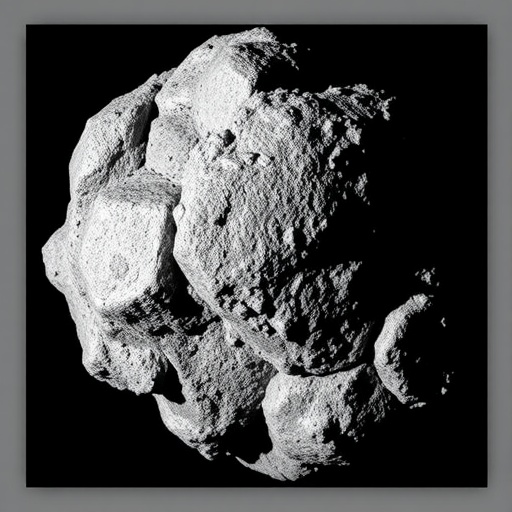
In a groundbreaking new study published in Nature Communications (2025), researchers have unveiled compelling evidence of hydrothermal alteration on the near-Earth asteroid Ryugu, challenging our understanding of the asteroid’s geological history and the processes it underwent after a disruptive impact event. These findings stem from an unprecedentedly detailed analysis of samples returned by the Hayabusa2 mission, shedding light on the complex interplay between impact dynamics, aqueous processes, and asteroidal evolution.
Ryugu, a carbonaceous near-Earth asteroid approximately 900 meters in diameter, has been the focus of intense scientific scrutiny due to its primitive nature and potential as a repository of early solar system materials. The Japan Aerospace Exploration Agency’s (JAXA) Hayabusa2 mission successfully retrieved samples from the asteroid’s surface, enabling direct laboratory analyses that surpass the limitations of remote sensing techniques. This study represents one of the first comprehensive investigations into the hydrothermal history recorded within these returned grains.
A key revelation of the research is that hydrothermal alteration on Ryugu’s surface was not a protracted process but instead was directly linked to a singular, disruptive impact event. By leveraging advanced mineralogical, chemical, and isotopic characterization techniques, the authors have reconstructed the thermal and fluid evolution that ensued following the impact, demonstrating that liquid water played an instrumental role in ever-so-brief but profound alteration episodes.
The delicate mineralogical textures and secondary phases identified in the samples indicate that the impact generated sufficient heat to mobilize subsurface ice, converting it to liquid water which then circulated through the asteroid’s porous matrix. This hydrothermal regime, albeit transient, created reactive environments that favored aqueous alteration—transforming primary anhydrous silicates into hydrous phyllosilicates and other secondary minerals. These mineral transformations provide a microscopic record of water-rock interactions shortly after the impact event.
Crucially, the study utilized synchrotron-based X-ray diffraction, electron microscopy, and nanoscale chemical mapping to tease apart the fine-grained mineral assemblages and their spatial distribution. This multi-modal approach revealed distinct zonations of alteration intensity around impact-induced fractures, suggesting that fluid flow pathways were heterogeneous and controlled by the asteroid’s fractured architecture. Such findings elucidate how liquid water can percolate unevenly even in small, rubble-pile bodies.
The isotopic signatures, including oxygen and hydrogen isotope ratios measured in hydrous minerals, corroborated the aqueous origin of altered phases and pointed toward the thermal regime’s temporal constraints. The data suggest that once the impact-induced hydrothermal system cooled, alteration effectively ceased as free water reservoirs dissipated or froze. Thus, the alteration history is constrained to a relatively narrow window following the disruptive impact.
Importantly, these insights carry profound implications for understanding the early solar system’s geochemical cycles and the potential delivery mechanisms of hydrated materials to terrestrial planets. Ryugu’s alteration record exemplifies how small bodies can act as transient reactors, processing primordial water and organics in localized, impact-triggered hydrothermal systems. This provides a potential model for aqueous alteration pathways that may have contributed prebiotic ingredients to early Earth.
Moreover, the discovery challenges previous assumptions that hydrothermal alteration on primitive asteroids necessarily requires internal radiogenic heating over extended periods. Instead, it suggests that short-lived, impact-generated hydrothermal episodes can achieve substantial chemical processing in asteroids lacking significant intrinsic heat sources. This revelation could reshape models of alteration histories across various small bodies and meteorite parent bodies.
The study also highlights the importance of fracture networks and porosity as crucial controls on fluid migration and mineralization in rubble-pile asteroids like Ryugu. These physical factors create heterogeneous microenvironments, enabling preservation of pristine materials alongside altered zones within the same sample. This complexity complicates interpretations of remote analyses but enriches our understanding of asteroidal geodynamics.
To complement their empirical data, the researchers employed numerical modeling to simulate hydrothermal fluid flow, heat dissipation, and mineral reaction kinetics under impact-induced conditions. These models were consistent with the mineralogical and isotopic evidence, producing transient windows of alteration lasting hundreds to thousands of years before cooling below aqueous alteration thresholds. The modeling illuminated parameters such as fluid temperature, pressure gradients, and alteration front propagation in detail.
The implications extend to planetary protection and sample return strategies, emphasizing the vast scientific potential hidden within even small grains returned from asteroids. By precisely documenting and contextualizing alteration signatures, scientists can better reconstruct the timing, nature, and fluid history of extraterrestrial materials. This enhances the value of ongoing and future missions targeting near-Earth objects.
Indeed, these findings rekindle interest in the role of impacts not only as destructive forces but as catalysts of chemical evolution on minor bodies. Impact-triggered hydrothermal systems may be commonplace across the asteroid belt and beyond, acting as crucibles for aqueous processing. Such processes might influence organic molecule synthesis, mineral alteration, and the redistribution of volatiles across planetary building blocks.
This study’s interdisciplinary approach, combining petrology, geochemistry, planetary science, and experimental modeling, underscores the power of sample return missions for revolutionizing our grasp of solar system history. As additional Ryugu samples continue to be examined and new datasets emerge, our understanding of impact hydrothermal systems will grow richer, informing models of asteroidal evolution and planetary system formation.
In conclusion, the observed hydrothermal alteration of Ryugu, linked directly to a disruptive impact event recorded in returned samples, dramatically advances the field of planetary materials science. It provides a vivid example of how small bodies experience complex, short-lived aqueous episodes that leave lasting mineralogical imprints. This discovery opens new avenues for exploring the dynamic processes shaping primitive asteroids and rekindles our quest to understand the origins of water and life’s precursors in the cosmos.
Cite Scienmag News
Violet Maxwell. (December 13, 2025). Ryugu Sample Reveals Impact-Driven Hydrothermal Alteration. Scienmag. https://scienmag.com/ryugu-sample-reveals-impact-driven-hydrothermal-alteration/
Violet Maxwell. "Ryugu Sample Reveals Impact-Driven Hydrothermal Alteration." Scienmag, 13 December 2025, https://scienmag.com/ryugu-sample-reveals-impact-driven-hydrothermal-alteration/. Accessed 4 September 2026.
Violet Maxwell. "Ryugu Sample Reveals Impact-Driven Hydrothermal Alteration." Scienmag. December 13, 2025. https://scienmag.com/ryugu-sample-reveals-impact-driven-hydrothermal-alteration/


