


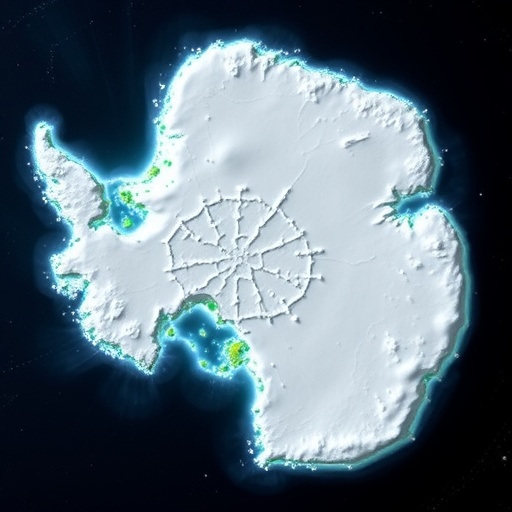
In a groundbreaking study poised to redefine our knowledge of Southern Ocean ecology, recent findings reveal that Antarctic phytoplankton net primary production (NPP) during the winter months has been significantly underestimated over the past decade. This revelation emerges from advanced data obtained through spaceborne Light Detection and Ranging (LiDAR) technology, providing an unprecedented window into the hidden productivity of one of Earth’s most remote and ecologically pivotal regions.
Phytoplankton form the foundational base of the marine food web, absorbing carbon dioxide and releasing oxygen while driving oceanic carbon cycling. Traditionally, winter in the Southern Ocean has been considered a period of minimal phytoplankton activity due to the limited sunlight and harsh climatic conditions. Previous satellite observations, relying primarily on passive ocean color sensors, suggested a drastic seasonal decline in NPP as ice cover extended and sunlight waned. However, these methods struggled to penetrate under the extensive sea ice and detect subsurface biological processes, leaving wintertime productivity poorly quantified.
The advent of spaceborne LiDAR systems has revolutionized this understanding. By emitting laser pulses and analyzing their reflections from various ocean layers, LiDAR can detect phytoplankton concentrations beneath sea ice and deeper into the water column where traditional optical sensors cannot reach. The recent decade-long dataset collected by these instruments demonstrates that winter phytoplankton production is not only ongoing but has been increasing at rates previously unappreciated, marking an accelerated biological response within the Antarctic marine ecosystem.
Researchers led by Chen, Zhang, and Bisson meticulously analyzed LiDAR returns to quantify phytoplankton biomass and infer NPP levels throughout winter seasons. Their analysis revealed that prior models routinely underestimated the winter NPP by a significant margin, highlighting overlooked pulses of productivity sustained beneath seasonal sea ice and in marginal ice zones. These bloom events, although smaller and more sporadic than summer maxima, are critical as they influence nutrient cycling, carbon sequestration, and the feeding ecology of krill and higher trophic levels during otherwise resource-scarce periods.
One of the most startling aspects of the findings is the apparent acceleration of winter NPP trends in recent years. This increase correlates with subtle but important climate-driven changes in ice cover dynamics, mixed layer stratification, and nutrient availability. As seasonal ice retreats earlier and forms later, coupled with shifts in ocean circulation and temperature, the environmental window favorable for phytoplankton growth expands. The spaceborne LiDAR data thus points to a dynamic Antarctic biosphere adapting swiftly to climatic shifts, with implications extending beyond regional ecosystems to global carbon cycling and climate feedback mechanisms.
Technically, the success of spaceborne LiDAR in measuring Antarctic winter NPP challenged previous operational thresholds. Unlike passive optical sensors vulnerable to cloud cover and low light levels, active LiDAR instruments operate independently of sunlight, providing continuous year-round monitoring capabilities. The lidar’s sensitivity to chlorophyll fluorescence signatures directly ties the signal to living phytoplankton cells, affording researchers an accurate proxy for biomass and NPP even amidst cloudy winter skies and under thick ice layers.
The methodology employed leverages cutting-edge signal processing algorithms to discriminate between water types, phytoplankton species with varying fluorescence characteristics, and ice backscatter. This level of discrimination has enabled a refined mapping of spatial heterogeneity in winter productivity, revealing hotspots linked to polynyas—areas of open water surrounded by ice—and sub-ice melt zones where light penetrates more deeply. Understanding these microscale variations is critical for ecosystem modeling and predicting the responses of Antarctic food webs to environmental change.
Beyond ecological insights, the enhanced data feed into global climate models by closing a previously large uncertainty gap in the Earth system carbon budget. The Southern Ocean acts as a major carbon sink, with phytoplankton-driven biological drawdown playing a vital role in sequestering atmospheric CO2. Recognizing higher winter NPP indicates greater than estimated carbon fixation, which could moderate projections of rising atmospheric greenhouse gases. If such trends continue or intensify, they could introduce important feedback loops in global climate regulation.
However, this promising discovery also poses challenges. Increased phytoplankton activity during Antarctic winters could alter nutrient depletion patterns, potentially affecting seasonal cycles of nitrogen and iron essential for sustaining long-term ecosystem productivity. Furthermore, shifts in the timing and magnitude of blooms may reshape predator-prey interactions, influencing the abundance and distribution of zooplankton, fish, seabirds, and marine mammals that depend on a predictable food supply.
The implications are especially profound for krill populations, which form the cornerstone of the Southern Ocean food web. Enhanced winter phytoplankton may support higher survival rates of larval stages, potentially leading to population increases that cascade through the ecosystem. Conversely, changing bloom phenology might mismatch with life cycles of dependent species, creating ecological imbalances with complex repercussions that scientists are now eager to explore.
This study underscores the transformative power of integrating emerging remote sensing technologies with traditional oceanographic research, revealing hidden dimensions of polar ecosystems. As satellite LiDAR continues to evolve with improved sensitivity and higher spatial resolution, we can anticipate increasingly nuanced insights into biological processes once deemed inaccessible, refining our planetary stewardship efforts.
Efforts are now underway to incorporate these findings into multidisciplinary Antarctic monitoring programs that combine in situ measurements, autonomous underwater vehicles, and model simulations to validate and expand upon the LiDAR-derived winter NPP estimates. Such comprehensive data integration is vital for assembling a holistic understanding of Southern Ocean biogeochemistry and for designing adaptive conservation strategies in the face of rapid environmental change.
In conclusion, this pioneering research redefines our perception of Antarctic winter ecosystems, challenging the long-held notion of productivity dormancy and highlighting the resilience and responsiveness of phytoplankton communities amidst shifting conditions. The use of spaceborne LiDAR has not only uncovered a hidden pulse of life beneath the ice but has also opened new horizons for studying polar biology, climate interactions, and the intricate balances sustaining our planet’s largest oceanic wilderness.
As the implications of these findings permeate scientific discourse and inform policy, the Southern Ocean once again reminds us of its critical role as both a sentinel and a regulator in the Earth system. Continued investment in advanced observational tools and focused interdisciplinary research will be essential to unraveling the complexities of Antarctic ecosystems and their evolving responses to the global climate crisis.
Cite Scienmag News
Violet Maxwell. (December 12, 2025). Spaceborne LiDAR Reveals Boosted Antarctic Winter Phytoplankton. Scienmag. https://scienmag.com/spaceborne-lidar-reveals-boosted-antarctic-winter-phytoplankton/
Violet Maxwell. "Spaceborne LiDAR Reveals Boosted Antarctic Winter Phytoplankton." Scienmag, 12 December 2025, https://scienmag.com/spaceborne-lidar-reveals-boosted-antarctic-winter-phytoplankton/. Accessed 3 September 2026.
Violet Maxwell. "Spaceborne LiDAR Reveals Boosted Antarctic Winter Phytoplankton." Scienmag. December 12, 2025. https://scienmag.com/spaceborne-lidar-reveals-boosted-antarctic-winter-phytoplankton/


