


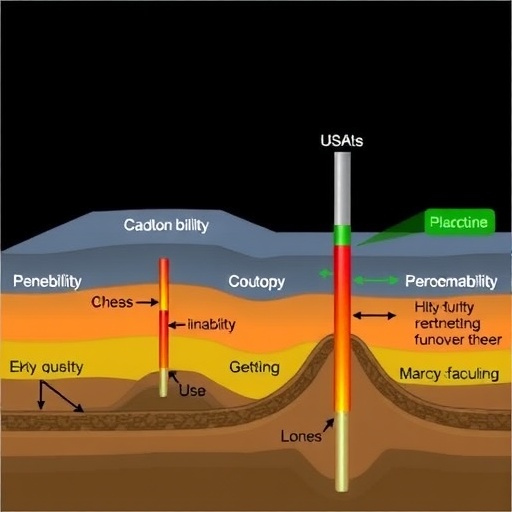
In an ambitious study poised to advance our understanding of coal permeability, researchers Zhang, Tian, Zhang, and their team have meticulously investigated the intricate relationship between coal permeability and stress factors. The findings, anticipated in the prestigious journal Natural Resources Research in 2025, explore how permeability evolves in a stepwise manner under conditions reflective of real-world mining scenarios. This research is particularly significant given the continuous demand for cleaner energy sources and the need to optimize coal extraction strategies.
The research builds on the premise that understanding coal’s permeability under stress is crucial for effective resource management. Permeability, which refers to the ability of a material to allow fluids to pass through it, is a critical parameter in coal mining and gas extraction processes. It largely influences not only the efficiency of extraction but also the safety of mining activities and the environmental impact of coal utilization.
One of the key innovations introduced in this study is the concept of “Double-Prevention Boreholes.” These specially designed boreholes are aimed not only at improving the efficiency of gas extraction from coal seams but also at minimizing the risks associated with mine accidents. By systematically studying the evolution of coal permeability as stress conditions change, the researchers propose a methodology for employing these boreholes to maintain safety while maximizing output.
The researchers conducted a series of rigorous experiments that mimicked the full-stage stress conditions that coals naturally face in geological settings. The experiments utilized advanced instrumentation to measure permeability changes at various stages of stress application. This approach yielded comprehensive data that reveal how permeability adapts over time, facilitating a better understanding of the underlying mechanisms at play.
A critical finding of the study reveals that the relationship between stress and permeability is not linear. As stress is applied, coal exhibits a complex response characterized by initial increases in permeability, followed by a gradual reduction as plastic deformation occurs. This phenomenon aligns with existing theories regarding the mechanical behavior of porous materials but adds a unique perspective to the field of coal science. By documenting the stepwise evolution of coal permeability, the researchers provide a framework for predicting how permeability can be managed during mining operations.
Another significant aspect of this study is its implications for climate change mitigation. With growing concerns about the carbon footprint of fossil fuels, optimizing coal extraction methods to minimize methane emissions is crucial. The Double-Prevention Borehole structure, coupled with the insights gained from permeability evolution data, presents a dual approach to enhancing extraction efficiency while also addressing environmental impacts. This aspect of the research aligns with global sustainability goals aimed at reducing greenhouse gas emissions.
Furthermore, the study highlights the relevance of advanced predictive models based on experimental data. By integrating computational simulations with laboratory findings, the team demonstrates how predictive models can be developed to forecast permeability changes under various operational and environmental conditions. Such models would be invaluable for mining engineers, allowing them to design more effective and safer extraction systems, thereby reducing operational costs and improving safety.
The research also underscores the importance of multidisciplinary collaboration in tackling complex geological challenges. The investigation involved contributions from geologists, engineers, and environmental scientists, showcasing the necessity of collaborative approaches in modern science. This model of integrated research not only enriches the findings but also presents a scalable framework for addressing other resource management challenges that arise from mining activities.
In light of these findings, the research team advocates for the adoption of innovative mining practices that leverage their insights. They call for industry stakeholders to consider investing in such technologies that enhance coal safety while maximizing extraction potential. The findings urge policymakers to integrate scientific research into legislation governing coal mining, highlighting the potential benefits of informed decision-making in resource management.
Moreover, the implications extend beyond immediate mining practices. As energy needs continue to evolve, understanding the stress-permeability dynamic will have repercussions for long-term energy policy and resource allocation. As nations pivot toward a more sustainable energy future, the insights gleaned from this study could help shape the trajectory of coal as a transitional fuel source in the global energy landscape.
In summary, the study conducted by Zhang et al. presents a significant contribution to the understanding of coal permeability under stress, emphasizing the need for innovative borehole designs and sophisticated predictive models. By addressing not just efficiency but also the environmental implications of coal mining, this research speaks to the broader narrative of sustainable development in energy production. It is a clarion call for the integration of empirical research in the quest for cleaner and safer energy sources.
The findings of this study will no doubt incite further research addressing the evolving challenges facing the coal industry as well as inspire significant discourse on resource management in the context of a changing energy landscape. Continued exploration in these areas holds great promise for advancing both scientific knowledge and practical applications within the field.
Subject of Research:
Coal Permeability and Double-Prevention Boreholes in Stress Conditions.
Article Title:
Stepwise Evolution of Coal Permeability Under Full-Stage Stress with Double-Prevention Boreholes Structure.
Article References:
Zhang, T., Tian, J., Zhang, L. et al. Stepwise Evolution of Coal Permeability Under Full-Stage Stress with Double-Prevention Boreholes Structure. Nat Resour Res (2025). https://doi.org/10.1007/s11053-025-10611-w
Image Credits:
AI Generated
DOI:
https://doi.org/10.1007/s11053-025-10611-w
Keywords:
Coal permeability, Double-Prevention Boreholes, full-stage stress, sustainable energy, resource management.
Cite Scienmag News
Gavin Prescott. (December 12, 2025). Coal Permeability Evolution with Dual Borehole Strategy. Scienmag. https://scienmag.com/coal-permeability-evolution-with-dual-borehole-strategy/
Gavin Prescott. "Coal Permeability Evolution with Dual Borehole Strategy." Scienmag, 12 December 2025, https://scienmag.com/coal-permeability-evolution-with-dual-borehole-strategy/. Accessed 4 September 2026.
Gavin Prescott. "Coal Permeability Evolution with Dual Borehole Strategy." Scienmag. December 12, 2025. https://scienmag.com/coal-permeability-evolution-with-dual-borehole-strategy/


