


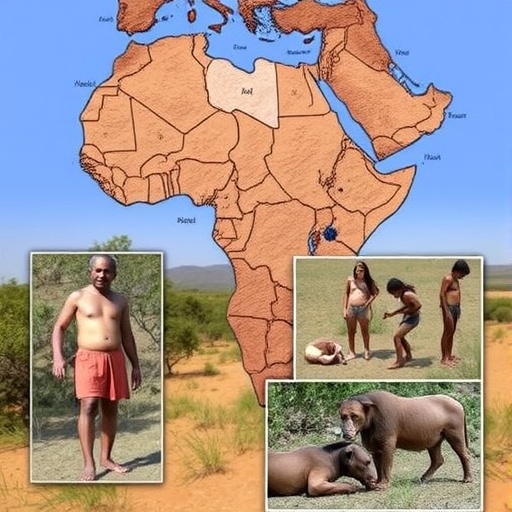
A groundbreaking genetic study has unveiled unprecedented insights into the evolutionary history of Homo sapiens by analyzing ancient southern African genomes. This research, utilizing over tenfold coverage genomes of ancient Africans alongside pre-Neolithic Eurasians, archaic Neandertals, and Denisovans, sheds new light on the genetic diversity, population structure, and demographic changes that have shaped early human evolution specifically within Africa. The comprehensive genomic data reveal nuanced patterns of genetic divergence and population dynamics extending back hundreds of thousands of years, offering a refined perspective on our species’ unique evolutionary trajectory.
The study reports a notable measure of genetic differentiation, quantified by pairwise genetic differences denoted as π (pi), illustrating approximately 1.41 differences per 1,000 base pairs between Homo sapiens and archaic humans like Neandertals and Denisovans. Intriguingly, intra-African comparisons depict slightly lower divergence, with pairwise differences between ancient southern Africans and other ancient African populations, as well as pre-Neolithic Eurasians, measuring around 1.02 × 10⁻³. This finding underscores a closer genetic affinity within African groups relative to their archaic counterparts, painting a complex picture of ancient human migration and admixture.
When evaluating genetic variation within ancient African populations, the data indicates that southern African individuals exhibit a pairwise difference of 0.82 × 10⁻³, marginally higher than the 0.79 × 10⁻³ observed between ancient western and eastern Africans. Such subtle differences point to extensive genetic diversity and long-standing population structure across the African continent, emphasizing its critical role as the cradle of human diversity. These results contribute to a deeper understanding of the spatial and temporal distribution of ancient human genetic lineages.
Heterozygosity analyses further unveil that ancient southern Africans possessed levels of genetic variation similar to other ancient Africans, with mean heterozygosity (HO) values around 0.80 × 10⁻³. Remarkably, one ancient western African individual surpassed this, exhibiting heterozygosity near 0.93 × 10⁻³, indicative of a historically large Holocene population size. These findings counter prior assumptions of uniformly reduced diversity in ancient populations and suggest robust demographic stability and effective population sizes in much of Africa during the Holocene epoch.
In a more detailed demographic reconstruction employing multiple sequentially Markovian coalescent methodologies, the researchers estimated effective population sizes (Ne) over evolutionary timescales. Ancient southern Africans maintained a large Ne for several hundred thousand years, peaking around 30,000 individuals approximately 200,000 years ago. This extensive population size is consistent with evidence from other African lineages, supporting a scenario of sustained demographic robustness prior to and during key phases of human evolution.
The observed large Ne at temporal horizons beyond 300,000 years may be attributed to significant population subdivision, which maintained genetic diversity across different subpopulations of early humans. However, a clear demographic decline emerged in ancient southern Africans between roughly 100,000 to 50,000 years ago, with effective population sizes contracting to approximately 10,000 individuals by the Last Glacial Maximum (~20,000 years ago). This contraction parallelled trends observed in non-African and ancient northern African groups, suggesting widespread climatic and environmental impacts on human demography across continents.
Runs of homozygosity (ROH) analyses, which provide insight into recent population size and inbreeding, reveal intriguing patterns among ancient southern Africans. These individuals occupy the upper spectrum of ROH distributions compared to modern African groups yet remain less extreme than most non-Africans. This pattern reflects smaller recent population sizes in southern Africa relative to western Africa but underscores less severe bottlenecks compared to populations descending from migrants who left Africa, implicating the Out-of-Africa bottleneck as a pivotal demographic event.
More specifically, ancient southern Africans demonstrate increased total lengths of homozygous segments without a corresponding rise in the number of such segments, deviating from typical ROH distributions. Notably, individuals from archaeological sites such as Great Brak River (dated between 2,355 and 2,310 calibrated years before present) and Matjes River 1 (7,845 to 7,690 cal. BP) exemplify this trend. This confluence of genetic signatures suggests a combination of population isolation, fragmentation, and possibly inbreeding, implying that Holocene-era southern African populations experienced demographic challenges distinct from other regions.
Collectively, these genetic insights portray ancient southern Africans south of the Limpopo River as part of a large, stable population persisting over millennia. Yet they also indicate a modest population decline beginning around 50,000 years ago, with further fragmentation and reduction during the Holocene period. This demographic trajectory intricately aligns with archaeological findings and environmental reconstructions, highlighting how climatic fluctuations and shifting ecosystems influenced human populations in this region.
The study’s pioneering approach incorporating high-coverage ancient genomes broadens the scope of paleo-genomic research, allowing unprecedented resolution in deciphering past population dynamics. It facilitates a more precise understanding of how Homo sapiens evolved within Africa, including the impact of admixture with archaic humans and regional demographic patterns that shaped genetic diversity observed today. This work opens new avenues for exploring the co-evolution of culture, environment, and genetics in shaping early human history.
Furthermore, the comparative framework linking ancient African genomes with archaic humans like Neandertals and Denisovans underscores the intricate web of ancestry that informs modern human identity. Findings illustrating genetic differences and shared variation between these groups nuance our understanding of interspecies interactions and the selective pressures influencing Homo sapiens-specific traits. Such multi-faceted investigations hold promise for resolving longstanding questions regarding the timing and geography of key evolutionary developments.
In summary, this research marks a significant stride toward unraveling the genomic fabric of our species by casting light on ancient southern African populations. Their genetic legacy, characterized by long-standing diversity, demographic fluctuations, and localized isolations, enriches our comprehension of Homo sapiens’ unique evolutionary journey. The integration of comprehensive genome-wide data and sophisticated analytical models sets a new benchmark for future human evolutionary studies, cementing Africa’s pivotal role in humanity’s deep past.
Cite Scienmag News
Gavin Prescott. (December 12, 2025). Ancient African Genomes Reveal Human Evolution. Scienmag. https://scienmag.com/ancient-african-genomes-reveal-human-evolution/
Gavin Prescott. "Ancient African Genomes Reveal Human Evolution." Scienmag, 12 December 2025, https://scienmag.com/ancient-african-genomes-reveal-human-evolution/. Accessed 4 September 2026.
Gavin Prescott. "Ancient African Genomes Reveal Human Evolution." Scienmag. December 12, 2025. https://scienmag.com/ancient-african-genomes-reveal-human-evolution/


