


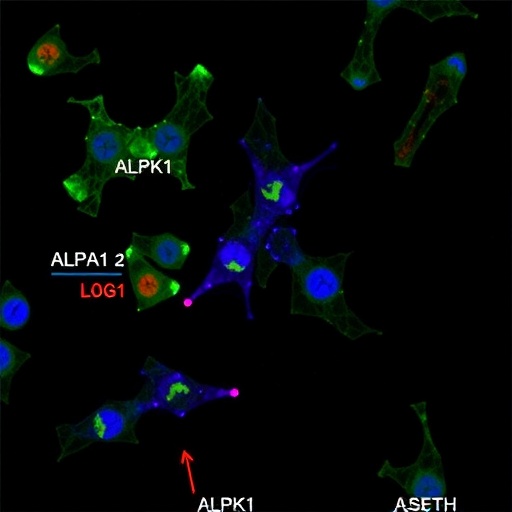
In the relentless quest to harness the immune system against cancer, recent discoveries have spotlighted a novel protagonist: the cytosolic bacterial receptor ALPK1. This receptor, responding to a distinct bacterial molecule known as ADP-heptose (ADP-Hep), has emerged as a powerful trigger of antitumour immunity, offering a promising avenue for enhancing the efficacy of cancer immunotherapies. Unlike the well-studied pathways involving Toll-like receptors (TLRs) and stimulator of interferon genes (STING), ALPK1 agonism represents a fresh frontier with unique immunomodulatory features.
The therapeutic landscape of innate immunity in cancer has been traditionally dominated by the activation of TLRs and STING, receptors that detect pathogenic molecules and initiate robust immune responses. While promising in theory, these receptors’ agonists have encountered significant clinical hurdles, ranging from systemic toxicity to limited efficacy. Against this backdrop, the recent identification of ALPK1 as a sensor for bacterial ADP-Hep presents an intriguing alternative, potentially circumventing the pitfalls seen with TLR and STING agonists.
In seminal preclinical studies, administration of ADP-Hep to mice has been shown to induce potent proinflammatory chemokines, notably CXCL10 and CCL2, orchestrating a concerted immune assault on tumors. Crucially, this anti-tumor effect depends on the presence of ALPK1 – mice lacking this receptor fail to mount a comparable response. Such findings underscore ALPK1’s vital role in integrating bacterial metabolic cues into host antitumour immunity, an axis previously unexplored in immuno-oncology.
Delving deeper into the receptor’s biology, mouse models bearing a gain-of-function ALPK1 mutation, specifically the T237M variant associated with autoinflammatory states, demonstrated spontaneous rejection of implanted tumors. This observation not only consolidates ALPK1’s function in antitumour immunity but also hints at the receptor’s potential to be pharmacologically modulated in clinically relevant contexts, leveraging inherited or induced receptor polymorphisms for therapeutic gain.
Building upon the natural ligand, researchers have ingeniously synthesized a novel analogue called UDSP-Hep, which surpasses ADP-Hep in potency and selectivity. Unlike its progenitor, UDSP-Hep’s activity discriminates between ALPK1 polymorphisms that correlate with susceptibility to bacteria-induced colitis in different mouse strains. This ability to distinguish receptor variants enhances the prospect of tailoring ALPK1-targeted therapies, optimizing efficacy while minimizing adverse effects tied to genetic background.
Critically, the antitumor potency of UDSP-Hep goes beyond its innate immunostimulatory capacity. When combined with checkpoint inhibitors, which have revolutionized cancer treatment by unleashing T cell responses, UDSP-Hep exhibits synergistic effects leading to amplified tumor control. Mechanistically, this synergy requires the orchestration of CD8+ cytotoxic T cells alongside dendritic cells (DCs) and macrophages, pointing to a complex interplay between innate and adaptive immunity mediated by ALPK1 activation.
The blockade of chemokine pathways, specifically those involving CXCL10 and CCL2, effectively abrogates the benefits conferred by ALPK1 agonism, highlighting that these chemokines form the molecular bridge between receptor activation and immune cell recruitment within the tumor microenvironment. This chemokine-driven immune cell trafficking is vital for mounting an effective antitumour response, exemplifying the multifaceted immunological axis influenced by ALPK1.
At a cellular level, ALPK1 agonists markedly enhance the antigen-presenting functions of dendritic cells, facilitating cross-presentation—the process by which exogenous tumor antigens are presented on MHC class I molecules to prime CD8+ T cells. This function is pivotal for eliciting robust, tumor-specific cytotoxic T lymphocyte expansion in the tumor-draining lymph nodes, thus setting the stage for durable immunological memory and long-lasting tumor surveillance.
Notably, ALPK1 expression extends beyond immune cells and is more broadly distributed in non-immune tissues compared to STING. This broader expression profile accompanies a distinct inflammatory signature upon activation, differentiating ALPK1-mediated responses from classical STING pathways. Importantly, ALPK1 agonism does not induce T cell apoptosis, a detrimental side effect associated with some STING agonists that dampens therapeutic efficacy.
The distinct immunological cascade triggered by UDSP-Hep confers multiple advantages, including enhanced tumor cell antigen presentation, improved macrophage-dendritic cell cross-priming, and promotion of protective memory T cell phenotypes. These immunological hallmarks underline the therapeutic potential of ALPK1 agonists not only as monotherapies but also as critical adjuncts to existing immunotherapeutic modalities.
The discovery and characterization of ALPK1 as a cytosolic receptor mediating bacterial metabolite-induced antitumour immunity herald a paradigm shift in the field. By defining a new immune axis distinct from TLR and STING, this work expands the arsenal for cancer immunotherapists and opens avenues for precision-based interventions tailored to receptor polymorphisms and individual immune landscapes.
Looking ahead, the translation of ALPK1 agonists like UDSP-Hep into clinical settings holds promise for patients resistant to current checkpoint inhibitors or those with tumors refractory to standard immunotherapies. The synergy observed in preclinical models lays a strong foundation, but rigorous clinical trials will be essential to define dosing, safety profiles, and combination strategies to harness this pathway fully.
Moreover, understanding the broader implications of ALPK1 activation in various tissues and its role in inflammatory diseases linked to bacterial sensing could provide insights into balancing immunity and tolerance. Such knowledge is crucial for mitigating potential off-target effects and optimizing the therapeutic window for ALPK1-targeted agents.
In summary, the identification and exploitation of ALPK1 agonists mark a significant milestone in cancer immunotherapy research. Through sophisticated molecular design and insightful immunobiological investigation, this approach promises to augment the cancer treatment arsenal, potentially transforming patient outcomes by activating a previously underappreciated innate immune pathway linked to bacterial metabolite sensing.
Cite Scienmag News
Cedric L. (December 11, 2025). ALPK1 Agonists Trigger Potent Antitumor Immunity. Scienmag. https://scienmag.com/alpk1-agonists-trigger-potent-antitumor-immunity/
Cedric L. "ALPK1 Agonists Trigger Potent Antitumor Immunity." Scienmag, 11 December 2025, https://scienmag.com/alpk1-agonists-trigger-potent-antitumor-immunity/. Accessed 29 August 2026.
Cedric L. "ALPK1 Agonists Trigger Potent Antitumor Immunity." Scienmag. December 11, 2025. https://scienmag.com/alpk1-agonists-trigger-potent-antitumor-immunity/


