


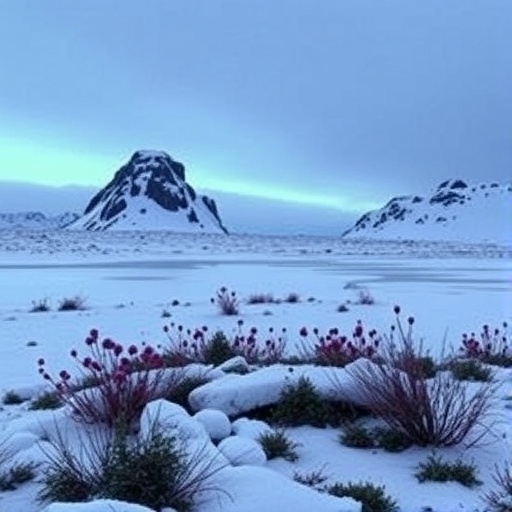
In the advancing field of microbial ecology, viruses have often been overlooked despite their ubiquitous presence and profound influence on ecosystems. A groundbreaking study by Trubl et al., published in Nature Communications in 2025, sheds unprecedented light on the population ecology and biogeochemical roles of single-stranded DNA (ssDNA) and double-stranded DNA (dsDNA) viruses along a gradient of permafrost thaw. This research unravels the complex dynamics of viral populations as Arctic environments respond dramatically to climate-induced warming, revealing critical implications for carbon cycling and microbial community structure in thawing soils.
Permafrost regions store vast amounts of organic carbon, frozen for millennia, representing roughly twice the carbon content of the atmosphere. As global temperatures rise, permafrost thaws progressively, releasing stored organic matter and spurring microbial activity that transforms these carbon stocks into greenhouse gases such as carbon dioxide and methane. While much attention has focused on microbial decomposers, this new work illuminates the hitherto underappreciated role of viruses, which infect and lyse microbial hosts, potentially influencing carbon turnover rates and nutrient availability in these vulnerable landscapes.
The study conducted an extensive survey of viral diversity and abundance across permafrost thaw gradients, employing state-of-the-art metagenomics alongside novel recovery methods that captured both ssDNA and dsDNA viral genomes. This comprehensive approach contrasts with previous work that predominantly targeted dsDNA viruses, obscuring the broader viral community structure. By integrating genomic sequencing with environmental data, the authors constructed detailed viral population profiles that correlate tightly with thaw stage, soil chemistry, and host microbial assemblages.
One of the key findings is the remarkable abundance and diversity of ssDNA viruses, which have traditionally been minimally studied due to technical challenges in detection. These viruses presented unique ecological patterns, displaying distinct host preferences and differential responses to changing physicochemical parameters tied to permafrost status. Sizable shifts in ssDNA viral populations were observed as landscapes transitioned from intact permafrost to fully thawed active layers, indicating dynamic viral-host interactions that mirror microbial succession in these soils.
The dsDNA viral communities also exhibited significant diversity but were comparatively stable across different thaw stages. Their genomic compositions included numerous auxiliary metabolic genes (AMGs) that presumably modulate host metabolism during infection, with potential repercussions for nutrient cycling pathways. For example, some AMGs encoded enzymes linked to carbon and nitrogen processing, suggesting viruses may directly influence host metabolic outputs relevant to greenhouse gas emission.
In terms of biogeochemical impact, viruses contribute to the microbial loop by lysing host cells and releasing cellular contents into the soil milieu—a process known as the viral shunt. This recycling of organic material can both stimulate microbial growth and alter the balance of carbon sequestration versus release. The research showed viral-mediated turnover of microbial biomass could either accelerate or inhibit carbon mineralization depending on the prevailing environmental conditions along the thaw gradient, underscoring the dualistic role of viruses in ecosystem functioning.
Further examination revealed viral interactions with key microbial taxa implicated in carbon cycling, including methanogens and methane-oxidizing bacteria. The differential infection patterns of these hosts by ssDNA and dsDNA viruses indicate a possible mechanism by which viral populations regulate methane fluxes in thawing soils. These findings suggest viruses are not mere passive entities but active agents shaping microbial networks and greenhouse gas dynamics in permafrost regions.
Methodologically, this study pioneered a hybrid approach combining viral enrichment protocols with metagenomic assembly and advanced bioinformatics classification to discriminate ssDNA from dsDNA viruses in complex soil samples. This technical innovation permitted the first quantified assessment of viral community shifts in situ and unveiled novel viral taxa with previously unrecognized ecological roles. By mapping viral populations against environmental predictors, the authors could resolve how abiotic factors—like temperature, moisture, and nutrient availability—drive viral ecology in thawing permafrost.
The implications of these discoveries extend far beyond local Arctic soils. Given the accelerating pace of global permafrost loss, understanding viral controls over microbial-mediated carbon cycling is essential to refine climate models that predict future greenhouse gas emissions. Incorporating viral dynamics into biogeochemical frameworks represents a paradigm shift, acknowledging viruses as pivotal modulators rather than passive background entities that simply reflect microbial activity.
Moreover, this research opens new frontiers for exploring viral contributions to soil resilience and ecosystem feedbacks amid environmental change. The identification of virus-host pairs and environmentally responsive viral genes lays the groundwork for deciphering viral influences on microbial community assembly and function. This knowledge could inform biotechnological or geoengineering strategies aimed at mitigating permafrost carbon release or enhancing soil carbon stabilization.
The study also poses intriguing questions regarding viral evolution in extreme and rapidly changing habitats. The detected viral genomic adaptations suggest ongoing selective pressures driven by host availability and environmental stressors inherent to thaw gradients. Unraveling these evolutionary trajectories promises insights into virus-host coevolution under climate perturbation scenarios, with repercussions for broader ecosystem health and stability.
In addition to ecological and biogeochemical insights, the data provide a rich viral genomic resource that expands the known diversity of environmental viruses. This genomic catalog enables comparative analyses that illuminate functional gene repertoires relevant to host metabolism and environmental persistence strategies, contributing to the broader understanding of virus biology in natural settings.
This landmark investigation demonstrates that viruses are integral components of thawing permafrost ecosystems, actively sculpting microbial populations and influencing fundamental biogeochemical cycles. Their roles are multifaceted and environmentally contingent, highlighting the importance of integrating viral ecology into studies of climate change impacts on soil microbial communities.
As the Arctic continues to warm at an unprecedented rate, this study exemplifies the urgency and value of multidisciplinary research approaches that couple molecular virology, environmental microbiology, and earth system sciences. The insights gained underscore the need to move beyond traditional microbial paradigms and embrace the complexity of virus-driven processes influencing global carbon cycling and climate feedbacks.
In conclusion, Trubl et al.’s work represents a pivotal advancement in our understanding of viral ecology in permafrost ecosystems. By characterizing the distribution, diversity, and functional potential of ssDNA and dsDNA viruses along thaw gradients, the study provides critical mechanistic links between viruses, microbial hosts, and carbon fluxes. These revelations not only broaden conceptual frameworks of permafrost biogeochemistry but also propel the integration of viral dimensions into predictive climate models, ultimately enhancing our capacity to forecast and mitigate climate change impacts.
Cite Scienmag News
Gavin Prescott. (December 11, 2025). Viruses Shape Ecology, Biogeochemistry in Thawing Permafrost. Scienmag. https://scienmag.com/viruses-shape-ecology-biogeochemistry-in-thawing-permafrost/
Gavin Prescott. "Viruses Shape Ecology, Biogeochemistry in Thawing Permafrost." Scienmag, 11 December 2025, https://scienmag.com/viruses-shape-ecology-biogeochemistry-in-thawing-permafrost/. Accessed 4 September 2026.
Gavin Prescott. "Viruses Shape Ecology, Biogeochemistry in Thawing Permafrost." Scienmag. December 11, 2025. https://scienmag.com/viruses-shape-ecology-biogeochemistry-in-thawing-permafrost/


