


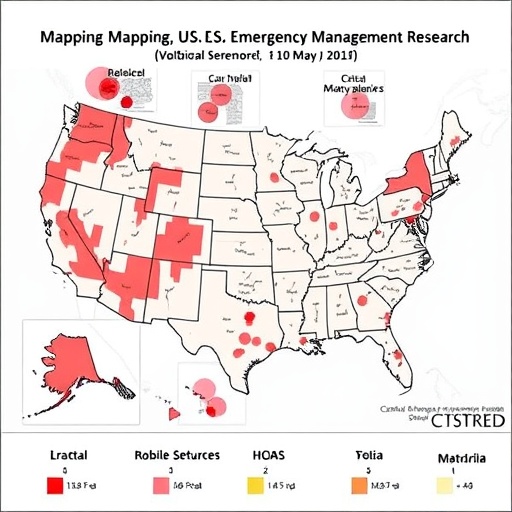
In today’s rapidly evolving world, the ability to understand and manage emergencies is more critical than ever before. The field of emergency management has grown substantially, with a staggering volume of research produced over recent decades. However, comprehending the complex knowledge structures within this expansive research landscape has remained a formidable challenge. A groundbreaking study by Liu, Lai, Hu, and colleagues, published in the International Journal of Disaster Risk Science, illuminates the evolution and intricate web of knowledge underpinning U.S. emergency management research, offering a panoramic view of the discipline’s intellectual progression.
The study employs advanced bibliometric methods and scientometric techniques to map the intellectual contours and dynamic trends shaping emergency management research. By dissecting published works, the authors reveal how knowledge production and thematic focus areas have shifted dramatically over time, responding to both natural and human-induced crises. Their analysis spans a broad temporal frame, capturing the rise of seminal topics, the decline of others, and the emergence of novel paradigms, thus painting a comprehensive picture of the forces driving research in this crucial domain.
One of the pivotal aspects examined in the study is the identification of core research themes across decades. The researchers used co-citation and keyword co-occurrence analyses to extract clusters of topics that define the discipline’s intellectual structure. These clusters reveal not only dominant problem areas but also interdisciplinary linkages, highlighting how emergency management intersects with public health, urban planning, climate science, and information technology. This structural mapping provides clarity on the cognitive foundations from which practical frameworks, policies, and strategies for disaster preparedness and response arise.
A cornerstone of this investigation is its attention to temporal evolution, capturing how emergency management knowledge has adapted to the changing nature and scale of emergencies. For instance, earlier research predominantly focused on disaster response coordination and federal emergency policies. Over time, however, the emphasis has increasingly shifted towards resilience, risk communication, and community-based approaches. This temporal lens underscores how real-world events — ranging from 9/11 to recent pandemic outbreaks and climate-induced disasters — have imprinted themselves upon academic discourse, steering inquiry toward more holistic and integrative perspectives.
Moreover, the study dissects the collaborative networks that facilitate knowledge dissemination and innovation within the field. Through social network analysis, Liu and colleagues map the intricate patterns of co-authorship and institutional partnerships, revealing how knowledge exchange occurs across universities, governmental agencies, and international bodies. These findings shed light on the hubs of expertise and influence, illustrating how certain institutions and researchers serve as intellectual linchpins, fostering multidisciplinary cooperation that propels emergency management science forward.
Notably, the researchers also highlight the role of emerging technologies and data-centered methods in transforming emergency management research. The integration of big data analytics, geographic information systems (GIS), and machine learning has spurred new avenues for anticipatory risk assessment and real-time crisis monitoring. The bibliometric evidence suggests a nascent but rapidly expanding vein of inquiry, poised to revolutionize how practitioners leverage information to mitigate disaster impacts and enhance response efficacy.
The landscape mapped by the study’s quantitative analyses also reveals shifts in publication venues and scholarly influence. As emergency management matures as a distinct academic discipline, specialized journals have proliferated, offering dedicated forums for niche topics that previously might have been sidelined. This diversification not only signifies the deepening sophistication of research but also the expanding ecosystem of practitioners, policymakers, and academics committed to disaster risk reduction.
One of the most striking insights offered by the study pertains to the critical interdependence between science and policy within emergency management. The bibliometric data underlines how research findings increasingly inform regulatory frameworks, operational protocols, and funding priorities. The evolution from theory-heavy constructs toward applied, evidence-based practice is palpable, reflecting the field’s urgent mandate to translate knowledge into actionable outcomes that can save lives and protect communities.
The authors also reflect on methodological challenges and future directions for research. They advocate for enhanced interdisciplinarity, urging scholars to integrate insights from social sciences, engineering, and health to tackle the multifaceted nature of contemporary disasters. Enhanced data sharing and longitudinal studies are cited as vital to understanding complex disaster dynamics and fostering adaptive governance structures.
Crucially, this comprehensive mapping of U.S. emergency management research serves as a vital compass for new scholars entering the field, helping them locate knowledge gaps and emerging themes worthy of attention. It also offers veteran researchers a reflective mirror to reassess dominant paradigms and recalibrate inquiry toward pressing contemporary challenges, such as climate change resilience, cyber threats, and social equity in disaster vulnerability.
This study’s findings resonate beyond academic circles, influencing how local and national agencies conceptualize capacity-building, public engagement, and risk communication. The revealed evolution towards more community-centric and resilience-oriented research reflects a growing recognition that disaster management must be participatory and inclusive, bridging technical expertise with lived experience.
Furthermore, the detailed knowledge map charts pathways for global collaboration, as many challenges facing the U.S. are mirrored worldwide. Understanding how U.S. emergency management research has evolved offers transferable lessons and prompts cross-national dialogue about best practices, shared risks, and cooperative innovation.
In sum, the research by Liu and colleagues represents a landmark in the meta-analysis of disaster management as a scientific field. It harnesses rigorous bibliometric methodologies to weave a comprehensive narrative that is both descriptive and predictive. This endeavor not only charts past trajectories but illuminates future horizons for research, policy, and practice in managing emergencies, underscoring the indispensable role of systematic knowledge synthesis in confronting the complex reality of disasters.
With emergency events growing in frequency and intensity, the ability to map, understand, and evolve knowledge structures is a crucial asset. This study’s integrative approach exemplifies how science can both trace its own developmental contours and responsibly guide the next frontier of disaster risk research and management.
As humanity faces challenges ranging from climate change to pandemics and technological disruptions, such comprehensive intellectual cartographies will become increasingly essential. They help to ensure that emergency management research remains both relevant and responsive, continually adapting to safeguard societies in an uncertain and turbulent global environment.
Cite Scienmag News
Rosalind W. (December 11, 2025). Mapping U.S. Emergency Management Research Evolution. Scienmag. https://scienmag.com/mapping-u-s-emergency-management-research-evolution/
Rosalind W. "Mapping U.S. Emergency Management Research Evolution." Scienmag, 11 December 2025, https://scienmag.com/mapping-u-s-emergency-management-research-evolution/. Accessed 29 August 2026.
Rosalind W. "Mapping U.S. Emergency Management Research Evolution." Scienmag. December 11, 2025. https://scienmag.com/mapping-u-s-emergency-management-research-evolution/


