


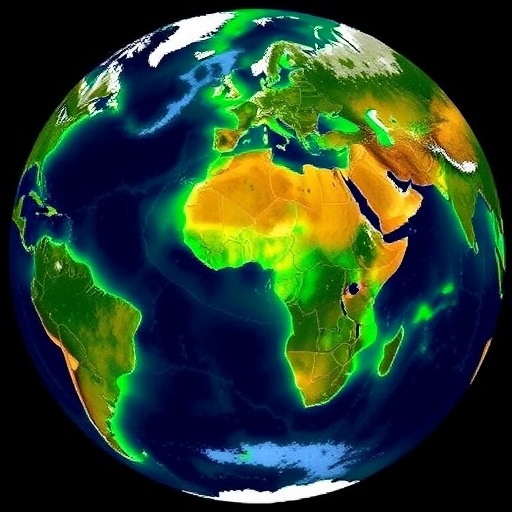
In a groundbreaking advancement for environmental science, researchers have unveiled a novel global assessment of national methane emissions by integrating satellite data inversions with established United Nations Framework Convention on Climate Change (UNFCCC) prior estimates. Methane, a potent greenhouse gas with a global warming potential significantly higher than carbon dioxide over short time horizons, has been under intense scrutiny due to its influential role in climate change. This innovative approach promises to refine the accuracy of methane emission inventories worldwide, offering policymakers a more precise tool for climate action and mitigation strategies.
Methane emissions originate from diverse sources including agriculture, fossil fuel production, waste management, and natural wetlands. However, inconsistencies and uncertainties in emission inventories have long challenged climate scientists. Traditional bottom-up inventories, which compile data from reported activities and emission factors, often suffer from inaccuracies due to incomplete reporting, unquantified sources, or outdated methodologies. To overcome these deficits, the researchers utilized atmospheric inversion techniques that infer emission rates by analyzing observed methane concentrations and applying mathematical models that incorporate atmospheric transport dynamics.
Central to their methodology was the employment of satellite observations that capture global atmospheric methane distributions with remarkable spatial and temporal resolution. With advancements in satellite technology, including enhanced sensors capable of detecting methane plumes from space, comprehensive atmospheric data has become accessible for inversion models. By harmonizing these satellite observations with the UNFCCC’s prior estimates, the team formulated a refined inversion framework capable of deducing national methane emissions with unprecedented accuracy.
The inversion approach operates by constraining the model to align the predicted atmospheric methane concentrations with the satellite-observed data, iteratively adjusting emission estimates until the best fit is attained. This method effectively bridges the gap between top-down and bottom-up assessments, marrying empirical observations with reported inventories. It enables the identification of previously unreported or underestimated emission sources, thereby illuminating sectors or regions requiring urgent mitigation efforts.
Importantly, the study emphasizes the temporal variations and geographical heterogeneity of methane emissions. Seasonal dynamics, industrial activity patterns, and regulatory impacts manifest distinctly in the atmospheric data. The inversion system captures these fluctuations, revealing emission trends that are critical for evaluating the efficacy of environmental policies. Such temporal granularity provides a dynamic lens through which national emissions can be monitored and verified continually, enhancing transparency and accountability.
One striking revelation from this analysis is the disparity between some countries’ self-reported methane emissions and the inversion-derived estimates from atmospheric data. Certain nations appear to underreport emissions from oil and gas sectors or waste management systems, underscoring a pressing need for strengthened emission monitoring and reporting mechanisms. The study thus acts as an essential reality check, encouraging improved accuracy and honesty in environmental disclosures aligned with the Paris Agreement commitments.
Furthermore, the inversion results offer a platform for more targeted policy interventions. With refined spatial mapping of emission hotspots, governments can allocate resources more efficiently, prioritize high-impact mitigation technologies, and evaluate policy outcomes with higher confidence. This capability is particularly vital for methane management since the gas’s short atmospheric lifetime means that prompt reductions can yield rapid climate benefits. Consequently, the research provides a tactical advantage in the global fight against warming.
From a methodological perspective, this research underscores the synergy of combining cutting-edge remote sensing with international climate reporting frameworks. By leveraging both observed atmospheric patterns and well-established inventory data, the study demonstrates a robust and scalable blueprint for methane emission assessment that could be adapted to other greenhouse gases. This integrated approach marks a significant shift towards more holistic and validated greenhouse gas accounting methodologies.
Technically, the inversion model incorporated state-of-the-art atmospheric transport simulations to ensure precise attribution of observed methane concentrations to their source regions. These simulations accounted for complex meteorological variables such as wind patterns, temperature stratification, and boundary layer dynamics. Such detailed modeling was crucial to disentangling the contributions of overlapping emission sectors and enhancing the fidelity of national estimates.
Coupled with increasing satellite coverage and sensor improvements, this technique offers vast potential for continuous global methane surveillance. It empowers the scientific community with near-real-time data to assess emission trajectories and identify emergent trends or anomalies. In a rapidly changing climate landscape, this timely intelligence is invaluable for adaptive management and timely policy adjustments.
The implications of this research extend beyond climate change mitigation: accurate methane emission data also influence air quality assessments, public health policies, and economic analyses concerning resource extraction and agricultural practices. By providing a more comprehensive picture of methane fluxes, the study enhances interdisciplinary understanding and promotes integrative environmental governance.
Overall, this study represents a major leap forward in remote sensing applications for climate science. It underscores the vital role of satellite observations in complementing and validating national emissions inventories, fostering greater confidence in global methane tracking. As international bodies strive to curb greenhouse gas emissions, such sophisticated tools become indispensable assets for evidence-based policymaking and transparent environmental stewardship.
Going forward, the researchers advocate for sustained investment in satellite missions and atmospheric modeling capabilities to refine inversion techniques further. They also highlight the potential for integrating additional data streams such as airborne measurements, ground-based monitoring networks, and industrial activity reports. Such multifaceted approaches could enhance resolution and accuracy, offering even clearer insights into methane dynamics.
In conclusion, the integration of satellite-derived inversions with UNFCCC prior estimates presents a transformative advance in understanding global national methane emissions. This pioneering work not only challenges existing inventories but also equips policymakers with robust, evidence-based tools essential for achieving methane reduction targets. As the urgency to address climate change mounts, the deployment of such high-fidelity emission assessment methodologies will be pivotal in steering global environmental efforts towards a sustainable and resilient future.
Cite Scienmag News
Marcus Vaughn. (December 11, 2025). Global Methane Emissions Mapped Using Satellite Data. Scienmag. https://scienmag.com/global-methane-emissions-mapped-using-satellite-data/
Marcus Vaughn. "Global Methane Emissions Mapped Using Satellite Data." Scienmag, 11 December 2025, https://scienmag.com/global-methane-emissions-mapped-using-satellite-data/. Accessed 5 September 2026.
Marcus Vaughn. "Global Methane Emissions Mapped Using Satellite Data." Scienmag. December 11, 2025. https://scienmag.com/global-methane-emissions-mapped-using-satellite-data/


