


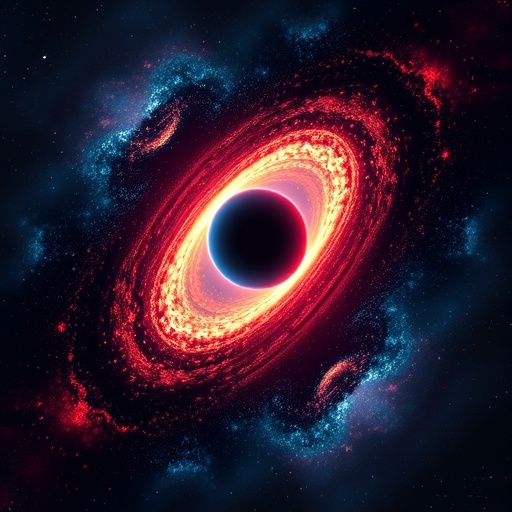
Echoes from the Dawn of Time: Primordial Black Holes and the Unlocking of Proton Secrets Could Revolutionize Physics
Scientists are buzzing with the implications of a groundbreaking new theoretical framework that could simultaneously explain two of the universe’s most profound mysteries: the elusive gravitational rumble of the Big Bang and the ultimate fate of the proton, the very cornerstone of matter as we know it. Published in the prestigious European Physical Journal C, this research ventures into the chaotic aftermath of cosmic inflation, proposing that tiny, primordial black holes, born in the universe’s earliest moments, could be the source of a detectable stochastic gravitational-wave background. Even more astonishingly, the same inflationary model that predicts these cosmic ripples offers a tantalizing glimpse into the possibility of observing proton decay, a phenomenon so rare it has eluded direct detection for decades, thus potentially unraveling the fundamental structure of reality and the very forces that bind everything together.
The concept ignites imaginations by connecting the incredibly vast and the infinitesimally small, the ancient cosmic symphony to the fundamental building blocks of atoms. Imagine the universe, just fractions of a second after its birth, undergoing a period of exponential expansion known as inflation. This rapid stretching, a key component of modern cosmology, is thought to have smoothed out initial irregularities and seeded the large-scale structure we observe today. However, this violent genesis likely birthed not just energy and fundamental particles, but also density fluctuations so extreme that they could have collapsed into black holes, incredibly small yet possessing immense gravitational influence, far before the formation of stars and galaxies. These “primordial black holes” (PBHs) have long been theorized, but now, a compelling argument is being made for their distinct gravitational wave signature.
The stochastic gravitational-wave background is essentially the faint, persistent hum of gravitational waves permeating the cosmos, originating not from single, colossal events like black hole mergers or supernovae, but from a myriad of unresolved, weaker sources acting in concert. Think of it as the constant, almost imperceptible murmur of a crowded room rather than the sharp clap of thunder. If these PBHs were indeed created in abundance during inflation, their collective gravitational dance would have generated a persistent gravitational wave emission from the universe’s infancy. Detecting this specific “afterglow” would be akin to hearing the universe’s first whisper, offering unparalleled insights into the physical conditions and processes that governed its very earliest moments, far beyond the reach of any other observational probe.
What makes this research particularly electrifying is its connection to proton decay, a theoretical prediction of Grand Unified Theories (GUTs) that aim to unify the fundamental forces of nature. These theories posit that at extremely high energies, the electromagnetic, weak nuclear, and strong nuclear forces merge into a single, unified force. Within such a framework, protons, which are considered stable in the Standard Model of particle physics, would in fact be unstable, albeit with an incredibly long lifetime, eventually decaying into lighter particles. The challenge for experimentalists has been the immense timescales involved; even a single proton decays, if it does, on average, longer than the age of the universe, making direct observation exceedingly difficult and requiring massive detectors.
The proposed R-symmetric SU(5) Inflationary model, central to this study, provides a unique pathway to bridge these seemingly disparate phenomena. This specific inflationary scenario, rooted in theories that extend the Standard Model and attempt to unify forces, not only suggests the conditions for PBH formation but also generates specific predictions for proton decay rates. The R-symmetry, a theoretical concept that relates particles with opposite “R-parity,” along with the SU(5) gauge group, a common framework for GUTs, work in tandem to sculpt the inflationary epoch in a way that allows for both phenomena to manifest in potentially observable ways, creating a fascinating synergy between cosmic archaeology and fundamental particle physics.
The R-symmetric SU(5) Inflation scenario specifically addresses how the universe could have transitioned from the inflationary epoch to the hot, dense state that followed, known as the radiation-dominated era. During this transition, termed “reheating,” the energy accumulated during inflation is converted into matter and radiation. The details of this process are crucial, as they determine the spectrum of gravitational waves generated and the conditions for particle creation, including those that could lead to observable proton decay signatures. The specific R-symmetric SU(5) formulation, as explored by the researchers, naturally leads to the formation of PBHs within a viable mass range and also influences the masses and interactions of hypothetical particles that mediate proton decay, thus tying the cosmic background to a fundamental particle decay process.
The implications of detecting this stochastic gravitational-wave background are staggering. Current gravitational wave detectors like LIGO and Virgo, and future observatories such as LISA, are primarily designed to detect transient, powerful events. However, the proposed background is a continuous whisper, requiring different detection strategies and potentially necessitating future generations of even more sensitive instruments capable of sifting through cosmic noise. If detected, the characteristics of this background – its amplitude and frequency spectrum – would provide invaluable information about the physics of the very early universe, including the energy scale of inflation, the duration of this rapid expansion, and crucially, the relics it left behind, such as PBHs.
Furthermore, the link to proton decay opens up an entirely new avenue for probing the fundamental nature of matter. If the R-symmetric SU(5) model correctly describes the early universe, then observing proton decay, even indirectly through its predicted rate within this model, would be a monumental discovery. It would validate the existence of GUTs and provide direct evidence for the unification of fundamental forces, a Holy Grail of modern physics. This would signify that protons are not eternally stable, a notion that has underpinned much of our understanding of matter and chemistry, and that the universe holds deeper, more interconnected symmetries.
The research delves into the complex interplay between the energy scales involved. Inflationary models typically operate at extremely high energies, far beyond what can be achieved in terrestrial particle accelerators. The PBHs predicted by this model would have formed at these energetic scales. Similarly, proton decay is predicted to occur at GUT scales, which are also vastly higher than achievable energies, meaning direct experimental verification of proton decay is currently impossible. The only way to probe these phenomena is through their cosmological consequences, such as the gravitational waves from PBHs and the predicted rate of proton decay.
The researchers meticulously calculate the expected amplitude and spectral shape of the gravitational waves produced by PBHs within their specific R-symmetric SU(5) Inflationary model. They explore scenarios where these PBHs have specific mass ranges and abundances, and how these parameters translate into a unique gravitational wave signature. This detailed theoretical work is crucial for guiding future experimental efforts, providing concrete targets for gravitational wave observatories and particle physics experiments searching for ultra-rare decay events.
The challenge of detecting proton decay rests on its incredibly long predicted lifetime, often exceeding 10^34 years. Experiments like Super-Kamiokande have set stringent limits on this lifetime by monitoring vast volumes of water for the faint Cherenkov radiation emitted by potential decay products. If the R-symmetric SU(5) model is correct, and its predicted decay rate is within the reach of future, more sensitive detectors, then a positive detection would not only confirm proton instability but also offer clues about the specific particles and interactions responsible for this decay.
The proposed unified framework offers a compelling narrative where the very earliest universe, through the process of inflation and the subsequent formation of PBHs, leaves an indelible mark on both the cosmic background radiation and the fundamental stability of matter. This synergy between gravitational wave astronomy and particle physics represents a powerful new approach to unraveling the universe’s deepest secrets. It highlights how studying the largest scales and the smallest constituents of reality can be intimately intertwined.
The researchers acknowledge the immense observational challenges ahead. Detecting the stochastic gravitational-wave background from PBHs will likely require sophisticated data analysis techniques to distinguish it from other astrophysical and instrumental noise sources. Similarly, confirming proton decay, even if its rate is predicted to be higher than previously thought, will demand continued upgrades and potentially new generations of ultra-sensitive experiments. However, the potential rewards – a unified understanding of cosmic origins and fundamental forces – make these challenges well worth pursuing.
This theoretical work is not just about numbers and equations; it’s about painting a picture of a universe far more dynamic and interconnected than we might have ever imagined. It suggests that the echoes of creation are not silent, and that the very stability of the matter that forms us could be a temporary state, a fleeting moment in a grand cosmic narrative. The implications for our understanding of fundamental physics, cosmology, and our place in the universe are profound and far-reaching, promising a new era of discovery.
The R-symmetric SU(5) Inflation framework offers an elegant solution to how these two profound mysteries might be linked. The inflationary epoch, a period of rapid expansion in the universe’s infancy, is theorized to have generated specific density fluctuations. These fluctuations, under the extreme conditions of inflation, could have collapsed to form tiny, yet incredibly dense, primordial black holes. The very process that seeded these PBHs, according to this model, also sets the stage for the unification of fundamental forces at extremely high energies, a unification that, in turn, predicts the eventual decay of protons, the seemingly eternal building blocks of atomic nuclei.
The stochastic gravitational-wave background, a constant hum of ripples in spacetime, is predicted to emanate from the collective gravitational influence of these PBHs. Imagine countless tiny black holes, formed in the universe’s first moments, constantly generating and re-emitting gravitational waves as they interact and coalesce. This continuous, low-frequency “noise” is theorized to permeate the entire cosmos, a faint but potentially detectable echo of the universe’s violent birth, offering a direct probe into the energy scales and physical processes of the inflationary era. Its detection would provide irrefutable evidence of PBHs and offer detailed information about their mass distribution and abundance.
The prospect of observing proton decay, a cornerstone prediction of Grand Unified Theories, has captivated physicists for decades. Protons, composed of quarks and held together by the strong nuclear force, are considered remarkably stable within the Standard Model of particle physics. However, GUTs propose that at energies far exceeding those achievable in current particle accelerators, the fundamental forces of nature merge. This unification implies that protons are not infinitely stable but will eventually decay into lighter particles, albeit with an extraordinarily long half-life, potentially exceeding the age of the universe. The R-symmetric SU(5) Inflation model provides a specific theoretical pathway that could make this decay observable.
The R-symmetric SU(5) Inflation model intricately links the scale of inflation with the scale of grand unification. R-symmetry is a theoretical property that relates particles with opposite “R-parity,” a concept that can extend the symmetries of the Standard Model. SU(5) is a common gauge group used in GUTs, representing a proposed unification of the electromagnetic, weak, and strong forces. By embedding these concepts within the inflationary epoch, the model naturally generates both the necessary conditions for the formation of PBHs and the specific interactions that mediate proton decay, creating a remarkable concordance between cosmic evolution and particle physics. This interlocking mechanism allows for the theoretical prediction of both a primordial gravitational wave background and a proton decay rate that might, with future advancements, be experimentally verifiable.
The universe’s earliest moments, a realm of extreme energy and rapid change, are incredibly difficult to probe directly. Current telescopes can observe light from epochs much later in cosmic history, but the light from the very first moments is obscured by an opaque plasma. Gravitational waves, however, are not electromagnetic radiation and can travel unimpeded across the cosmos, carrying information from epochs inaccessible to photon-based astronomy. Therefore, detecting the stochastic gravitational-wave background from PBHs would be akin to opening a window into the universe’s infancy, an epoch that shaped all subsequent cosmic evolution and the very laws of physics we observe today.
The potential discovery of proton decay would represent a paradigm shift in our understanding of fundamental physics. It would provide direct experimental evidence for the existence of Grand Unified Theories, confirming the unification of forces at high energies and suggesting that the proton’s apparent stability is a consequence of the lower energies we experience today. This would have profound implications for cosmology, particle physics, and our understanding of the fundamental constituents of matter, potentially revealing new particles and interactions beyond the Standard Model.
The researchers highlight the intricate relationship between the mass of the PBHs and the characteristics of the gravitational wave background. Different formation mechanisms and inflationary potentials lead to PBHs with a range of masses. The collective gravitational radiation emitted by these PBHs would have a specific spectrum, dependent on their mass distribution. Analyzing this spectrum would allow cosmologists to deduce valuable information about the conditions during inflation and the population of these primordial remnants. This makes the precise prediction of this spectrum a crucial aspect of the research, guiding future observational endeavors.
The challenge for experimental particle physics is immense, as the predicted half-life of a proton is so staggeringly long that direct observation requires monitoring colossal quantities of matter for extremely long durations. However, if the R-symmetric SU(5) Inflation model predicts a slightly shorter, yet still incredibly long, half-life that falls within the sensitivity range of future, more advanced detectors, then a positive detection would be transformative. It would provide definitive proof of proton instability and offer a direct glimpse into the symmetry-breaking mechanisms that lead to the observed hierarchy of fundamental forces.
The theoretical framework presented in this study offers a compelling narrative where the universe’s most enigmatic phenomena are not isolated curiosities but interconnected aspects of a deeper, underlying reality. The invisible gravitational soundtrack of the early universe and the potential impermanence of the very substance of matter might be two sides of the same fundamental coin, waiting to be uncovered through innovative scientific inquiry and technological advancement, promising to reshape our comprehension of existence itself.
Ijaz, N., Mehmood, M. & Ur Rehman, M. The stochastic gravitational-wave background from primordial black holes and observable proton decay in R-symmetric SU(5) Inflation.
Eur. Phys. J. C 85, 1394 (2025). https://doi.org/10.1140/epjc/s10052-025-15078-w
Cite Scienmag News
Ellis H. (December 11, 2025). Primordial Black Holes, Proton Decay Linked in Inflation. Scienmag. https://scienmag.com/primordial-black-holes-proton-decay-linked-in-inflation/
Ellis H. "Primordial Black Holes, Proton Decay Linked in Inflation." Scienmag, 11 December 2025, https://scienmag.com/primordial-black-holes-proton-decay-linked-in-inflation/. Accessed 29 August 2026.
Ellis H. "Primordial Black Holes, Proton Decay Linked in Inflation." Scienmag. December 11, 2025. https://scienmag.com/primordial-black-holes-proton-decay-linked-in-inflation/


