


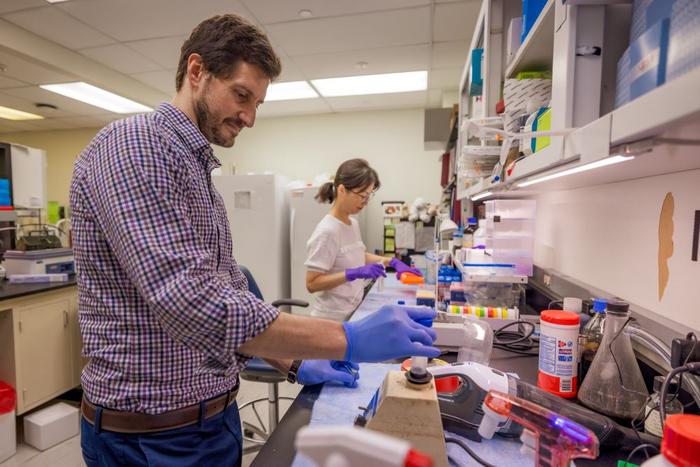
The link between severe headache disorders headaches and the body’s circadian clock in pain timing and thresholds will be studied with a $2.4 million grant from the National Institute of Neurological Disorders and Stroke (NINDS) to UTHealth Houston researchers.

Credit: UTHealth Houston
The link between severe headache disorders headaches and the body’s circadian clock in pain timing and thresholds will be studied with a $2.4 million grant from the National Institute of Neurological Disorders and Stroke (NINDS) to UTHealth Houston researchers.
The research is led by two faculty members of McGovern Medical School at UTHealth Houston: Mark Burish, MD, PhD, associate professor in the Vivian L. Smith Department of Neurosurgery, and Seung-Hee Yoo, PhD, associate professor in the Department of Biochemistry and Molecular Biology.
The study builds on earlier research by Burish and Yoo, funded by the Will Erwin Headache Research Foundation and published in 2023 in the journal Neurology, which revealed that both cluster headache and migraine are strongly linked to the internal clock that regulates body processes known as the circadian system. Burish and Yoo became interested in the topic of circadian clock regulation in headaches due to the clear circadian feature from cluster headache patients.
Cluster headache, which affects 1 in 1,000 people, is an extremely painful disorder that carries a higher risk of suicidality than the general population and can severely impact a patient’s quality of life. In the previous research, Burish and Yoo found that there was a circadian pattern of cluster headache attacks in more than 70% of participants, with a peak between 9 a.m. and 3 p.m., and seasonal peaks in spring and autumn.
“Both migraine and cluster headache, but cluster headache in particular, have an unusually circadian pattern of attacks,” Yoo said. “And several of the treatments for cluster headache and migraine, like steroids and melatonin, strongly influence the core molecular machinery of our body’s internal clock. We thought that these links were interesting. With Dr. Burish’s background in headaches and my background in circadian biology, we started to discuss new ways to study the circadian features of headaches.”
In a pre-clinical study by the team recently published in Headache, Yoo and Burish found a new circadian pattern of pain in a laboratory headache mouse model that involved nitroglycerin, a medication that can trigger cluster headaches and migraines in those patients. When the clock genes were genetically altered in this laboratory model, the circadian pattern of pain disappeared. Burish and Yoo believe this research, which was years in development through funding by the Will Erwin Headache Research Foundation, holds promise as a new model for studying the unusually circadian nature of these headaches.
“The circadian aspect of cluster headache and migraine are fascinating – something seems to get activated at the same time every day,” Burish said. “A goal of our research is to understand that activation, with the hopes of someday preventing these headaches from occurring. We are grateful to the Will Erwin Headache Research Foundation for giving us the type of long-term support needed to explore a new field of research, and are very happy to have now received funding from the NIH.”
Burish is also the director of the Will Erwin Headache Research Center at UTHealth Houston Neurosciences. Yoo and Burish are faculty members in The University of Texas MD Anderson Cancer Center UTHealth Houston Graduate School of Biomedical Sciences.
The grant number for the award from NINDS, part of the National Institutes of Health, is R01NS136677-01.
Cite Scienmag News
Ophelia Keating. (June 23, 2024). Circadian clock impact on cluster headaches funded by $2.4M NIH grant for UTHealth Houston research. Scienmag. https://scienmag.com/circadian-clock-impact-on-cluster-headaches-funded-by-2-4m-nih-grant-for-uthealth-houston-research/
Ophelia Keating. "Circadian clock impact on cluster headaches funded by $2.4M NIH grant for UTHealth Houston research." Scienmag, 23 June 2024, https://scienmag.com/circadian-clock-impact-on-cluster-headaches-funded-by-2-4m-nih-grant-for-uthealth-houston-research/. Accessed 3 September 2026.
Ophelia Keating. "Circadian clock impact on cluster headaches funded by $2.4M NIH grant for UTHealth Houston research." Scienmag. June 23, 2024. https://scienmag.com/circadian-clock-impact-on-cluster-headaches-funded-by-2-4m-nih-grant-for-uthealth-houston-research/

