


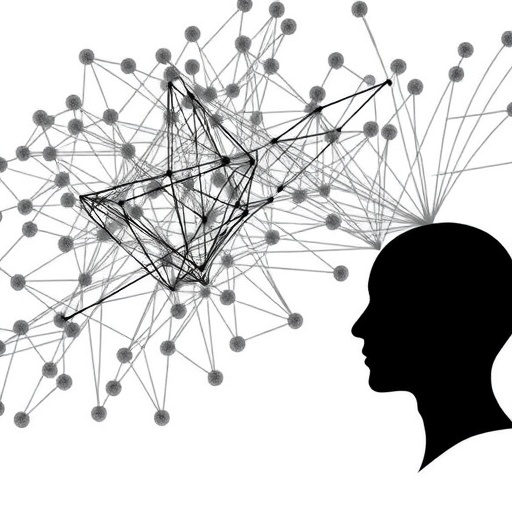
In a groundbreaking advancement that promises to revolutionize the understanding and diagnosis of early psychosis, researchers have unveiled new findings on the structure and complexity of language use in individuals experiencing a first episode of psychosis. This novel study leverages syntactic network analysis—a cutting-edge computational linguistic technique—to probe the intricacies of sentence construction in the minds of affected patients, offering fresh windows into the cognitive underpinnings of psychiatric disorders.
Language is the direct manifestation of thought, weaving together neural processes into communicative threads that express ideas, intentions, and emotions. For decades, clinicians have observed that individuals undergoing psychosis often exhibit disorganized speech and impaired communication, symptoms that are notoriously difficult to quantify objectively. The present research breakthrough bypasses subjective clinical impressions by harnessing advanced network science to decode syntactic patterns embedded in speech, transforming language into an analyzable graph of nodes and connections.
The research team, led by Ciampelli and collaborators, sought to determine whether syntactic network metrics could serve as reliable biomarkers for early psychosis, ultimately facilitating earlier detection and intervention. By analyzing the spoken language of first-episode psychosis patients and comparing it with healthy controls, the study elucidates the specific ways in which illness alters the architecture of linguistic expression. These alterations, the authors argue, not only illuminate the cognitive deficits inherent to psychosis but also hold potential for universal application across diverse populations.
What sets this study apart is its methodological ingenuity. The scientists first transcribed naturalistic speech samples obtained during clinical interviews and then parsed these texts into syntactic dependency trees. Each word and its grammatical relationships formed nodes and edges within a complex network. Metrics such as node degree distribution, clustering coefficients, and path length were computed to capture the global and local connectivity of syntactic structures. This approach transcends standard linguistic analyses by quantifying structure rather than merely cataloging errors or disfluencies.
Notably, the findings reveal that the syntactic networks generated from psychosis patients exhibit marked reductions in connectivity and complexity, indicative of fragmented and less integrated sentence construction. Such impoverishment in syntactic organization could underlie the famously disjointed and tangential speech patterns characteristic of schizophrenia spectrum disorders. Moreover, these network aberrations correlated with clinical severity, hinting at their direct relevance to symptomatic expression.
Beyond confirming previously suspected deficits, the study’s robust design addresses a critical challenge in psychiatric research: generalizability. By recruiting a large and demographically diverse cohort, and applying uniform analytical frameworks, the investigators demonstrate that the syntactic network signatures of psychosis are reproducible across independent samples and linguistic contexts. This generalizability bolsters confidence in the utility of syntactic network analysis as a universal diagnostic adjunct.
In addition to diagnostic potential, the approach offers valuable insights into pathophysiology. The degradation of syntactic complexity might reflect underlying neural circuit dysconnectivity, an emerging hallmark of psychotic illnesses revealed by neuroimaging studies. Language networks in the brain, particularly those spanning frontal and temporal regions, support the hierarchical organization of grammar and meaning. Disruptions in these circuits might manifest as the syntactic disintegration quantitatively identified here.
The implications extend even further. Since language is a culturally mediated system, syntactic network analysis could facilitate cross-linguistic and cross-cultural investigations, paving the way for global psychiatric screening tools. The computational nature of the method also allows for rapid and automated processing, which could be integrated into mobile health applications, telemedicine, and real-world clinical workflows. Early detection is critical in psychiatry, and this technology has the potential to flag at-risk individuals before debilitating symptoms fully bloom.
Moreover, the scalability of this approach means it could be adapted to analyze not only spoken language but also written texts, clinical narratives, and even social media platforms. Thus, it might capture subtle cognitive shifts in prodromal phases or track disease progression and treatment response longitudinally. This represents a paradigm shift towards objective, data-driven psychiatry that blends neuroscience, linguistics, and computational science.
While the study highlights several promising avenues, it also acknowledges limitations and challenges. Differentiating psychosis from other neuropsychiatric states with overlapping language impairments requires further refinement. Additionally, integrating syntactic metrics with semantic and pragmatic analyses may yield a more complete picture of communicative dysfunction. Ethical considerations surrounding privacy and data use when analyzing natural language must be thoughtfully managed.
Nevertheless, the current work stands as a testament to the power of interdisciplinary research to illuminate perplexing disorders. By visualizing speech as a network, the research provides a tangible and quantifiable handle on the intangible chaos of psychotic thought. This accomplishment reinvigorates hope that fine-grained language biomarkers can one day aid clinicians in making faster, more accurate diagnoses, tailoring treatments, and ultimately improving outcomes for millions worldwide.
In the broader context of neuroscience and artificial intelligence, these findings also exemplify how machine learning and network theory can decode the neural signatures of mental illness embedded within everyday behaviors. As syntactic network analysis matures, it may reveal new therapeutic targets, assist in the creation of synthetic conversational agents for patient engagement, and deepen fundamental understanding of human cognition and its vulnerabilities.
The trajectory from this pioneering investigation is clear: future research must expand longitudinally, assessing how syntactic networks evolve with illness trajectory and therapeutic intervention. Collaborative efforts across linguistic traditions, clinical settings, and computational platforms will be essential to refine algorithms and validate results. Ultimately, this synthesis of language science and psychiatry exemplifies the cutting edge of mental health innovation, offering hope that the complexities of psychosis can be untangled through the very sentences it disrupts.
This landmark study signifies a critical step toward the vision of personalized psychiatry propelled by quantitative biomarkers. The seamless marriage of syntax and network science not only elucidates the elusive architecture of psychotic speech but also charts a hopeful path toward earlier detection, objective diagnosis, and responsive care. With continued development, syntactic network analysis might soon become an indispensable tool in clinical practice, transforming the future of mental health diagnostics and treatment.
Cite Scienmag News
Glenn Wilkins. (December 11, 2025). Syntactic Network Analysis Advances First-Episode Psychosis Understanding. Scienmag. https://scienmag.com/syntactic-network-analysis-advances-first-episode-psychosis-understanding/
Glenn Wilkins. "Syntactic Network Analysis Advances First-Episode Psychosis Understanding." Scienmag, 11 December 2025, https://scienmag.com/syntactic-network-analysis-advances-first-episode-psychosis-understanding/. Accessed 3 September 2026.
Glenn Wilkins. "Syntactic Network Analysis Advances First-Episode Psychosis Understanding." Scienmag. December 11, 2025. https://scienmag.com/syntactic-network-analysis-advances-first-episode-psychosis-understanding/


