


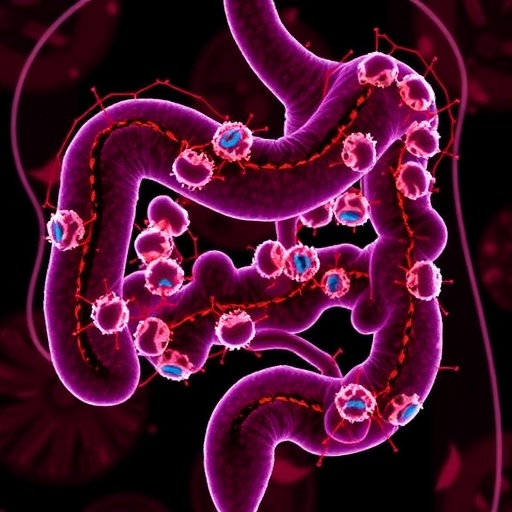
In a groundbreaking study published in Nature, researchers have unveiled remarkable insights into the nature of human gut M cells, revealing their unexpected resemblance to dendritic cells and their unique ability to present gluten antigen. This discovery sheds new light on the complex interplay between the intestinal epithelium and the immune system, offering promising avenues for understanding gut immunity and related diseases.
M cells, or microfold cells, are specialized epithelial cells located in the gut-associated lymphoid tissue that play a critical role in sampling luminal antigens and orchestrating immune responses. Traditionally, M cells were thought to be distinct from immune cells, but recent findings challenge this view by highlighting their gene expression profile and functional capabilities that closely mimic those of dendritic cells, a key immune cell type responsible for antigen presentation.
By integrating transcriptomic data from primary human intestinal epithelial cells alongside various immune cells, the research team employed single-cell RNA sequencing techniques to map gene expression patterns with unprecedented resolution. Clustering analyses revealed a unique cellular population, designated as cluster 9, wherein both M cells and lymphoid dendritic cells co-localized, indicating shared molecular signatures.
This convergence was underscored by the expression of canonical lymphoid dendritic cell markers such as CD83, LAMP3, IL7R, and FSCN1, which were notably upregulated during M cell differentiation. Notably, although M cells exhibited these dendritic cell-associated markers, they retained expression of typical M cell-specific genes, including ICAM2, CCL23, and SOX8, suggesting a specialized hybrid phenotype.
The researchers further explored this dual identity by examining the expression of genes traditionally linked to conventional dendritic cells (cDCs) and plasmacytoid dendritic cells (pDCs). Astonishingly, M cells expressed a broad spectrum of dendritic cell-related genes such as CD74, DC-SIGN, and CD11B, as well as CXCR3 and RUNX2, which are associated with pDCs. This complex gene expression landscape indicates that M cells do not closely mirror a single dendritic cell subtype but instead embody a broader dendritic cell-like program.
To elucidate the functional implications of this resemblance, Gene Ontology (GO) analyses centered on differentially expressed genes in M cells pointed to their close association with activated dendritic cells and antigen-presenting cell populations. This highlighted the potential of M cells to actively engage in immune surveillance and antigen presentation beyond their conventional role as antigen-sampling epithelial cells.
Crucially, the study uncovered that M cells express major histocompatibility complex class II (MHC-II) molecules, which are essential for antigen presentation to CD4+ T cells. Their expression profile of MHC-II genes increased significantly during M cell maturation, positioning these cells as active participants in initiating adaptive immune responses within the gut microenvironment.
Validation of these molecular findings was conducted through flow cytometry and confocal microscopy analyses of cultured human intestinal organoids, which serve as physiologically relevant models of M cell differentiation. MHC-II expression was robustly detected on the basolateral surface of M cells and localized within their cytoplasm, further confirming their antigen-presenting capabilities.
Furthermore, immuno-electron microscopy provided ultrastructural evidence of MHC-II-containing intracellular compartments resembling MIIC (MHC class II compartments), characteristic of professional antigen-presenting cells. These organelles facilitate the loading of peptide antigens onto MHC-II molecules, enabling effective T cell priming.
The discovery that human M cells possess such dendritic cell-like features revolutionizes our understanding of gut immunology. It implies that M cells may serve as frontline players in the detection and presentation of dietary and microbial antigens, including those implicated in conditions like celiac disease, where gluten triggers pathological immune responses.
By presenting gluten antigens directly to the immune system, M cells could contribute to the etiology and perpetuation of intestinal inflammation. This positions them as potential targets for therapeutic intervention aimed at modulating aberrant immune activation in gluten-related disorders.
Moreover, this hybrid epithelial-immune phenotype of M cells underscores the remarkable plasticity and functional versatility of intestinal epithelial cells, which not only form physical barriers but also actively communicate with and shape the mucosal immune landscape.
The study’s integrative approach combining transcriptomics, flow cytometry, advanced imaging, and functional assays serves as a blueprint for dissecting complex cellular phenotypes within human tissues. It highlights the power of single-cell technologies to unravel cellular heterogeneity and redefine canonical cell classifications.
These findings could have far-reaching implications beyond celiac disease, potentially informing novel vaccine strategies that leverage M cells’ antigen-presenting capabilities to enhance mucosal immunity against infectious pathogens.
Overall, this research marks a paradigm shift by establishing human gut M cells as a unique epithelial cell type exhibiting hybrid dendritic cell characteristics, bridging innate and adaptive immunity at the intestinal mucosal interface. The identification of these features opens exciting new research directions and potential clinical applications for gastrointestinal and immune-mediated diseases.
As research progresses, a deeper understanding of how M cells interact with other immune cells and the microbiota will be vital. Emphasizing their dual role could unveil novel mechanisms of gut homeostasis and pathology, catalyzing innovations in diagnostics, therapeutics, and personalized medicine for intestinal disorders.
Cite Scienmag News
Juliet Wilcox. (December 10, 2025). Human Gut M Cells Mimic Dendritic Cells Presenting Gluten. Scienmag. https://scienmag.com/human-gut-m-cells-mimic-dendritic-cells-presenting-gluten/
Juliet Wilcox. "Human Gut M Cells Mimic Dendritic Cells Presenting Gluten." Scienmag, 10 December 2025, https://scienmag.com/human-gut-m-cells-mimic-dendritic-cells-presenting-gluten/. Accessed 4 September 2026.
Juliet Wilcox. "Human Gut M Cells Mimic Dendritic Cells Presenting Gluten." Scienmag. December 10, 2025. https://scienmag.com/human-gut-m-cells-mimic-dendritic-cells-presenting-gluten/


