


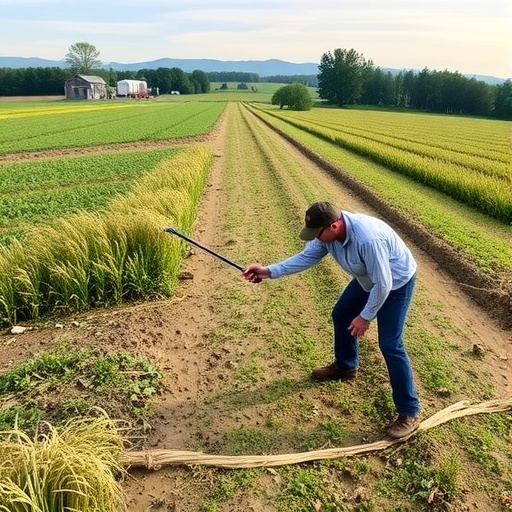
In the rapidly evolving sphere of sustainable agriculture, understanding the psychological and social drivers that influence farmers’ decisions to adopt conservation agricultural (CA) practices is paramount. A recent comprehensive study sheds light on this by extending the well-established Theory of Planned Behavior (TPB) to better capture the complex factors influencing farmers’ intentions to adopt practices such as direct seeded rice (DSR) and zero-till maize (ZT-maize). This research integrates core psychological constructs with additional external variables to present a multifaceted view of farmer decision-making processes, highlighting new pathways to encourage more sustainable farming.
Fundamentally, the Theory of Planned Behavior links behavioral intentions to three intrinsic determinants: attitude, subjective norm, and perceived behavioral control. Attitude reflects the individual’s evaluation of the expected outcomes, subjective norm represents perceived social influences, and perceived behavioral control signifies the sense of agency over performing a given behavior. This classical model has seen widespread use in predicting farmer behavior, yet for conservation agriculture practices that carry unique socioeconomic and technical profiles, it benefits from augmentation with further explanatory variables.
The study explores several external factors—perceived benefit, environmental benefit, prior knowledge, coping appraisal, risk perception, and perceived ease of adoption—and their relationship with farmers’ intentions to engage in DSR and ZT-maize farming. These variables enrich the model, considering that adopting CA involves not only internal motivation but also external conditions and knowledge levels. The nuanced findings offer a layered understanding of how these factors collectively mediate intentions, shedding crucial insights into sustainable agricultural transitions.
Attitude emerges as a powerful predictor of intention for both DSR and ZT-maize, reinforcing that farmers who view these practices as advantageous and valuable are more mentally prepared to embrace them. Interestingly, this positive relationship holds stronger for ZT-maize than for DSR, a variance attributed to the relative complexity in managing DSR, particularly due to weed control challenges absent in ZT-maize. Farmers perceive ZT-maize as more straightforward, reinforcing a higher confidence level in adopting this technology.
The social dimension, encapsulated by subjective norm, also plays a vital role. Farmers are heavily influenced by social pressures and the expectations of significant referents, a phenomenon especially pronounced in collectivist farming communities. The pressure to conform to normative behaviors can serve as a potent motivator. For ZT-maize, the social reinforcement is stronger, linked to perceptions of ease and tangible benefits such as improved soil health and reduced loss risks. Conversely, the challenges in managing DSR create a more cautious social attitude, tempering this influence somewhat.
Perceived behavioral control notably correlates with farmers’ intentions, emphasizing the importance of self-efficacy in adopting new agricultural techniques. When farmers feel confident and capable of managing the agronomic intricacies of DSR and ZT-maize, particularly with guidance from extension agents and targeted training, their willingness to adopt rises significantly. However, where support and knowledge are lacking, perceived behavioral control weakens, potentially stalling adoption due to feelings of incompetence or uncertainty.
An intriguing interplay exists between subjective norm and perceived behavioral control, wherein positive social endorsement boosts farmers’ confidence to manage CA practices effectively. This synergy indicates that communal encouragement not only influences social approval but also enhances individual agency, creating a reinforcing feedback loop conducive to adoption.
Beyond core TPB constructs, perceived benefit and environmental benefit significantly shape attitudes and intentions. When farmers recognize that CA reduces cultivation costs, boosts yields, and enhances income, their attitudes toward adoption become favorable. Simultaneously, an ecological awareness—appreciating the reduction in greenhouse gas emissions, improved soil health, and lowered water use associated with these practices—further catalyzes positive attitudes. These dual benefits create a compelling rationale for adoption.
Prior knowledge stands as a key antecedent to perceived behavioral control rather than directly influencing intention. Experience and familiarity with CA principles empower farmers to better judge the ease or difficulty of adoption, fostering confidence. Nevertheless, prior knowledge alone does not suffice to drive intention without translating into perceived control, underscoring the necessity of practical support and training. Barriers such as psychological resistance to change and economic concerns highlight why cognitive awareness must be paired with tangibly accessible resources and social networks to promote behavior change.
The role of coping appraisal, particularly response efficacy, reinforces this dynamic. Farmers who believe that CA adoption can effectively reduce costs and enhance productivity develop positive attitudes, even amidst acknowledged risks. This optimism drives stronger intentions, reflecting a calculated weighing of benefits versus potential losses. Positive attitudes partially mediate this relationship, underscoring their pivotal role in behavioral determination.
Self-efficacy related to perceived ease of adoption is another critical factor. If farmers view CA practices as straightforward, with adequate access to machinery, training, and timely support, this perception fuels adoption intention. The differing experiences between DSR and ZT-maize shine through here; ZT-maize’s relative ease builds confidence, whereas DSR’s challenges, particularly in weed and pest management, generate apprehensions that need to be addressed to unlock adoption potential.
Risk perception introduces a countervailing force. Farmers’ apprehensions regarding potential yield loss and increased management pressures can dampen attitudes and reduce intentions to adopt CA. These perceptions often stem from uncertainty in managing complex agronomic conditions inherent to DSR and residual management issues in ZT-maize. Notably, risk perception does not seem to shape subjective norms, suggesting that while farmers are individually concerned about risks, these concerns do not translate into communal pressures for or against adoption. Instead, positive social networks and shared experiences overwhelmingly guide normative influences.
The study’s nuanced exploration of perceived ease of adoption reveals differential mediation effects. For ZT-maize, perceived ease influences intentions both directly and indirectly through attitudes and perceived behavioral control. In contrast, the more complex management demands of DSR mute this mediation, reflecting farmer skepticism about yield reliability and operational difficulties. This highlights the need for tailored extension approaches that address specific technical challenges to bridge gaps in perceived ease and foster positive attitudes.
Overall, this research articulates a compelling, integrative framework that captures the interplay of psychological, social, and technical factors underlying farmers’ adoption intentions of conservation agriculture practices. By extending the TPB and incorporating relevant external factors, it provides actionable insights for policymakers, extension services, and development agencies seeking to enhance CA uptake. Central to success are approaches that build farmer confidence through knowledge dissemination, social support, risk mitigation, and practical facilitation, attuned to the distinct characteristics of different CA practices.
The findings emphasize the dual importance of framing CA as both economically and environmentally beneficial, alongside reducing perceived technical barriers and managing risks. Such a holistic strategy fosters positive attitudes, leverages social capital, and strengthens behavioral control, creating fertile ground for widespread adoption. As the global agricultural sector grapples with climate challenges and sustainability imperatives, insights like these pave the way for transformative change rooted in an understanding of farmer psychology and community dynamics.
In conclusion, the study offers a robust model for forecasting and enhancing farmer willingness to embrace innovative, sustainable farming methods. By recognizing the complex motivators and inhibitors that shape behavior, stakeholders can craft nuanced interventions that resonate with farmers’ lived realities and aspirations—thereby accelerating the transition toward resilient, conservation-oriented agriculture on a global scale.
Cite Scienmag News
Alan Morgan. (December 10, 2025). Farmers’ Willingness to Adopt Conservation Practices. Scienmag. https://scienmag.com/farmers-willingness-to-adopt-conservation-practices/
Alan Morgan. "Farmers’ Willingness to Adopt Conservation Practices." Scienmag, 10 December 2025, https://scienmag.com/farmers-willingness-to-adopt-conservation-practices/. Accessed 4 September 2026.
Alan Morgan. "Farmers’ Willingness to Adopt Conservation Practices." Scienmag. December 10, 2025. https://scienmag.com/farmers-willingness-to-adopt-conservation-practices/


