


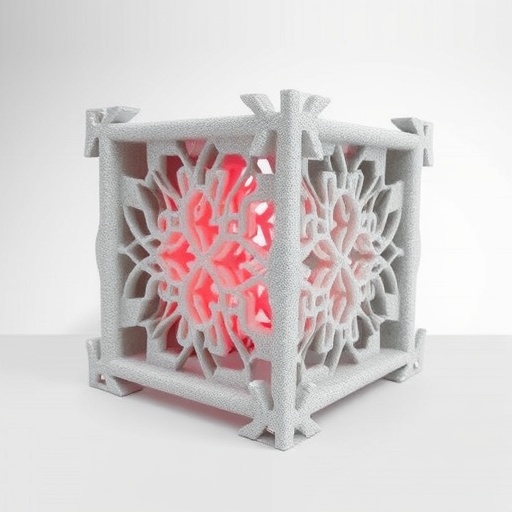
In recent years, the advancement of aerospace and thermal protection technologies has spurred significant research into materials that can withstand extreme thermal environments while maintaining structural integrity. A breakthrough study published in npj Advanced Manufacturing outlines an innovative multiscale cure process modeling approach for a highly sophisticated 3D-woven composite material designed specifically for thermal protection systems. This cutting-edge research combines computational mechanics with material science to tackle the enduring challenges of composite manufacturing, particularly focusing on a highly complex woven architecture employed in thermal shielding applications.
The cornerstone of this study lies in its multiscale modeling capability, which integrates phenomena occurring at different length scales—from the microscale fiber-matrix interactions to the macroscale structural behavior of the composite component. Traditional modeling techniques often fail to capture this intricate behavior accurately, leading to suboptimal predictions of the curing process, residual stresses, and ultimately, the performance of the composite. By bridging multiple scales, this new approach delivers unprecedented insight into how the 3D-woven architecture behaves during curing, significantly improving the reliability and effectiveness of thermal protection systems.
Central to the research is the simulation of the cure process itself, a critical stage in composite manufacturing where the thermoset resin undergoes a chemical transformation that binds the reinforcing fibers into a solid structure. The model accounts for the complex heat transfer, chemical kinetics, and resin flow inherent in this process, all of which substantially influence the final properties and durability of the composite material. The 3D weaving technique introduces additional complexity with its unique fiber architecture, which alters heat conduction pathways and affects the cure kinetics in non-trivial ways. The research team’s innovative computational approach successfully captures these complexities by incorporating detailed geometrical and material properties.
One of the compelling aspects of this study is its focus on advanced thermal protection systems, which are pivotal for aerospace vehicles operating under severe thermal loads, such as re-entry vehicles in atmospheric flight. Composite materials used in this context must endure rapid temperature fluctuations and high heat flux without losing mechanical integrity or degrading. The 3D-woven composites studied here exhibit exceptional resistance to these extreme conditions due to their tailored fiber architecture, which facilitates superior load distribution and thermal insulation. The multiscale cure process modeling thus plays a crucial role in optimizing manufacturing processes to harness these inherent material advantages effectively.
The researchers utilized an integrated computational framework that couples finite element analysis with advanced cure chemistry models, enabling precise tracking of thermal gradients, degree of cure, and development of residual stresses. This level of detail is vital because improper curing can lead to defects such as voids, matrix cracking, or uneven stress distributions, which dramatically reduce the composite’s performance and service life. By predicting these outcomes during the design and manufacturing stages, engineers can proactively adjust process parameters like temperature profiles and curing durations to ensure the highest quality.
A particularly groundbreaking contribution of the paper is its ability to model the anisotropic thermal and mechanical behavior resulting from the 3D weave pattern. Unlike traditional laminate composites, 3D-woven architectures afford through-thickness reinforcement, enhancing delamination resistance and damage tolerance. However, this complex fiber orientation creates directional dependencies in thermal conductivity and mechanical stiffness, which conventional isotropic or quasi-isotropic assumptions cannot accurately represent. The multiscale modeling framework accounts for these anisotropies by incorporating detailed microstructural representations, thus elevating predictive fidelity to new heights.
To validate their simulations, the authors performed experimental tests on specimens manufactured under controlled curing regimes. Thermal and mechanical characterization data were compared against predictions, revealing excellent agreement that underscored the model’s robustness and practical utility. This synergy between computation and experiment offers a powerful toolset for materials engineers aiming to innovate novel curing schedules, optimize composite architectures, and ultimately push the envelope of performance for thermal protection applications.
Equally notable is the study’s impact on manufacturing scalability. The multiscale cure process modeling can inform real-time process monitoring and control in industrial settings, facilitating the transition from lab-scale composite fabrication to full-scale production. By integrating process models with sensor data, manufacturers can achieve greater consistency and reduce defects, which has historically been a major barrier to the widespread adoption of advanced 3D-woven composites in critical aerospace components.
The implications of this research extend beyond aerospace, touching upon any domain requiring materials that combine high thermal resistance with structural strength. Potential fields of impact include automotive brake systems, electronics cooling modules, and energy infrastructure components exposed to harsh environments. The generalizable nature of the multiscale modeling framework paves the way for broader applications where precise control over curing processes governs final material properties.
The study further contributes to ongoing efforts to reduce reliance on extensive physical testing, which is often time-consuming and costly. By leveraging high-fidelity predictive models, engineers and designers can iterate more efficiently in silico, accelerating innovation cycles. The comprehensive understanding of the interplay between microscopic features and macroscopic behavior also encourages the design of novel composite architectures tailored for specific thermal and mechanical requirements, fostering the development of next-generation materials.
Moreover, the methodological advances presented in the article highlight the importance of interdisciplinary collaboration, merging insights from polymer chemistry, textile engineering, computational mechanics, and thermal analysis. This holistic approach to composite design and processing marks a decisive step forward in tackling the intricacies of multiscale phenomena that define material performance in demanding environments.
The authors emphasize that continuous refinement of the cure process models can incorporate additional factors such as moisture diffusion, oxidative degradation, and manufacturing variability to further enhance predictive accuracy. Integration with machine learning algorithms to analyze large datasets generated from simulations and experiments could also offer new pathways for intelligent process optimization and materials discovery.
Looking ahead, the implementation of multiscale cure process modeling aligns well with digital twin technologies, creating virtual representations of composite manufacturing and performance that evolve alongside the physical counterparts. Such advances promise to revolutionize quality assurance, predictive maintenance, and lifecycle management of critical thermal protection structures, driving significant cost savings and reliability improvements in aerospace missions.
In summary, the multiscale cure process modeling approach introduced by Olaya, Ricks, and Maiarù represents a major leap in understanding and optimizing 3D-woven composite materials for thermal protection system applications. By illuminating the complex interplay between curing kinetics, fiber architecture, and thermal-mechanical behavior, their work lays a robust foundation for advancing state-of-the-art composite manufacturing. This research not only addresses key technical challenges encountered in extreme thermal environments but also opens new horizons for high-performance composite materials across a host of industries.
As thermal protection systems continue to evolve in response to increasing demands for lightweight, durable, and thermally resilient materials, studies like this are indispensable in guiding technological innovation. The fusion of multiscale modeling with experimental validation signifies a paradigm shift toward smarter, more predictive composite manufacturing processes. The ripple effects of such advancements will likely be felt beyond aerospace, inspiring novel applications and reinforcing the central role of computational sciences in the material engineering landscape.
Given the rapid pace of aerospace material innovation, the multiscale cure process modeling technique offers a forward-looking strategy to address not only present manufacturing bottlenecks but also future challenges posed by emerging thermal protection requirements. Its adoption in industry and research could accelerate the deployment of safer and more efficient space exploration vehicles and re-entry technologies, marking a transformative moment in materials science and engineering.
In conclusion, the comprehensive and multiscale-coupled modeling paradigm revealed in this research stands as a paradigm of excellence in composite process simulation, poised to influence research directions, manufacturing standards, and material performance expectations. Through such pioneering work, the promise of robust, high-performance, and thermally stable 3D-woven composites is being realized, heralding a new era in thermal protection system technology.
Cite Scienmag News
Denise Maddox. (December 8, 2025). Multiscale Modeling of 3D-Woven Composite Curing. Scienmag. https://scienmag.com/multiscale-modeling-of-3d-woven-composite-curing/
Denise Maddox. "Multiscale Modeling of 3D-Woven Composite Curing." Scienmag, 8 December 2025, https://scienmag.com/multiscale-modeling-of-3d-woven-composite-curing/. Accessed 6 September 2026.
Denise Maddox. "Multiscale Modeling of 3D-Woven Composite Curing." Scienmag. December 8, 2025. https://scienmag.com/multiscale-modeling-of-3d-woven-composite-curing/


