


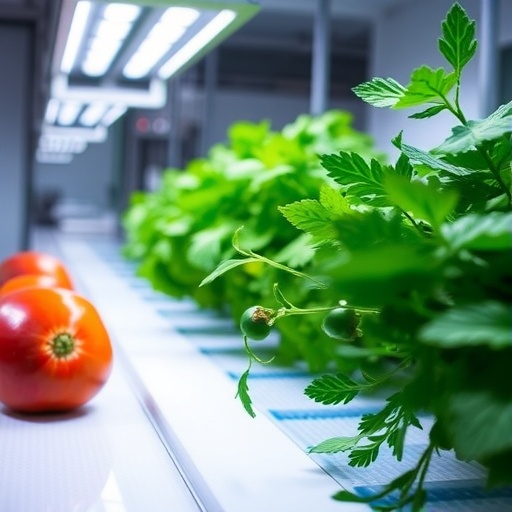
In a groundbreaking study poised to redefine the paradigms of postharvest technology, researchers Kim, de Jesus Ornelas-Paz, and Prakash have unveiled compelling evidence demonstrating the nuanced effects of low-dose food irradiation on antioxidant systems in fruits and vegetables after harvest. Published in the prestigious journal Food Science and Biotechnology, this investigation dives deep into the biochemical and molecular landscapes altered by irradiation, offering promising implications for shelf life extension, food safety, and nutritional quality. As the global demand for fresh produce grows exponentially, findings from this work could herald a transformative approach in postharvest management, potentially revolutionizing how perishables are preserved and delivered to consumers worldwide.
The meticulous research tackles the challenge of balancing microbial safety and nutritional integrity, a pivotal concern in food science. Traditionally, food irradiation has been employed primarily at doses sufficient to eradicate pathogens and pests. However, concerns persist regarding the potential degradation of delicate phytonutrients and antioxidants, which are essential to human health and serve as a measure of produce quality. The authors pivot away from high-dose irradiation toward exploring the impacts of finely calibrated, low-dose exposure, uncovering a novel window wherein oxidative stress responses in plant tissues are modulated without significant compromise to their antioxidant capacity.
At the heart of the study is an elaborate exploration of antioxidant enzymes such as superoxide dismutase (SOD), catalase (CAT), and peroxidases, alongside non-enzymatic antioxidants like ascorbic acid and phenolic compounds. By employing a series of controlled irradiation treatments at doses meticulously calibrated below conventional thresholds, the researchers monitored postharvest changes in enzymatic activities and antioxidant concentrations over extended storage periods. This approach allowed for a comprehensive temporal assessment of the plant’s biochemical resilience under irradiation-induced stress.
The data reveal that low-dose irradiation induces a hormetic response—that is, a stimulatory effect on the antioxidant defense systems—effectively enhancing the fruit and vegetable’s endogenous capacity to scavenge reactive oxygen species (ROS). Such activation serves as a fortified barrier against oxidative deterioration, a principal contributor to postharvest spoilage. The nuanced increase in SOD and CAT activities signals an intrinsic upregulation of oxidative stress mitigation pathways, suggesting that low-dose irradiation could act as a mild abiotic stress inducer, thereby priming produce for extended shelf life without deleterious effects on quality attributes.
Intriguingly, the study highlights differential responses contingent upon the type of produce evaluated. For instance, fruits with inherently higher antioxidant profiles such as berries and citrus demonstrated a pronounced augmentation in phenolic content post-irradiation, while certain leafy greens exhibited a more modest but statistically significant elevation in enzymatic antioxidants. This interspecific variability underscores the importance of tailoring irradiation protocols to specific commodities, maximizing the beneficial hormetic effects while minimizing any negative impacts on texture, flavor, or nutritional composition.
The implications of these findings reach far beyond the laboratory bench. From a commercial perspective, integrating low-dose irradiation into postharvest handling processes could revolutionize supply chain dynamics by extending the freshness window of perishable goods. This, in turn, would reduce food waste—a critical global challenge—with added benefits for retailers and consumers alike. Additionally, by mitigating oxidative damage, the irradiation process holds the potential to preserve or even enhance the nutritional value of produce, thereby delivering health benefits alongside improved safety.
A crucial component addressed by the authors is the mechanistic insight into the molecular signaling cascades activated by irradiation. Their work sheds light on how moderate oxidative stimuli facilitate the expression of genes encoding antioxidant enzymes and impact secondary metabolite biosynthesis pathways. This fine-tuned molecular orchestration orchestrates a defensive yet adaptive response, highlighting the sophisticated interplay between environmental stressors and cellular homeostasis in harvested plant tissues.
In terms of methodology, the research employed advanced analytical techniques including high-performance liquid chromatography (HPLC) to quantify phenolic profiles, spectrophotometric assays for enzyme activity, and gene expression analyses via quantitative PCR. This comprehensive suite of approaches provided robust, reproducible data that collectively underpin the study’s conclusions. Additionally, parameters such as irradiation dose rate, exposure duration, and post-irradiation storage conditions were systematically varied to model realistic industry scenarios, ensuring the results’ relevance and application potential.
Moreover, the study offers critical perspectives on regulatory and safety aspects. By focusing on doses below the conventional limits established by international food safety agencies, the authors demonstrate that low-dose irradiation can achieve desirable antioxidant-modulating effects without inducing harmful radiolytic compounds or detrimental changes in sensory attributes. This positions low-dose irradiation as a viable and consumer-friendly alternative to more aggressive preservation technologies that often compromise quality or raise public apprehension.
From an ecological standpoint, the research advocates for the sustainability of low-dose irradiation practices. Lower energy inputs and reduced chemical use during storage and transportation underscore the environmental benefits of this approach. As industries strive to meet sustainability targets, these insights into irradiation-induced antioxidant modulation could inform greener postharvest management strategies that align with circular economy principles and minimize carbon footprints.
The study also prompts further exploration into the synergistic integration of irradiation with other preservation approaches such as modified atmosphere packaging, cold storage, and natural antioxidant treatments. By layering these technologies, it may be possible to harness additive or synergistic effects, culminating in superior preservation outcomes that balance safety, quality, cost-effectiveness, and environmental impact.
Significantly, consumer acceptance—a historically sensitive facet of food irradiation—may receive an uplift through the insights presented. Public awareness campaigns emphasizing low-dose irradiation as not just a safety measure but as a tool to enhance antioxidant profiles could reframe perceptions, fostering trust and willingness to embrace irradiated produce. This aligns with contemporary trends where consumers increasingly value health-promoting functional foods and sustainable production practices.
The researchers conclude by urging the scientific community to expand investigations into crop-specific responses and to dissect long-term storage effects, varietal differences, and post-irradiation metabolic dynamics. They also call for multi-disciplinary collaborations bridging plant physiology, food technology, and consumer sciences to drive innovation in postharvest preservation.
In summary, the study by Kim, de Jesus Ornelas-Paz, and Prakash represents a monumental step forward in the nuanced application of food irradiation, combining rigorous scientific inquiry with practical implications that resonate across sectors. By elucidating the beneficial modulation of antioxidant systems through low-dose irradiation, their work lays the foundation for next-generation postharvest treatments designed to safeguard both food quality and human health.
As the food industry grapples with mounting challenges from climate change, supply chain disruptions, and shifting consumer demands, such advances nurture optimism for innovative, science-driven solutions. The critical balance achieved between microbial safety and nutritional preservation heralds a promising horizon where fresh produce can be delivered with enhanced resilience, efficacy, and sustainability.
This pioneering research not only deepens our understanding of plant stress physiology postharvest but also paves the path for technology-driven evolution in global food systems. Its reverberations will likely stimulate further research and investment, guiding policy, industrial practice, and ultimately enriching the consumer experience.
Cite Scienmag News
Daisy Hatcher. (December 8, 2025). Low-Dose Irradiation Boosts Antioxidants in Produce. Scienmag. https://scienmag.com/low-dose-irradiation-boosts-antioxidants-in-produce/
Daisy Hatcher. "Low-Dose Irradiation Boosts Antioxidants in Produce." Scienmag, 8 December 2025, https://scienmag.com/low-dose-irradiation-boosts-antioxidants-in-produce/. Accessed 4 September 2026.
Daisy Hatcher. "Low-Dose Irradiation Boosts Antioxidants in Produce." Scienmag. December 8, 2025. https://scienmag.com/low-dose-irradiation-boosts-antioxidants-in-produce/


